


The myocardial contractile response to physiological stress improves with high saturated fat feeding in heart failure
- PMID: 20511406
- PMCID: PMC2930388
- DOI: 10.1152/ajpheart.00270.2010
The myocardial contractile response to physiological stress improves with high saturated fat feeding in heart failure
Abstract
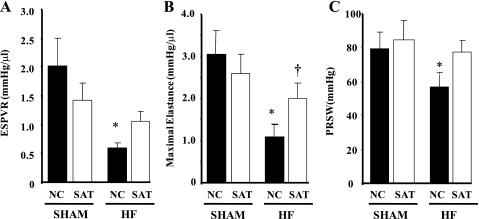
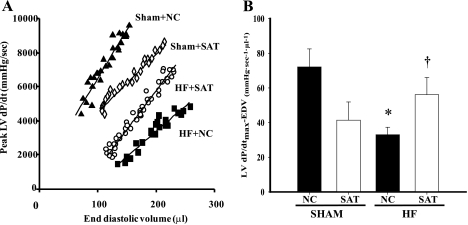
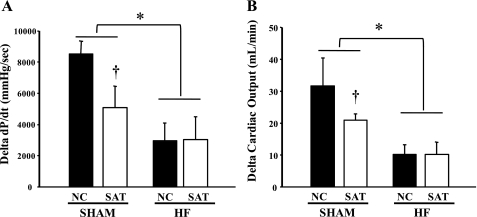
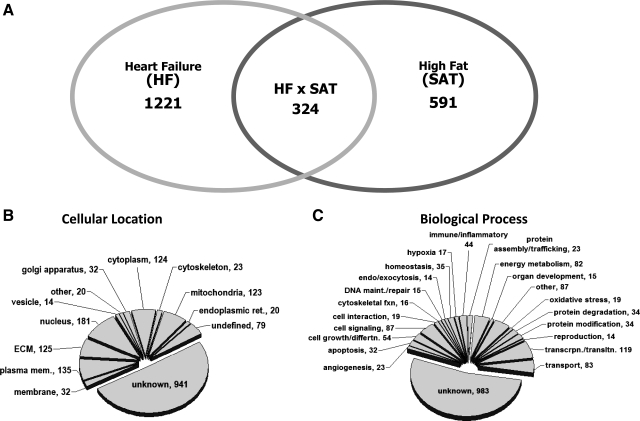
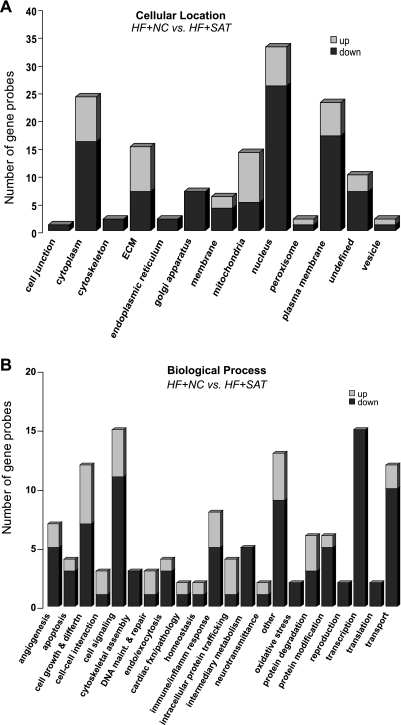
Impaired myocardial contractile function is a hallmark of heart failure (HF), which may present under resting conditions and/or during physiological stress. Previous studies have reported that high fat feeding in mild to moderate HF/left ventricular (LV) dysfunction is associated with improved contractile function at baseline. The goal of this study was to determine whether myocardial function is compromised in response to physiological stress and to evaluate the global gene expression profile of rats fed high dietary fat after infarction. Male Wistar rats underwent ligation or sham surgery and were fed normal chow (NC; 10% kcal fat; Sham + NC and HF + NC groups) or high-fat chow (SAT; 60% kcal saturated fat; Sham + SAT and HF + SAT groups) for 8 wk. Myocardial contractile function was assessed using a Millar pressure-volume conductance catheter at baseline and during inferior vena caval occlusions and dobutamine stress. Steady-state indexes of systolic function, LV +dP/dt(max), stroke work, and maximal power were increased in the HF + SAT group versus the HF + NC group and reduced in the HF + NC group versus the Sham + NC group. Preload recruitable measures of contractility were decreased in HF + NC group but not in the HF + SAT group. beta-Adrenergic responsiveness [change in LV +dP/dt(max) and change in cardiac output with dobutamine (0-10 microg x kg(-1) x min(-1))] was reduced in HF, but high fat feeding did not further impact the contractile reserve in HF. The contractile reserve was reduced by the high-fat diet in the Sham + SAT group. Microarray gene expression analysis revealed that the majority of significantly altered pathways identified contained multiple gene targets correspond to cell signaling pathways and energy metabolism. These findings suggest that high saturated fat improves myocardial function at rest and during physiological stress in infarcted hearts but may negatively impact the contractile reserve under nonpathological conditions. Furthermore, high fat feeding-induced alterations in gene expression related to energy metabolism and specific signaling pathways revealed promising targets through which high saturated fat potentially mediates cardioprotection in mild to moderate HF/LV dysfunction.
Figures
References
-
- Barger PM, Kelly DP. PPAR signaling in the control of cardiac energy metabolism. Trends Cardiovasc Med 10: 238–245, 2000 - PubMed
-
- Boudina S, Abel ED. Diabetic cardiomyopathy revisited. Circulation 115: 3213–3223, 2007 - PubMed
-
- Burkhoff D, Mirsky I, Suga H. Assessment of systolic and diastolic ventricular properties via pressure-volume analysis: a guide for clinical, translational, and basic researchers. Am J Physiol Heart Circ Physiol 289: H501–H512, 2005 - PubMed
Publication types
MeSH terms
Substances
Grants and funding
LinkOut - more resources
Full Text Sources
Medical
Research Materials
Miscellaneous
