


Importance of polyadenylation in the selective elimination of meiotic mRNAs in growing S. pombe cells
- PMID: 20512112
- PMCID: PMC2905246
- DOI: 10.1038/emboj.2010.108
Importance of polyadenylation in the selective elimination of meiotic mRNAs in growing S. pombe cells
Abstract
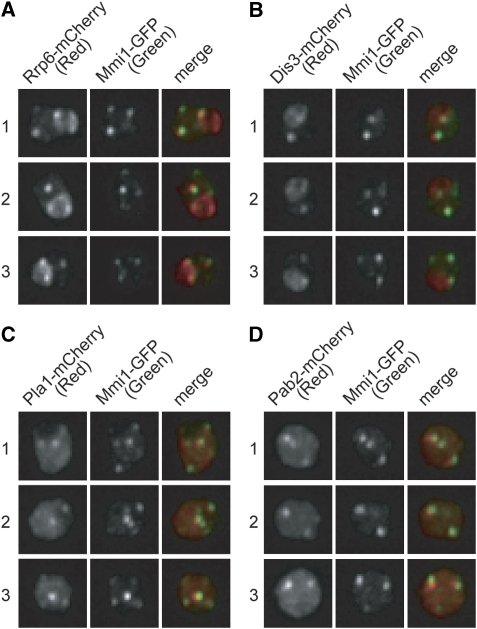
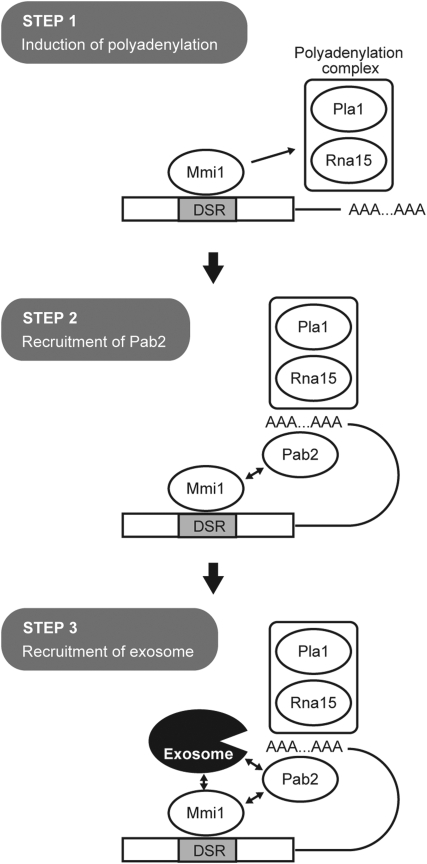
A number of meiosis-specific mRNAs are initially weakly transcribed, but then selectively removed during fission yeast mitotic growth. These mRNAs harbour a region termed DSR (determinant of selective removal), which is recognized by the YTH family RNA-binding protein Mmi1p. Mmi1p directs the destruction of these mRNAs in collaboration with nuclear exosomes. However, detailed molecular mechanisms underlying this process of selective mRNA elimination have remained elusive. In this study, we demonstrate the critical role of polyadenylation in this process. Two-hybrid and genetic screens revealed potential interactions between Mmi1p and proteins involved in polyadenylation. Additional investigations showed that destruction of DSR-containing mRNAs by exosomes required polyadenylation by a canonical poly(A) polymerase. The recruitment of Pab2p, a poly(A)-binding protein, to the poly(A) tail was also necessary for mRNA destruction. In cells undergoing vegetative growth, Mmi1p localized with exosomes, Pab2p, and components of the polyadenylation complex in several patchy structures in the nucleoplasm. These patches may represent the sites for degradation of meiosis-specific mRNAs with untimely expression.
Conflict of interest statement
The authors declare that they have no conflict of interest.
Figures
References
-
- Bähler J, Wu JQ, Longtine MS, Shah NG, McKenzie A III, Steever AB, Wach A, Philippsen P, Pringle JR (1998) Heterologous modules for efficient and versatile PCR-based gene targeting in Schizosaccharomyces pombe. Yeast 14: 943–951 - PubMed
-
- Briggs MW, Burkard KT, Butler JS (1998) Rrp6p, the yeast homologue of the human PM-Scl 100-kDa autoantigen, is essential for efficient 5.8 S rRNA 3′ end formation. J Biol Chem 273: 13255–13263 - PubMed
-
- Bühler M, Haas W, Gygi SP, Moazed D (2007) RNAi-dependent and -independent RNA turnover mechanisms contribute to heterochromatic gene silencing. Cell 129: 707–721 - PubMed
Publication types
MeSH terms
Substances
LinkOut - more resources
Full Text Sources
Molecular Biology Databases
