


Neuroplasticity regulation by noradrenaline in mammalian brain
- PMID: 20514208
- PMCID: PMC2811862
- DOI: 10.2174/157015909790031193
Neuroplasticity regulation by noradrenaline in mammalian brain
Abstract
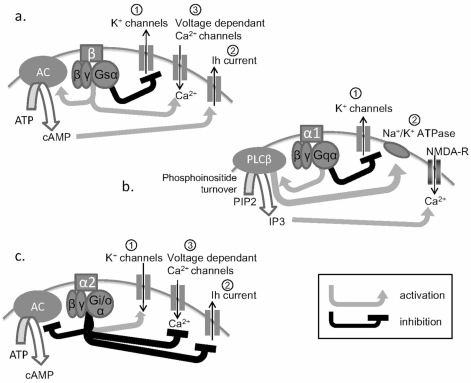
The neuromodulator noradrenaline (NA) is released in almost all brain areas in a highly diffused manner. Its action is slow, as it acts through G protein-coupled receptors, but its wide release in the brain makes NA a crucial regulator for various fundamental brain functions such as arousal, attention and memory processes [102]. To understand how NA acts in the brain to promote such diverse actions, it is necessary to dissect the cellular actions of NA at the level of single neurons as well as at the level of neuronal networks. In the present article, we will provide a compact review of the main literatures concerning the NA actions on neuroplasticity processes. Depending on which subtype of adrenoceptor is activated, NA differently affects intrinsic membrane properties of postsynaptic neurons and synaptic plasticity. For example, beta-adrenoceptor activation is mainly related to the potentiation of synaptic responses and learning and memory processes. alpha2-adrenoceptor activation may contribute to a high-order information processing such as executive function, but currently the direction of synaptic plasticity modification by alpha2-adrenoceptors has not been clearly determined. The activation of alpha1-adrenoceptors appears to mainly induce synaptic depression in the brain. But its physiological roles are still unclear: while its activation has been described as beneficial for cognitive functions, it may also exert detrimental effects in some brain structures such as the prefrontal cortex.
Keywords: LTD; LTP; Noradrenaline; neuromodulation; synaptic plasticity..
Figures
References
-
- Abraham WC, Mason SE. Effects of the NMDA receptor/channel antagonists CPP and MK801 on hippocampal field potentials and long-term potentiation in anesthetized rats. Brain Res. 1988;462:40–46. - PubMed
-
- Aghajanian GK. Modulation of a transient outward current in serotonergic neurones by alpha 1-adrenoceptors. Nature. 1985;315:501–503. - PubMed
-
- Almaguer-Melian W, Rojas-Reyes Y, Alvare A, Rosillo JC, Frey JU, Bergado JA. Long-term potentiation in the dentate gyrus in freely moving rats is reinforced by intraventricular application of norepinephrine, but not oxotremorine. Neurobiol. Learn. Memory. 2005;83:72–78. - PubMed
-
- Aoki C, Go C G, Venkatesan C, Kurose H. Perikaryal and synaptic localization of alpha 2A-adrenergic receptor-like immunoreactivity. Brain Res. 1994;650:181–204. - PubMed
LinkOut - more resources
Full Text Sources