


Auxin-responsive SAUR39 gene modulates auxin level in rice
- PMID: 20514239
- PMCID: PMC2819449
- DOI: 10.4161/psb.4.12.10043
Auxin-responsive SAUR39 gene modulates auxin level in rice
Abstract
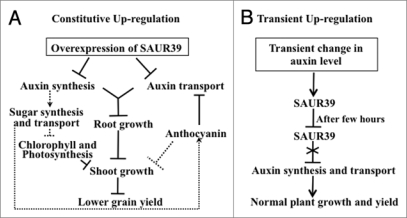
The signaling molecule auxin plays a central role in several aspects of plant growth and developmental processes. Underlying optimization of these processes are complex mechanisms orchestrating the expression of genes involved in controlling auxin level, movement and signalling. The small auxin-up RNA (SAUR) family comprises a large set of genes whose expressions are early auxin-responsive. However, the function of these genes is largely unknown. Loss-of-function mutants in a number of Arabidopsis SAUR genes did not show any marked phenotypic differences to wild-type plants likely due to compensatory functions of conserved members of the SAUR gene family. We have recently shown that a rice SAUR39 gene negatively regulates auxin synthesis and transport in rice. Here we propose a model that constitutive induction of SAUR39 gene expression reduces growth and seed yield in rice plants due to the presence of a lower auxin level, reduced polar auxin transport, less chlorophyll and increased sugar and anthocyanin contents. In wild-type plants, the SAUR39 gene is expressed at a low level and is transiently induced by changes in external auxin or other environmental stimuli, but within hours of this change its expression is reduced to the low constitutive level. This homeostatic mechanism is essential for optimal plant growth and seed yield and its disruption due to the constitutive overexpression of SAUR39 leads to a set of negative pleiotropic phenotypes.
Keywords: anthocyanin; auxin synthesis; chlorophyll; polar auxin transport; sugar.
Figures
Comment on
-
SAUR39, a small auxin-up RNA gene, acts as a negative regulator of auxin synthesis and transport in rice.Plant Physiol. 2009 Oct;151(2):691-701. doi: 10.1104/pp.109.143875. Epub 2009 Aug 21. Plant Physiol. 2009. PMID: 19700562 Free PMC article.
References
-
- Teale WD, Paponov IA, Palme K. Auxin in action: signalling, transport and the control of plant growth and development. Nat Rev Mol Cell Biol. 2006;7:847–859. - PubMed
-
- Hagen G, Guilfoyle T. Auxin-responsive gene expression: genes, promoters and regulatory factors. Plant Mol Biol. 2002;49:373–385. - PubMed
-
- Jain M, Tyagi AK, Khurana JP. Genome-wide analysis, evolutionary expansion and expression of early auxin-responsive SAUR gene family in rice (Oryza sativa) Genomics. 2006;88:360–371. - PubMed
Publication types
LinkOut - more resources
Full Text Sources
