Incidence of hip fractures in Jeju Island, South Korea: a prospective study (2002-2006)
- PMID: 20514262
- PMCID: PMC2867200
- DOI: 10.4055/cios.2010.2.2.64
Incidence of hip fractures in Jeju Island, South Korea: a prospective study (2002-2006)
Abstract
Background: This study was performed to estimate the incidence of hip fractures of people older than 50 years in South Korea.
Methods: Information of patients over 50 years of age who had sustained a hip fracture were obtained from the records of eight hospitals in Jeju Island between 2002 and 2006 to calculate the incidence of hip fractures in this age group.
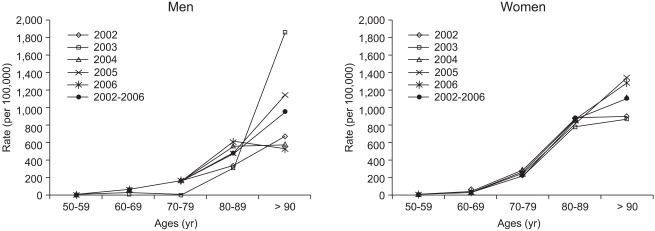
Results: There were 820 hip fractures during the study period. The mean age of the patients at the time of fracture was 77.8 years (71.3 years in 181 men, 79.7 years in 639 women). The crude incidence was 128/100,000 (66.1/100,000 in men, 174.4/100,000 in women). The age-specific incidence according to the 10-year age groups increased from 19.3/100,000 for those 50 to 59 years of age to 1,095.4/100,000 for those over 90 years of age (18.9/100,000-960.4/100,000 in men and 19.7/100,000-1112.1/100,000 in women). The standardized incidence of hip fracture to the Caucasian population in the United States in 1990 was 100/100,000 for men and 207/100,000 for women.
Conclusions: Hip fractures will become an important socioeconomic problem in South Korea due to the rapid aging of the population.
Keywords: Hip fractures; Incidence; Jeju Island.
Conflict of interest statement
No potential conflict of interest relevant to this article was reported.
Figures
References
-
- Randell AG, Nguyen TV, Bhalerao N, Silverman SL, Sambrook PN, Eisman JA. Deterioration in quality of life following hip fracture: a prospective study. Osteoporos Int. 2000;11(5):460–466. - PubMed
-
- Mullen JO, Mullen NL. Hip fracture mortality: a prospective, multifactorial study to predict and minimize death risk. Clin Orthop Relat Res. 1992;(280):214–222. - PubMed
-
- Lippuner K, Golder M, Greiner R. Epidemiology and direct medical costs of osteoporotic fractures in men and women in Switzerland. Osteoporos Int. 2005;16(Suppl 2):S8–S17. - PubMed
-
- Kanis JA, Pitt FA. Epidemiology of osteoporosis. Bone. 1992;13(Suppl 1):S7–S15. - PubMed
-
- Finsen V, Johnsen LG, Trano G, Hansen B, Sneve KS. Hip fracture incidence in central norway: a followup study. Clin Orthop Relat Res. 2004;(419):173–178. - PubMed
MeSH terms
LinkOut - more resources
Full Text Sources
Medical