. 2010 Jun 1:8:20.
doi: 10.1186/1476-7120-8-20.

Second-opinion stress tele-echocardiography for the Adonhers (Aged donor heart rescue by stress echo) project

Affiliations

Second-opinion stress tele-echocardiography for the Adonhers (Aged donor heart rescue by stress echo) project

Daniele Franchi et al. Cardiovasc Ultrasound. .

Abstract

Background: To resolve the current shortage of donor hearts, we established the Adonhers protocol. An upward shift of the donor age cut-off limit (from the present 55 to 65 years) is acceptable if a stress echo screening on the candidate donor heart is normal. This study aimed to verify feasibility of a "second opinion" of digitally transferred images of stress echo results to minimize technical variability in selection of aged donor hearts for heart transplant.

Methods: The informatics infrastructure was created for a core lab reading with a second opinion from the Pisa stress echo lab. To test the system, simulation standard stress echo cineloops were sent digitally from 5 peripheral labs to the central core lab.Starting January 2009, real marginal donor stress echos were sent via internet to the central core echo lab, Pisa, for a second opinion before heart transplant.

Results: In the simulation protocol, 30 dipyridamole stress echocardiograms were sent from the five peripheral echo labs to the central core lab in Pisa. Both the echo images and reports were correctly uploaded in the web system and sent to the core echo lab; the second opinion evaluation was obtained in all cases (100% feasibility). In the transplant protocol, eight donor cases were sent to the Pisa core lab for the second opinion protocol, and six of them were transplanted in marginal recipients.

Conclusions: Second-Opinion Stress Tele-Echocardiography can effectively be performed in a network aimed to safely expand the heart donor pool for heart transplant.


Figures
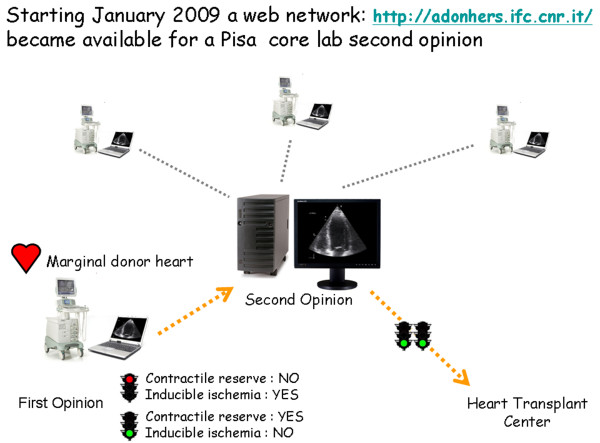
Figure 1
Figure 1
Telemedicine network architecture with all involved centers. The accredited cardiologist of the area where the donation takes place, will send, via internet stress echo digitized images to the central core Echo Lab, Pisa (IFC, CNR). Digitized eight-frame cine-loop quad screen echocardiograms are transmitted to the central core Echo Lab laptop computer-receiving station. One core-lab cardiologist is available by telephone or e-mail during the procedure. The Echo Lab is responsible for the "second opinion" of digitally transferred images. One of three cardiologists will interpret the tele-echocardiograms and will make "second-opinion" decisions, and is responsible for the final ("go-not go") green light to donation. When done, the second opinion report is finally sent to the transplant coordination center, and if the marginal heart is eligible for transplant, is proposed to the cardiac surgeon for transplant.
Figure 2
Figure 2
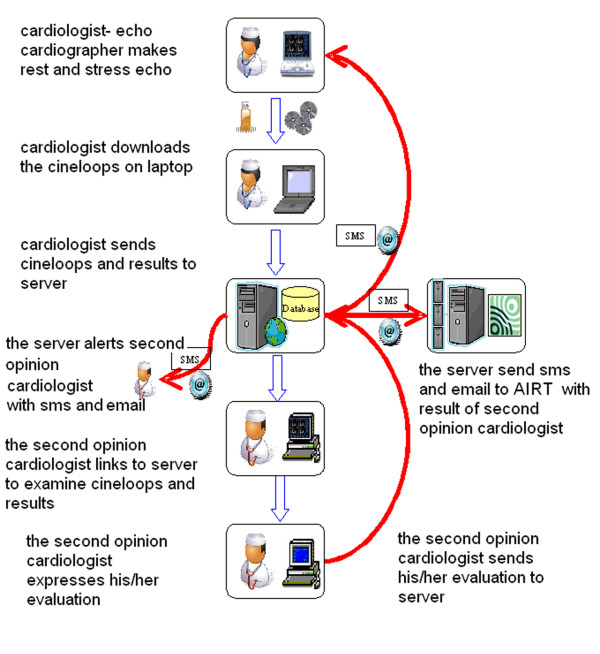
Phase diagram of the entire communication procedure. When the Transplant Coordination Center identifies a marginal aged Donor, the cardiologist where the donation takes place is alerted, performs resting echocardiography and when normal, stress echo. At the end of the stress echo the cardiologist of the recruiting center fills out a standard stress echo report; after that he/she selects and stores 4 cineloops (resting and stress echo) on any storage media (CD, memory pen) and transfers cineloops to a standard computer connected with the Internet. By the computer he/she logs into the transplant website and fills out resting echo and stress echo forms on the website. After completing all operations the cardiologist clicks the end of operations. The web site automatically transfers reports and images to the central server in Pisa and automatically the cardiologist of the central echo lab in Pisa is alerted by sms and e mail. Once alerted, the Pisa cardiologist opens the website, reads peripheral echo lab reports and views resting and stress echo cine loops. The Pisa cardiologist will interpret the tele-echocardiograms and will make "second-opinion" decisions and final ("go - not go") green light to donation.
Figure 3
Figure 3
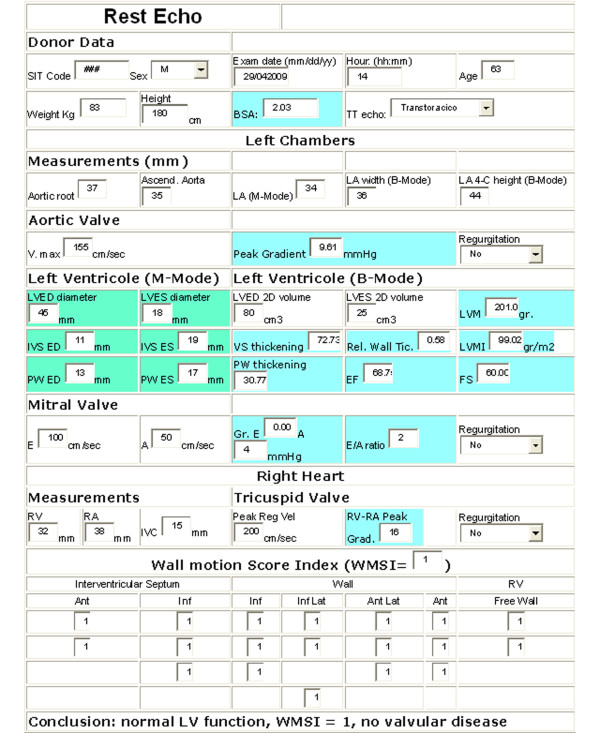
Form for resting echo report. Potential donors are recruited for the stress echo protocol if in resting echocardiogram: wall motion score index is completely normal (WMSI = 1), left ventricular ejection fraction > 45%, no signs of diastolic ventricular dysfunction , no significant valve disease , and left ventricular hypertrophy ≤ than mild.
Figure 4
Figure 4
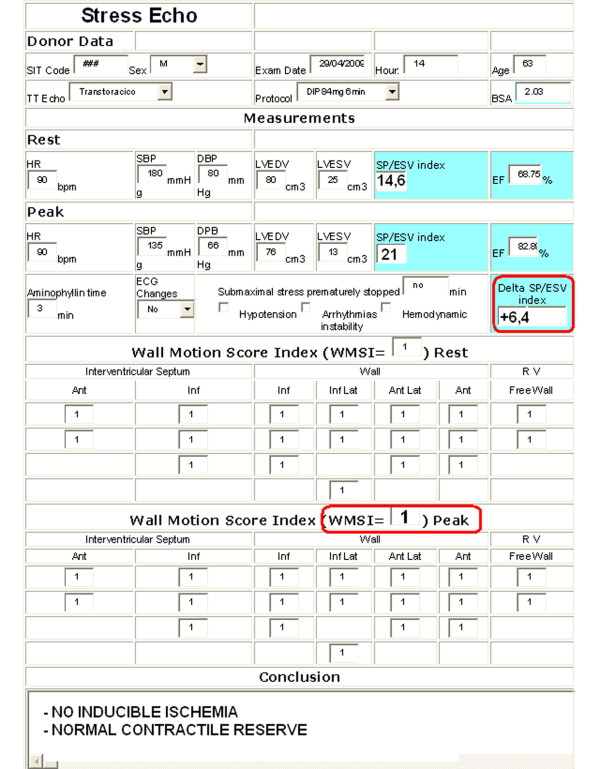
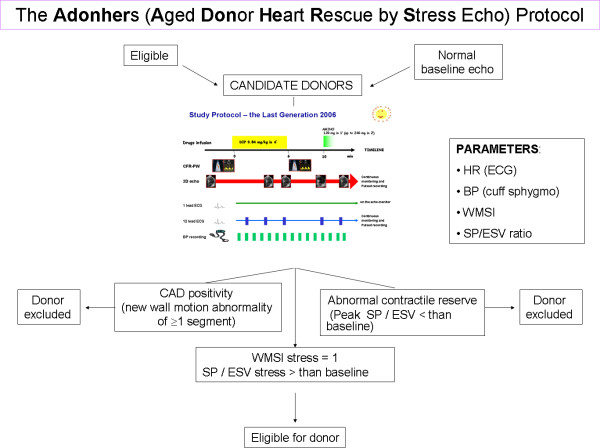
Form for stress echo report. The dipyridamole (0.84 mg/kg in 6 min ) "fast" pharmacological stress echo test is performed following the European Association of Echocardiography protocol. The Wall Motion Score Index is calculated in each potential donor at baseline and peak stress, from 1 = normal to 4 = dyskinetic, in a 17-segment model of the left ventricle. A test result is considered positive when the wall motion score increases by one grade or more at peak stress, with at least one normal segment becoming hypokinetic, akinetic or dyskinetic; it had been agreed a priori to consider mild hypokinesia. Regional wall motion abnormalities (WMSI > 1.0) exclude the heart from eligibility for donorship, and the phrase "inducible ischemia " automatically appears in the web stress echo report. Once the web form with rest and peak stress LV volume (EDV and ESV) values and pressures is filled out, contractile reserve is automatically calculated by the web system as the SP/ESV (Systolic Pressure/End-Systolic Volume) index increase (from baseline to peak stress). The contractile reserve is automatically reported normal up-sloping when peak exercise SP/ESV index is higher than baseline; abnormal negative, when peak exercise systolic pressure/end systolic volume index is lower than baseline. Donor hearts with abnormal negative contractile reserve are also excluded from donorship even if no signs of inducible ischemia are reported. Prematurely halted submaximal stress are considered non-diagnostic and exclude the heart from donorship.
Figure 5
Figure 5
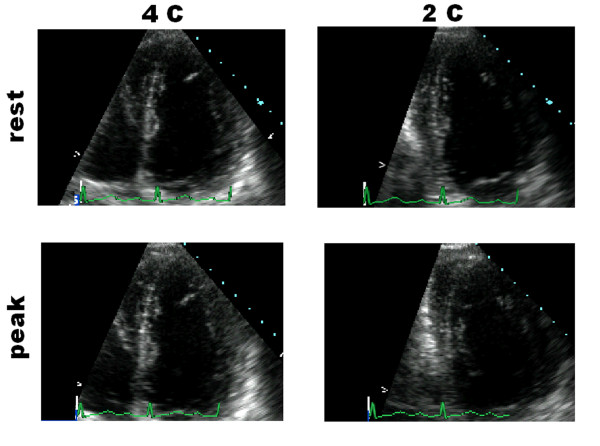
Rest and stress cineloops stored on the server. Normal stress echo of a marginal donor. When the Network for Organ Sharing identifies a marginal aged donor, the local cardiologist is alerted; he performs rest (upper panels) and stress-echo (lower panels, peak stress). At the end of the procedure the cardiologist selects and transfers the four cineloops to the core lab. In this example of normal stress echo of a marginal donor, the wall motion was normal at baseline and at peak stress (WMSI = 1 at baseline and peak stress), without signs of stress-inducible ischemia. The pressure/volume relation was 8 mmHg/ml/m2 at baseline, increasing to 14 mmHg/ml/m2 at peak stress, demonstrating the absence of latent myocardial dysfunction. Based on the dipyridamole stress results, despite an age beyond the 55-year limit, the heart was chosen for orthotopic heart transplantation, and was explanted using standard technique.
Figure 6
Figure 6
The dipyridamole stress echo in the Adonhers protocol. When resting echocardiography was normal a pharmacological stress echo test was performed using dipyridamole (0.84 mg/kg in 6 min ). We accepted a priori three criteria of stress echo positivity, excluding the heart from eligibility for donorship: 1) Regional wall motion abnormalities at rest or during stress. 2) A LV elastance falling during stress. 3) A submaximal stress halted due to non-diagnostic limiting effects before completion of the infusion, since a submaximal test dramatically lessens diagnostic and prognostic power. Accepting a heart was done in conformity with clinical and emergency criteria in use.
Figure 7
Figure 7
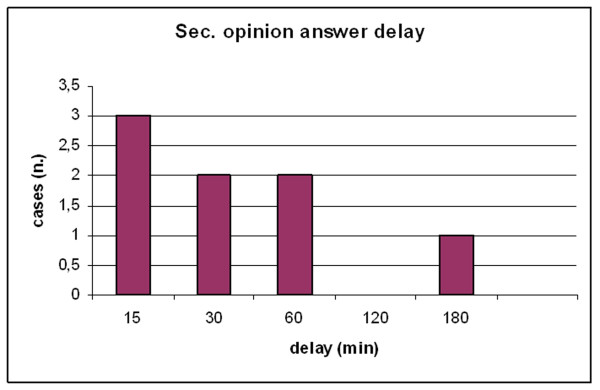
Second opinion cardiologist answer delay for the 8 marginal Donor hearts. Second opinion answer delay ranged from 15 to 180 min. In all cases the second opinion was largely sent before the end of the observational period and organ harvesting by the cardiac surgeon occurred after completion of the stress echo evaluation.

References

    1. Arpesella G, Gherardi S, Bombardini T, Picano E. Recruitment of aged donor heart with pharmacological stress echo. A case report. Cardiovasc Ultrasound. 2006;4:3. doi: 10.1186/1476-7120-4-3. - DOI - PMC - PubMed
    1. Leone O, Gherardi S, Targa L, Pasanisi E, Mikus P, Tanganelli P, Maccherini M, Arpesella G, Picano E, Bombardini T. Stress echocardiography as a gatekeeper to donation in aged marginal donor hearts: anatomic and pathologic correlations of abnormal stress echocardiography results. J Heart Lung Transplant. 2009;28:1141–9. doi: 10.1016/j.healun.2009.05.029. - DOI - PubMed
    1. Zaroff JG, Rosengard BR, Armstrong WF, Babcock WD, D'Alessandro A, Dec GW, Edwards NM, Higgins RS, Jeevanandum V, Kauffman M, Kirklin JK, Large SR, Marelli D, Peterson TS, Ring WS, Robbins RC, Russell SD, Taylor DO, Van Bakel A, Wallwork J, Young JB. Consensus conference report: maximizing use of organs received from cadaver donor-cardiac recommendations, , March 28-29, 2001, Crystal City, VA. Circulation. 2002;106:836–41. doi: 10.1161/01.CIR.0000025587.40373.75. - DOI - PubMed
    1. The U.S. Organ Procurement and Transplantation Network and the Scientific Registry of Transplant Recipients. OPTN/SRTR- data. 2008. - PubMed
    1. Picano E. Stress echocardiography: from pathophysiological toy to diagnostic tool. Point of view. Circulation. 1992;85:1604–12. - PubMed

Publication types