Review
doi: 10.1101/cshperspect.a004945.
Epub 2010 Apr 28.
Constructing partial models of cells
Affiliations
- PMID: 20516136
- PMCID: PMC2869526
- DOI: 10.1101/cshperspect.a004945
Item in Clipboard
Review
Constructing partial models of cells
Cold Spring Harb Perspect Biol.
2010 Jun.
Abstract
Understanding the origin of life requires knowledge not only of the origin of biological molecules such as amino acids, nucleotides and their polymers, but also the manner in which those molecules are integrated into the organized systems that characterize cellular life. In this article, we introduce a constructive approach to understand how biological molecules can be arranged to achieve a higher-order biological function: replication of genetic information.
Figures
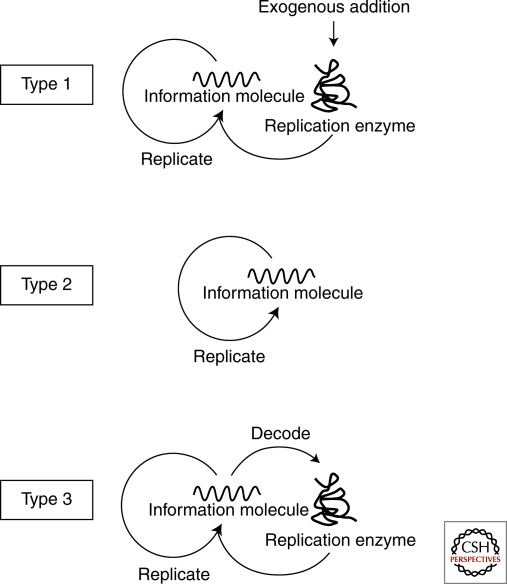
Types of self-replication. Type 1 is the self-replication reaction in which the information molecule (DNA or RNA) is replicated by an exogenous enzyme and includes PCR, 3SR and RNA replication by Qβ replicase. Type 2 self-replication does not require any replication enzymes and these reactions include self-ligating ribozymes, self-replicating peptides. Type 3 is a modification of type 1 in which the replication enzyme is supplied internally by synthesis rather than being exogenously added.
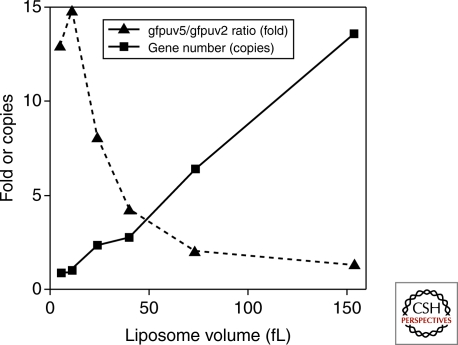
Relationship between liposome volume and efficiency of selection. Two types of GFP genes, GFPuv5 and GFPuv2 (GFPuv5:GFPuv2=0.85:0.15), were encapsulated into a liposome population having a diverse size range together with a cell-free transcription-translation system. GFPuv5 shows eightfold higher fluorescence signal than GFPuv2. Following translation, liposomes showing high GFP fluorescence were collected with a fluorescent-activated cell sorter, and investigated the copy number of total GFP genes and the ratio of the GFPuv5 gene to the GFPuv2 gene in the collected liposome population.
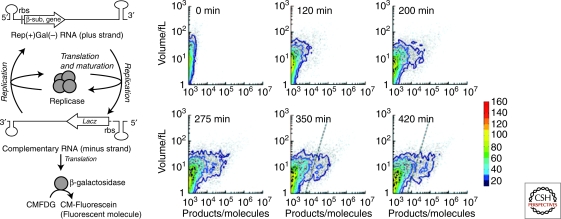
Type 3 self-replication of genetic information in liposomes (A) Schematic representation of the reaction with an additional phenotype that was generated by insertion of the lacZ gene. The Qβ replicase β-subunit was encoded on the plus-strand RNA, and β-galactosidase was encoded on the minus-strand RNA (complement of the plus-strand RNA). Nonfluorescent CMFDG was hydrolyzed by β-galactosidase to yield green fluorescent product, CM-fluorescein. (B) Time course of the reaction analyzed by FACS. The results of 15000 liposomes. The results of FACS analysis of product (horizontal) and internal aqueous volume (vertical) of each liposome are shown. Dots represent the data of individual liposomes. Contour maps are overlaid. The frequency is depicted in color code. At 350 and 420 min, the reacted liposomes were defined as those with a substantial amount of products (right of the dashed lines).
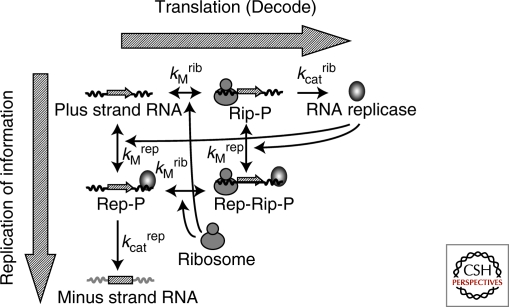
Kinetic model of a part of the type 3 self-replication The kinetic model contains four components: Plus strand RNA, minus strand RNA, RNA replicase (Qβ replicase) and ribosome. It carries out six reactions encompassing binding and dissociation of the plus strand RNA with RNA replicase and ribosome, translation, and minus strand synthesis. The binding and dissociation reactions are assumed to be in equilibrium. The forward reactions favor translation of RNA replicase (decoding processes). The downward reactions tend toward minus strand synthesis (replication processes). The ternary complex of the plus strand with ribosome and replicase (Rep-Rib-P) is incapable of translation and replication. The kinetic model has four measurable parameters: dissociation constants for ribosome (KMrib) and replicase (KMrep), and catalytic constants for translation (kcatrib) and replication (kcatrep).
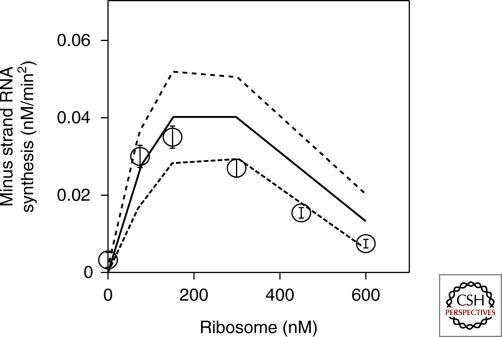
Effects of ribosome on minus strand RNA synthesis Ribosome concentration in a cell-free translation system was varied, and the amount of synthesized minus strand was measured by quantitative PCR after reverse transcription (open circle). Theoretical prediction from the kinetic model and experimentally estimated parameters were shown (solid line) with standard deviation (dotted lines).
References
-
- Bartel DP, Szostak JW 1993. Isolation of new ribozymes from a large pool of random sequences. Science 261:1411–1418 - PubMed
-
- Biebricher CK, Eigen M, Gardiner WC Jr 1985. Kinetics of RNA replication: competition and selection among self-replicating RNA species. Biochemistry 24:6550–6560 - PubMed
-
- Chakrabarti AC, Breaker RR, Joyce GF, Deamer DW 1994. Production of RNA by a polymerase protein encapsulated within phospholipid vesicles. J Mol Evol 39:555–559 - PubMed
Publication types
MeSH terms
Substances
LinkOut - more resources
Full Text Sources