


Limited efficacy of propranolol on the reconsolidation of fear memories
- PMID: 20516209
- PMCID: PMC2884288
- DOI: 10.1101/lm.1794710
Limited efficacy of propranolol on the reconsolidation of fear memories
Abstract
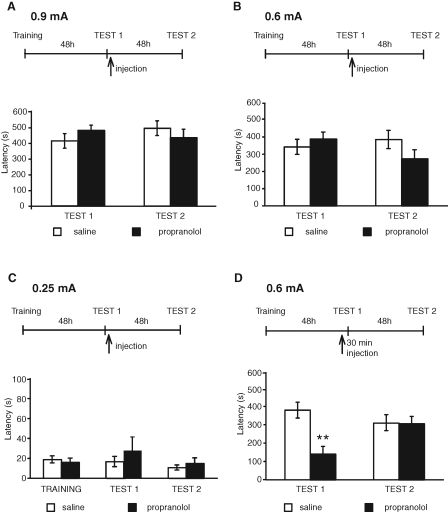
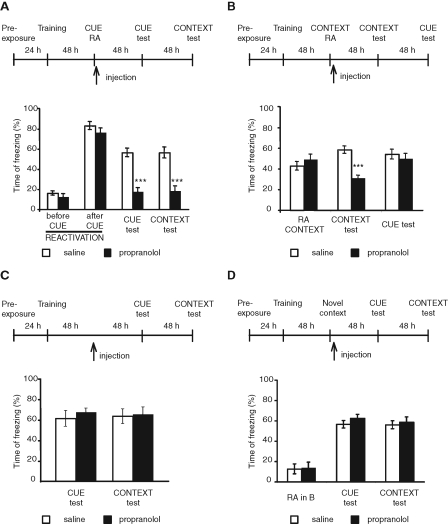
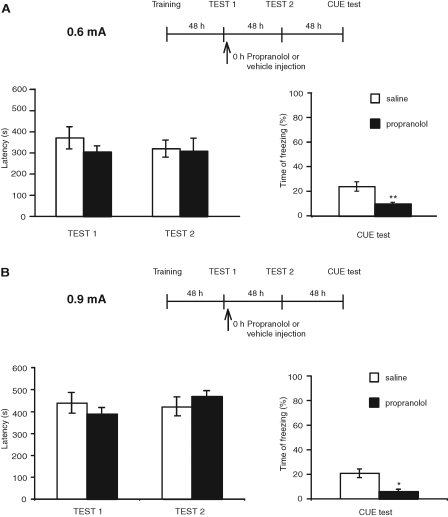
Previous studies suggested that the beta-adrenergic receptor antagonist propranolol might be a novel, potential treatment for post-traumatic stress disorder (PTSD). This hypothesis stemmed mainly from rodent studies showing that propranolol interferes with the reconsolidation of Pavlovian fear conditioning (FC). However, subsequent investigations in humans have produced controversial evidence about the effect of propranolol on fear memories and an effect on PTSD symptomatology has yet to be reported. Thus, it remains to be established whether propranolol interferes with the reconsolidation of fear memories at large. To address this question, we tested the effect of systemic injections of propranolol administered before or after the retrieval of an inhibitory avoidance (IA) memory elicited with different footshock intensities. In parallel, the same treatment was tested on the reconsolidation of Pavlovian FC. Propranolol showed no effect on the reconsolidation of IA, although the pre-retrieval administration resulted in a significant retrieval impairment. This impairment was transient, and memory returned to control levels at later times. In agreement with previous studies, we found that systemic administration of propranolol disrupts the reconsolidation of Pavlovian FC and that its injection following a retrieval elicited by cue exposure also interferes with the reconsolidation of contextual FC. Hence, propranolol disrupts the reconsolidation of Pavlovian FC, but has no effect on the reconsolidation of IA. The results indicate that the efficacy of systemic administration of propranolol in disrupting the reconsolidation of fear memories is limited.
Figures
Similar articles
-
Noradrenergic enhancement of reconsolidation in the amygdala impairs extinction of conditioned fear in rats--a possible mechanism for the persistence of traumatic memories in PTSD.Depress Anxiety. 2011 Mar;28(3):186-93. doi: 10.1002/da.20803. Depress Anxiety. 2011. PMID: 21394851 Free PMC article.
-
Blockade of muscarinic receptors impairs reconsolidation of older fear memory by decreasing cholinergic neurotransmission: A study in rat model of PTSD.Life Sci. 2020 Sep 1;256:118014. doi: 10.1016/j.lfs.2020.118014. Epub 2020 Jun 25. Life Sci. 2020. PMID: 32593712
-
Post-retrieval beta-adrenergic receptor blockade: effects on extinction and reconsolidation of cocaine-cue memories.Learn Mem. 2008 Aug 26;15(9):643-8. doi: 10.1101/lm.1054608. Print 2008 Sep. Learn Mem. 2008. PMID: 18772251 Free PMC article.
-
Revisiting propranolol and PTSD: Memory erasure or extinction enhancement?Neurobiol Learn Mem. 2016 Apr;130:26-33. doi: 10.1016/j.nlm.2016.01.009. Epub 2016 Jan 22. Neurobiol Learn Mem. 2016. PMID: 26808441 Free PMC article. Review.
-
Effects of propranolol on the modification of trauma memory reconsolidation in PTSD patients: A systematic review and meta-analysis.J Psychiatr Res. 2022 Jun;150:246-256. doi: 10.1016/j.jpsychires.2022.03.045. Epub 2022 Apr 4. J Psychiatr Res. 2022. PMID: 35405409
Cited by
-
Pharmacological treatment of anxiety disorders: current treatments and future directions.J Anxiety Disord. 2012 Dec;26(8):833-43. doi: 10.1016/j.janxdis.2012.07.009. Epub 2012 Aug 15. J Anxiety Disord. 2012. PMID: 23023162 Free PMC article. Review.
-
Recent progress in understanding the pathophysiology of post-traumatic stress disorder: implications for targeted pharmacological treatment.CNS Drugs. 2013 Mar;27(3):221-32. doi: 10.1007/s40263-013-0051-4. CNS Drugs. 2013. PMID: 23483368 Free PMC article. Review.
-
Brain aging and AD-like pathology in streptozotocin-induced diabetic rats.J Diabetes Res. 2014;2014:796840. doi: 10.1155/2014/796840. Epub 2014 Aug 14. J Diabetes Res. 2014. PMID: 25197672 Free PMC article.
-
Myocardial hypersensitivity to ischemic injury is not reversed by clonidine or propranolol in a predator-based rat model of posttraumatic stress disorder.Prog Neuropsychopharmacol Biol Psychiatry. 2019 Mar 8;89:117-124. doi: 10.1016/j.pnpbp.2018.09.003. Epub 2018 Sep 5. Prog Neuropsychopharmacol Biol Psychiatry. 2019. PMID: 30194949 Free PMC article.
-
β-Adrenergic receptor signaling and modulation of long-term potentiation in the mammalian hippocampus.Learn Mem. 2015 Aug 18;22(9):461-71. doi: 10.1101/lm.031088.113. Print 2015 Sep. Learn Mem. 2015. PMID: 26286656 Free PMC article. Review.
References
-
- Abrari K, Rashidy-Pour A, Semnanian S, Fathollahi Y 2007. Administration of corticosterone after memory reactivation disrupts subsequent retrieval of a contextual conditioned fear memory: Dependence upon training intensity. Neurobiol Learn Mem 89: 178–184 - PubMed
-
- Alberini CM 2005. Mechanisms of memory stabilization. Are consolidation and reconsolidation similar or distinct processes? Trends Neurosci 28: 51–56 - PubMed
-
- Anokhin KV, Tiunova AA, Rose SP 2002. Reminder effects—reconsolidation or retrieval deficit? Pharmacological dissection with protein synthesis inhibitors following reminder for a passive-avoidance task in young chicks. Eur J Neurosci 15: 1759–1765 - PubMed
-
- Brunet A, Orr SP, Tremblay J, Robertson K, Nader K, Pitman RK 2008. Effect of post-retrieval propranolol on psychophysiologic responding during subsequent script-driven traumatic imagery in post-traumatic stress disorder. J Psychiatr Res 42: 503–506 - PubMed
Publication types
MeSH terms
Substances
Grants and funding
LinkOut - more resources
Full Text Sources
Medical