


Pharmacokinetic study of once-daily versus twice-daily abacavir and lamivudine in HIV type-1-infected children aged 3-<36 months
- PMID: 20516550
- PMCID: PMC3827580
- DOI: 10.3851/IMP1532
Pharmacokinetic study of once-daily versus twice-daily abacavir and lamivudine in HIV type-1-infected children aged 3-<36 months
Abstract
Background: Once-daily dosing of abacavir and lamivudine has been approved for adults, but paediatric data are insufficient. We conducted a pharmacokinetic study of once-daily and twice-daily abacavir and lamivudine in children aged 3-<36 months.
Methods: Children with stable HIV type-1 (HIV-1) RNA levels after 12 weeks treatment with twice-daily abacavir (8 mg/kg) with or without lamivudine (4 mg/kg) underwent plasma pharmacokinetic sampling. Children then switched to once-daily abacavir (16 mg/kg) with or without lamivudine (8 mg/kg), and sampling was repeated 4 weeks later. The area under the plasma concentration-time curve over 24 h (AUC(0-24)) and the maximum concentration (C(max)) were compared using geometric mean ratios (GMRs); 90% confidence intervals (CIs) within the range of 0.80-1.25 were considered bioequivalent.
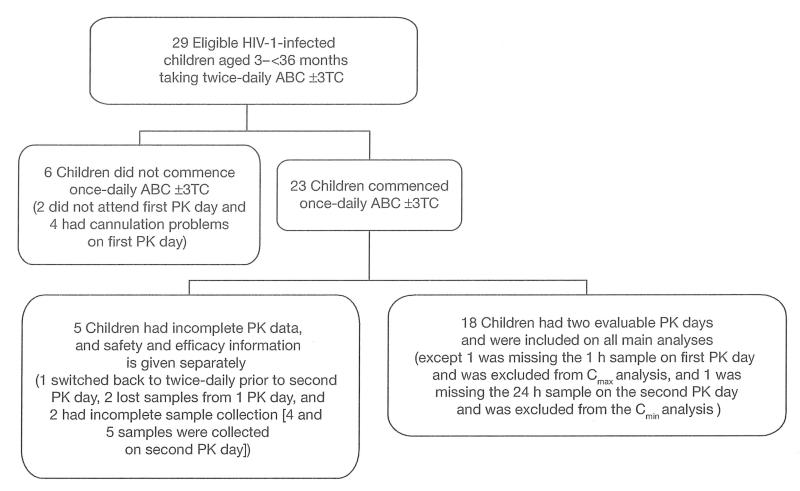
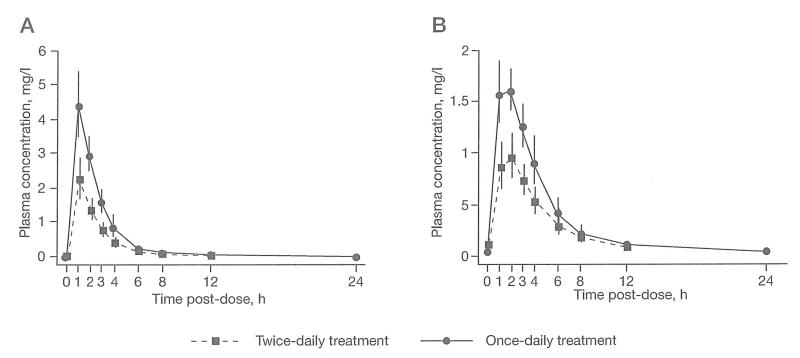
Results: A total of 18 children (4, 6 and 8 in the 3-<12, 12-<24 and 24-<36 month age ranges, respectively) provided pharmacokinetic data for abacavir (17 for lamivudine). The GMR of AUC(0-24), once-daily versus twice-daily, was 1.07 (90% CI 0.92-1.23) for abacavir and 0.91 (90% CI 0.79-1.06) for lamivudine. C(max) almost doubled on once-daily versus twice-daily dosing: abacavir and lamivudine GMRs were 2.04 (90% CI 1.73-2.42) and 1.78 (90% CI 1.52-2.09), respectively. At baseline, 12, 24 and 48 weeks, 89%, 94%, 100% and 89% of children had HIV-1 RNA<400 copies/ml, respectively.
Conclusions: Bioequivalence was demonstrated on AUC(0-24) between twice-daily and once-daily abacavir; very similar AUC(0-24) values were seen for twice-daily and once-daily lamivudine. Given that viral load suppression rates were maintained, these data suggest that once-daily abacavir and lamivudine might be an option for children aged 3-<36 months.
Figures
References
-
- Mocroft A, Ledergerber B, Katlama C, et al. Decline in the AIDS and death rates in the EuroSIDA study: an observational study. Lancet. 2003;362:22–29. - PubMed
-
- Murphy EL, Collier AC, Kalish LA, et al. Highly active antiretroviral therapy decreases mortality and morbidity in patients with advanced HIV disease. Ann Intern Med. 2001;135:17–26. - PubMed
-
- Paterson DL, Swindells S, Mohr J, et al. Adherence to protease inhibitor therapy and outcomes in patients with HIV infection. Ann Intern Med. 2000;133:21–30. - PubMed
-
- Montaner JS, Reiss P, Cooper D, et al. A randomized, double-blind trial comparing combinations of nevirapine, didanosine, and zidovudine for HIV-infected patients: the INCAS Trial. JAMA. 1998;279:930–937. - PubMed
Publication types
MeSH terms
Substances
Grants and funding
LinkOut - more resources
Full Text Sources
Medical
Research Materials
