


One-pill once-a-day HAART: a simplification strategy that improves adherence and quality of life of HIV-infected subjects
- PMID: 20517472
- PMCID: PMC2875721
- DOI: 10.2147/ppa.s10330
One-pill once-a-day HAART: a simplification strategy that improves adherence and quality of life of HIV-infected subjects
Abstract
Objective: The aim of the ADONE (ADherence to ONE pill) study was to verify the effect of a reduced number of pills on adherence and quality of life (QoL) in HIV-infected patients on highly active antiretroviral therapy (HAART).
Design: Prospective, multicenter, study.
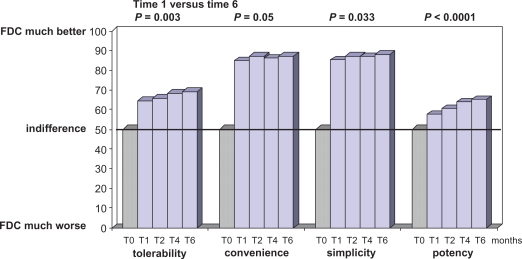
Methods: Patients chronically treated with emtricitabine (FTC) + tenofovir (TDF) + efavirenz (EFV) or lamivudine (3TC) +TDF +EFV and with a HIV-RNA < 50 copies/mL were switched to the single-pill fixed-dose regimen (FDR) of FTC +TDF +EFV. Data were collected with SF-36 using visual analog scales. Results of the final (6 months) primary as-treated analysis are reported.
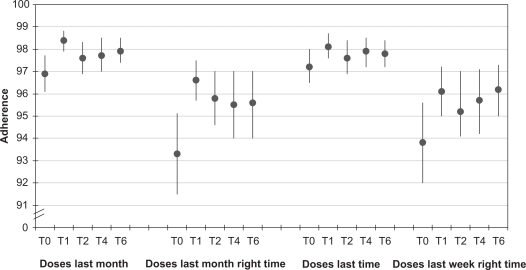
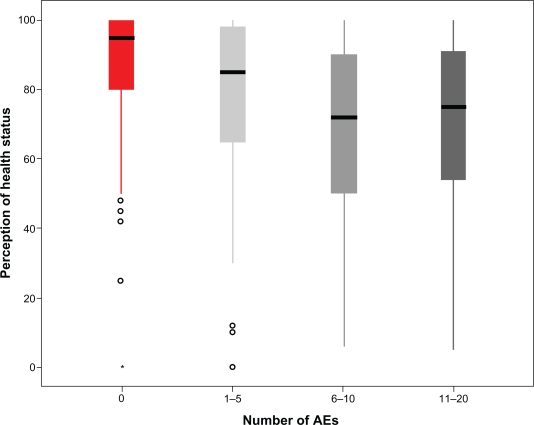
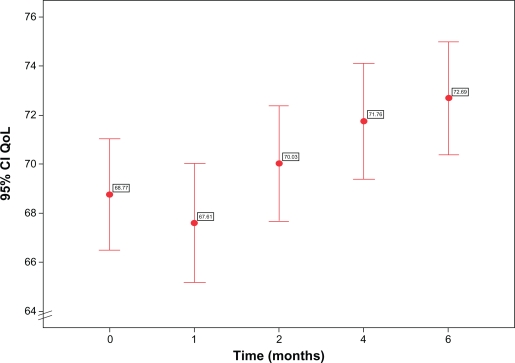
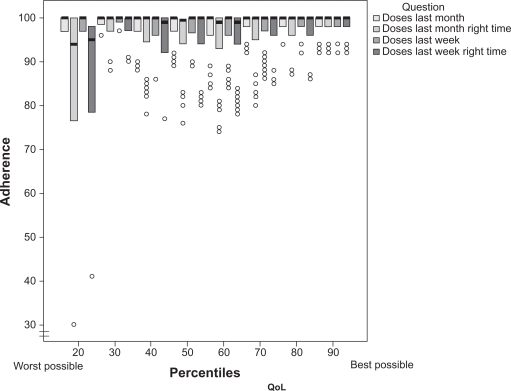
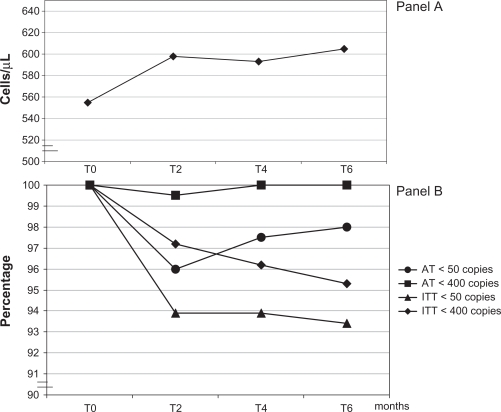
Results: 212 patients (77.4% males) of mean age 45.8 years were enrolled; 202 completed the study. One month post switch to FDR the adherence rate increased significantly to 96.1% from a baseline value of 93.8% (P < 0.01). The increase was steadily maintained throughout the study (96.2% at 6 months). QoL improved over time from 68.8% to 72.7% (P = 0.042) as well, and was significantly associated with the perception of health status, presence of adverse events (AEs) and number of reported AEs (P < 0.0001). QoL significantly influenced adherence (P < 0.0001). During FDR use the mean CD4 count increased from 556 to 605 cells/muL (P < 0.0001). At the end of follow-up 98% of patients maintained HIV-RNA level < 50 copies/mL and 100% <400 copies/mL. Four patients stopped therapy because they were lost to follow-up and 6 because of AEs (insomnia/nervousness 4, allergy 1, difficulties swallowing pills 1).
Conclusion: By substituting a one-pill once-a-day HAART, we observed an improvement of both adherence and QoL while maintaining high virologic and immunologic efficacy. HAART simplicity is an added value that favors adherence and may improve long-term success.
Keywords: EFV/FTC/TDF; QoL; adherence; once-daily antiretroviral regimen; patient preferences; single-pill regimen.
Figures
References
-
- Miller NH. Compliance with treatment regimens in chronic asymptomatic diseases. Am J Med. 1997;102:43–49. - PubMed
-
- Rodriguez-Rosado R, Jimenez-Nacher I, Soriano V, et al. Virological failure and adherence to antiretroviral therapy in HIV-infected patients. AIDS. 1998;12:1112–1113. - PubMed
-
- Bangsberg DR, Charlebois ED, Grant RM, et al. High levels of adherence do not prevent accumulation of HIV drug resistance mutations. AIDS. 2003;17:1925–1932. - PubMed
-
- Paterson DL, Swindells S, Mohr J, et al. Adherence to protease inhibitor therapy and outcomes in patients with HIV infection. Ann Intern Med. 2000;133:21–30. - PubMed
-
- Maggiolo F, Ravasio L, Ripamonti D, et al. Similar adherence rates favour different virologic outcomes for patients treated with nonnucleoside analogues or protease inhibitors. Clin Infect Dis. 2005;40:158–163. - PubMed
LinkOut - more resources
Full Text Sources
Research Materials
