Review
. 2010 Aug;117(8):961-70.
doi: 10.1007/s00702-010-0422-7. Epub 2010 Jun 2.

Macrophages in Alzheimer's disease: the blood-borne identity

Affiliations
Review

Macrophages in Alzheimer's disease: the blood-borne identity

David Gate et al. J Neural Transm (Vienna). 2010 Aug.

Abstract

Alzheimer's disease (AD) is a progressive and incurable neurodegenerative disorder clinically characterized by cognitive decline involving loss of memory, reasoning and linguistic ability. The amyloid cascade hypothesis holds that mismetabolism and aggregation of neurotoxic amyloid-beta (Abeta) peptides, which are deposited as amyloid plaques, are the central etiological events in AD. Recent evidence from AD mouse models suggests that blood-borne mononuclear phagocytes are capable of infiltrating the brain and restricting beta-amyloid plaques, thereby limiting disease progression. These observations raise at least three key questions: (1) what is the cell of origin for macrophages in the AD brain, (2) do blood-borne macrophages impact the pathophysiology of AD and (3) could these enigmatic cells be therapeutically targeted to curb cerebral amyloidosis and thereby slow disease progression? This review begins with a historical perspective of peripheral mononuclear phagocytes in AD, and moves on to critically consider the controversy surrounding their identity as distinct from brain-resident microglia and their potential impact on AD pathology.


Figures
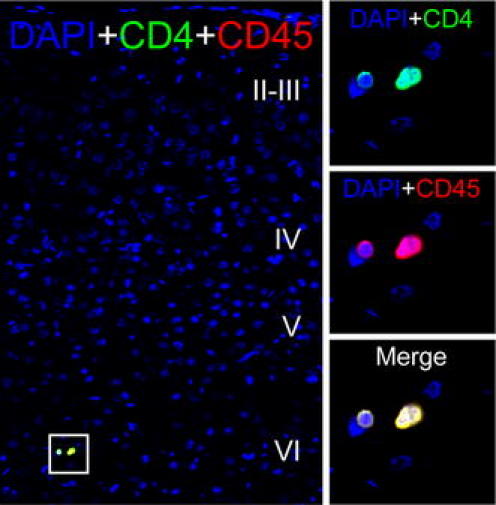
Fig. 1
Fig. 1
A confocal image of unmanipulated wild-type C57BL/6 mouse cerebral cortex showing presence of CD45+CD4+ cells in the parenchyma. Cortical layers are indicated by roman numerals and individual channels are shown with DAPI nuclear counterstain
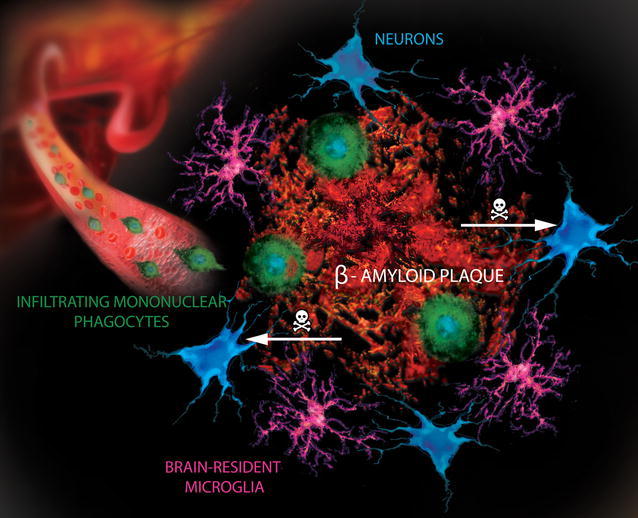
Fig. 2
Fig. 2
A schematic representation showing the roles of mononuclear phagocytes in Alzheimer’s disease. A penetrating cerebral artery is shown on the left, and a β-amyloid plaque within the brain parenchyma is shown to the right. Peripheral mononuclear phagocytes (macrophages) are infiltrating the brain parenchyma and homing to the β-amyloid plaque, where they phagocytose and clear deposited Aβ. Peripheral mononuclear phagocytes are depicted in green, brain-resident microglia are magenta, neurons are blue, and the β-amyloid plaque is shown in red

References

    1. Ajami B, Bennett JL, Krieger C, Tetzlaff W, Rossi FM. Local self-renewal can sustain CNS microglia maintenance and function throughout adult life. Nat Neurosci. 2007;10(12):1538–1543. doi: 10.1038/nn2014. - DOI - PubMed
    1. Alliot F, Godin I, Pessac B. Microglia derive from progenitors, originating from the yolk sac, and which proliferate in the brain. Brain Res Dev Brain Res. 1999;117(2):145–152. doi: 10.1016/S0165-3806(99)00113-3. - DOI - PubMed
    1. Attems J, Jellinger KA, Lintner F. Alzheimer’s disease pathology influences severity and topographical distribution of cerebral amyloid angiopathy. Acta Neuropathol. 2005;110(3):222–231. doi: 10.1007/s00401-005-1064-y. - DOI - PubMed
    1. Beers DR, Henkel JS, Zhao W, Wang J, Appel SH. CD4+ T cells support glial neuroprotection, slow disease progression, and modify glial morphology in an animal model of inherited ALS. Proc Natl Acad Sci USA. 2008;105(40):15558–15563. doi: 10.1073/pnas.0807419105. - DOI - PMC - PubMed
    1. Boissonneault V, Filali M, Lessard M, Relton J, Wong G, Rivest S. Powerful beneficial effects of macrophage colony-stimulating factor on beta-amyloid deposition and cognitive impairment in Alzheimer’s disease. Brain. 2009;132(4):1078–1092. doi: 10.1093/brain/awn331. - DOI - PubMed

Publication types