


In silico modelling of drug-polymer interactions for pharmaceutical formulations
- PMID: 20519214
- PMCID: PMC2943894
- DOI: 10.1098/rsif.2010.0190.focus
In silico modelling of drug-polymer interactions for pharmaceutical formulations
Abstract
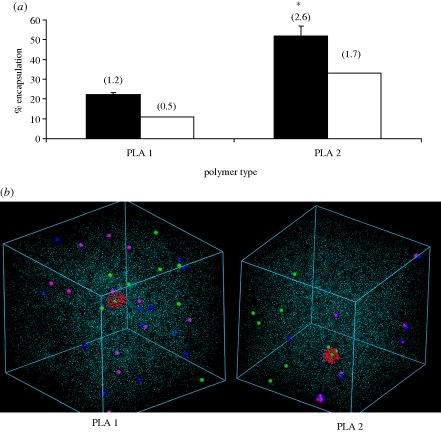
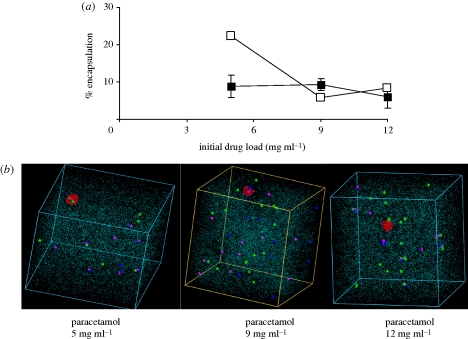
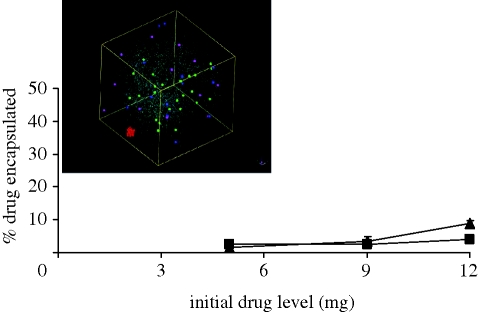
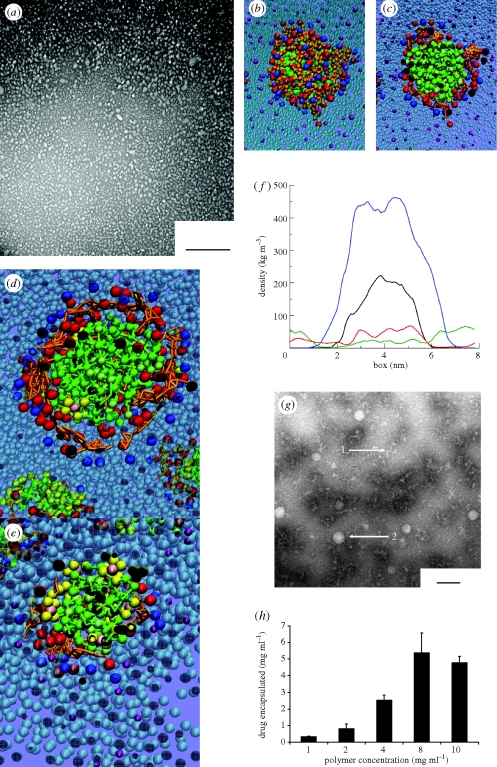
Selecting polymers for drug encapsulation in pharmaceutical formulations is usually made after extensive trial and error experiments. To speed up excipient choice procedures, we have explored coarse-grained computer simulations (dissipative particle dynamics (DPD) and coarse-grained molecular dynamics using the MARTINI force field) of polymer-drug interactions to study the encapsulation of prednisolone (log p = 1.6), paracetamol (log p = 0.3) and isoniazid (log p = -1.1) in poly(L-lactic acid) (PLA) controlled release microspheres, as well as the encapsulation of propofol (log p = 4.1) in bioavailability enhancing quaternary ammonium palmitoyl glycol chitosan (GCPQ) micelles. Simulations have been compared with experimental data. DPD simulations, in good correlation with experimental data, correctly revealed that hydrophobic drugs (prednisolone and paracetamol) could be encapsulated within PLA microspheres and predicted the experimentally observed paracetamol encapsulation levels (5-8% of the initial drug level) in 50 mg ml(-1) PLA microspheres, but only when initial paracetamol levels exceeded 5 mg ml(-1). However, the mesoscale technique was unable to model the hydrophilic drug (isoniazid) encapsulation (4-9% of the initial drug level) which was observed in experiments. Molecular dynamics simulations using the MARTINI force field indicated that the self-assembly of GCPQ is rapid, with propofol residing at the interface between micellar hydrophobic and hydrophilic groups, and that there is a heterogeneous distribution of propofol within the GCPQ micelle population. GCPQ-propofol experiments also revealed a population of relatively empty and drug-filled GCPQ particles.
Figures
References
-
- Arshady R. 1990. Microspheres and microcapsules, a survey of manufacturing techniques. Part III: solvent evaporation. Polym. Eng. Sci. 30, 915–924. ( 10.1002/pen.760301506) - DOI
-
- Boussou C., van der Walle C. 2006. Poly(lactic acid-co-glycolic acid) microspheres. In Polymers in drug delivery (ed. Uchegbu I. F.), pp. 81–99. Boca Raton, FL: CRC Press.
-
- Daoulas K. C., Muller M. 2010. Comparison of simulations of lipid membranes with membranes of block copolymers. In Polymer membranes/biomembranes (eds Meier W. P., Knoll W.), pp. 197–233. Berlin, Germany: Springer-Verlag.
-
- Frenkel D., Smit B. 2002. Understanding molecular simulations: from algorithms to applications. San Diego, CA: Academic Press.
-
- Glotzer S. C., Paul W. 2002. Molecular and mesoscale simulation methods for polymer materials. Annu. Rev. Mater. Res. 32, 401–436. ( 10.1146/annurev.matsci.32.010802.112213) - DOI
Publication types
MeSH terms
Substances
LinkOut - more resources
Full Text Sources
Other Literature Sources
Medical
