


Melatonin potentiates glycine currents through a PLC/PKC signalling pathway in rat retinal ganglion cells
- PMID: 20519319
- PMCID: PMC2916991
- DOI: 10.1113/jphysiol.2010.187641
Melatonin potentiates glycine currents through a PLC/PKC signalling pathway in rat retinal ganglion cells
Abstract
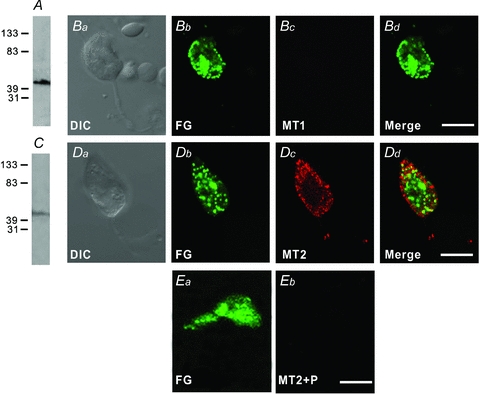
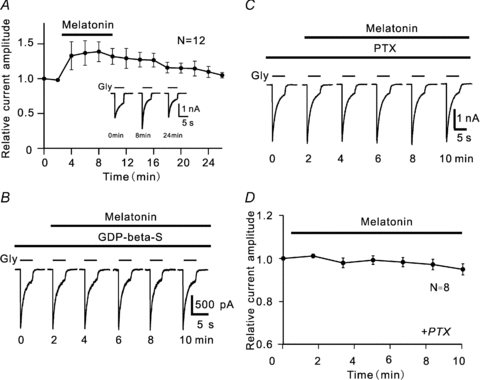
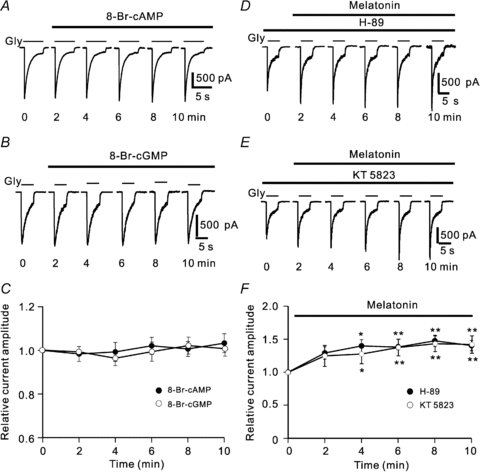
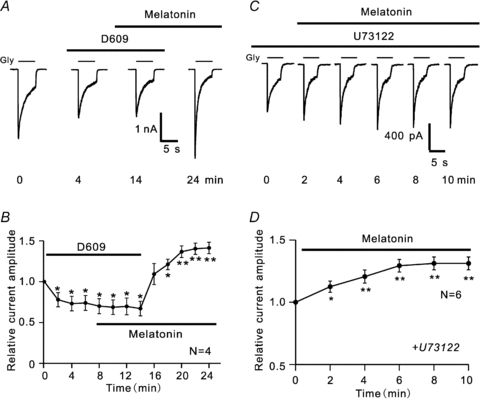
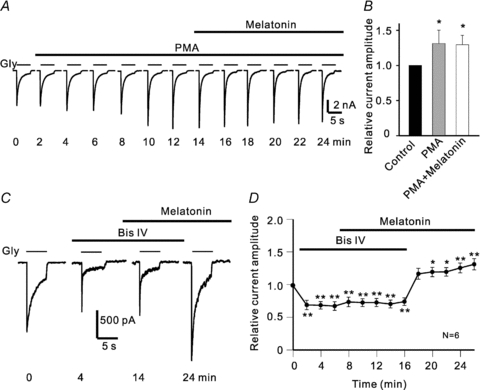
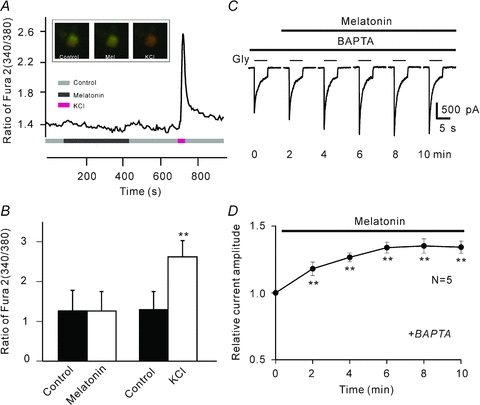
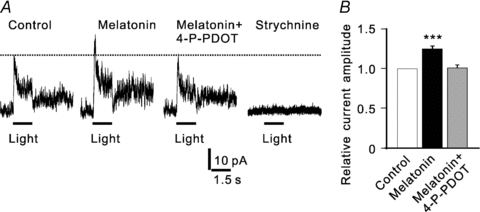
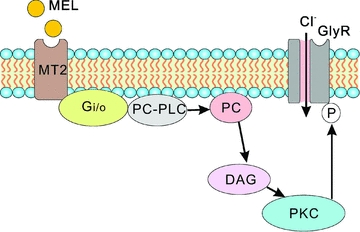
In vertebrate retina, melatonin regulates various physiological functions. In this work we investigated the mechanisms underlying melatonin-induced potentiation of glycine currents in rat retinal ganglion cells (RGCs). Immunofluorescence double labelling showed that rat RGCs were solely immunoreactive to melatonin MT(2) receptors. Melatonin potentiated glycine currents of RGCs, which was reversed by the MT(2) receptor antagonist 4-P-PDOT. The melatonin effect was blocked by intracellular dialysis of GDP-beta-S. Either preincubation with pertussis toxin or application of the phosphatidylcholine (PC)-specific phospholipase C (PLC) inhibitor D609, but not the phosphatidylinositol (PI)-PLC inhibitor U73122, blocked the melatonin effect. The protein kinase C (PKC) activator PMA potentiated the glycine currents and in the presence of PMA melatonin failed to cause further potentiation of the currents, whereas application of the PKC inhibitor bisindolylmaleimide IV abolished the melatonin-induced potentiation. The melatonin effect persisted when [Ca(2+)](i) was chelated by BAPTA, and melatonin induced no increase in [Ca(2+)](i). Neither cAMP-PKA nor cGMP-PKG signalling pathways seemed to be involved because 8-Br-cAMP or 8-Br-cGMP failed to cause potentiation of the glycine currents and both the PKA inhibitor H-89 and the PKG inhibitor KT5823 did not block the melatonin-induced potentiation. In consequence, a distinct PC-PLC/PKC signalling pathway, following the activation of G(i/o)-coupled MT(2) receptors, is most likely responsible for the melatonin-induced potentiation of glycine currents of rat RGCs. Furthermore, in rat retinal slices melatonin potentiated light-evoked glycine receptor-mediated inhibitory postsynaptic currents in RGCs. These results suggest that melatonin, being at higher levels at night, may help animals to detect positive or negative contrast in night vision by modulating inhibitory signals largely mediated by glycinergic amacrine cells in the inner retina.
Figures
References
-
- Alarma-Estrany P, Pintor J. Melatonin receptors in the eye: location, second messengers and role in ocular physiology. Pharmacol Ther. 2007;113:507–522. - PubMed
-
- Barrenetxe J, Delagrange P, Martinez JA. Physiological and metabolic functions of melatonin. J Physiol Biochem. 2004;60:61–72. - PubMed
-
- Bers DM, Patton CW, Nuccitelli R. A practical guide to the preparation of Ca2+ buffers. Methods Cell Biol. 1994;40:3–29. - PubMed
-
- Cahill GM, Besharse JC. Light-sensitive melatonin synthesis by Xenopus photoreceptors after destruction of the inner retina. Vis Neurosci. 1992;8:487–490. - PubMed
-
- Cecchetti S, Spadaro F, Lugini L, Podo F, Ramoni C. Functional role of phosphatidycholine-specific phospholipases C in regulating CD16 membrane expression in natural killer cells. Eur J Immunol. 2007;37:2912–2922. - PubMed
Publication types
MeSH terms
Substances
LinkOut - more resources
Full Text Sources
Research Materials
Miscellaneous
