Circadian clock proteins control adaptation to novel environment and memory formation
- PMID: 20519775
- PMCID: PMC2898019
- DOI: 10.18632/aging.100142
Circadian clock proteins control adaptation to novel environment and memory formation
Abstract
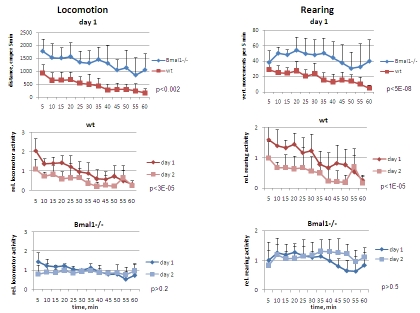
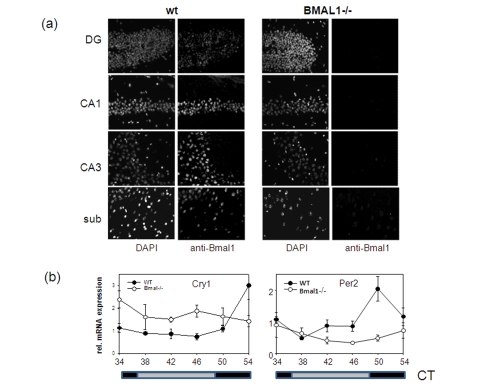
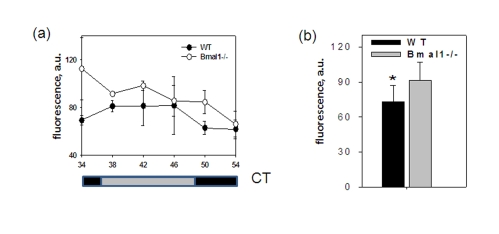
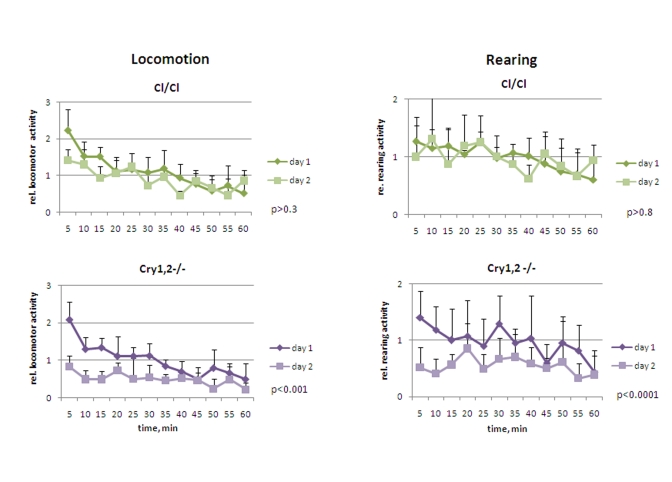
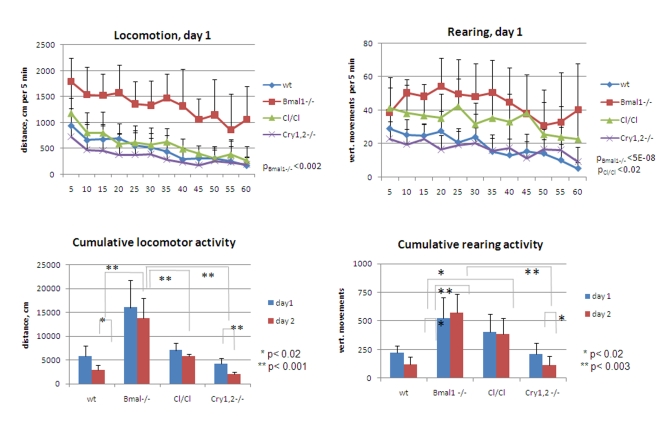
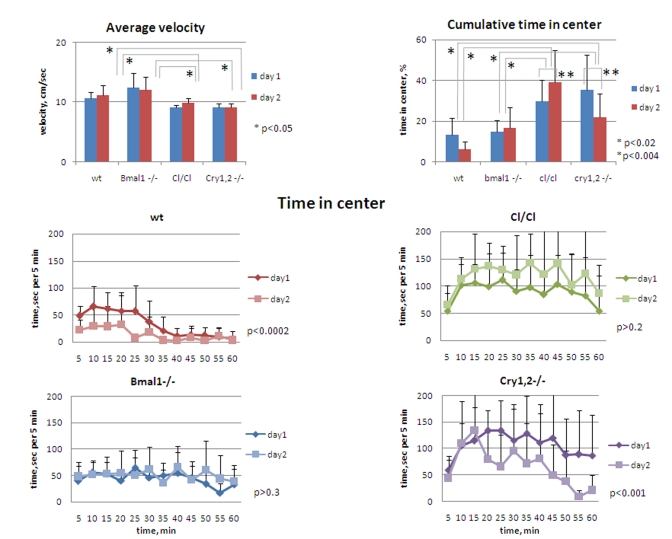
Deficiency of the transcription factor BMAL1, a core component of the circadian clock, results in an accelerated aging phenotype in mice. The circadian clock regulates many physiological processes and was recently implicated in control of brain-based activities, such as memory formation and the regulation of emotions. Aging is accompanied by the decline in brain physiology, particularly decline in the response and adaptation to novelty. We investigated the role of the circadian clock in exploratory behavior and habituation to novelty using the open field paradigm. We found that mice with a deficiency of the circadian transcription factor BMAL1 display hyperactivity in novel environments and impaired intra- and intersession habituation, indicative of defects in short- and long-term memory formation. In contrast, mice double-deficient for the circadian proteins CRY1 and CRY2 (repressors of the BMAL1-mediated transcription) demonstrate reduced activity and accelerated habituation when compared to wild type mice. Mice with mutation in theClock gene (encoding the BMAL1 transcription partner) show normal locomotion, but increased rearing activity and impaired intersession habituation. BMAL1 is highly expressed in the neurons of the hippocampus - a brain region associated with spatial memory formation; BMAL1 deficiency disrupts circadian oscillation in gene expression and reactive oxygen species homeostasis in the brain, which may be among the possible mechanisms involved. Thus, we suggest that the BMAL1:CLOCK activity is critical for the proper exploratory and habituation behavior, and that the circadian clock prepares organism for a new round of everyday activities through optimization of behavioral learning.
Conflict of interest statement
The authors of this manuscript have no conflict of interests to declare.
Figures
Comment in
-
The aging clock: to 'BMAL'icious toward learning and memory.Aging (Albany NY). 2010 May;2(5):251-4. doi: 10.18632/aging.100144. Aging (Albany NY). 2010. PMID: 20519776 Free PMC article. No abstract available.
-
Ageing or NOT, clock genes are important for memory processes: an interesting hypothesis raising many questions.Aging (Albany NY). 2010 May;2(5):259-60. doi: 10.18632/aging.100148. Aging (Albany NY). 2010. PMID: 20519780 Free PMC article. No abstract available.
-
Aging brains and waning clocks on the process of habituation.Aging (Albany NY). 2010 Jun;2(6):320-1. doi: 10.18632/aging.100154. Aging (Albany NY). 2010. PMID: 20603522 Free PMC article. No abstract available.
References
-
- Cerbone A, Sadile AG. Behavioral habituation to spatial novelty: interference and noninterference studies. Neurosci Biobehav Rev. 1994;18:497–518. - PubMed
-
- Leussis MP, Bolivar VJ. Habituation in rodents: a review of behavior, neurobiology, and genetics. Neurosci Biobehav Rev, 2006;30:1045–1064. - PubMed
-
- Rankin CH, Abrams T, Barry RJ, Bhatnagar S, Clayton DF, Colombo J, Coppola G, Geyer MA, Glanzman DL, Marsland S, McSweeney FK, Wilson DA, Wu CF, Thompson RF. Habituation revisited: an updated and revised description of the behavioral characteristics of habituation. Neurobiol Learn Mem. 2009;92:135–138. - PMC - PubMed
-
- Kondratov RV, Gorbacheva VY, Antoch MP. The role of mammalian circadian proteins in normal physiology and genotoxic stress responses. Curr Top Dev Biol. 2007;78:173–216. - PubMed
Publication types
MeSH terms
Substances
Grants and funding
LinkOut - more resources
Full Text Sources
Other Literature Sources
Medical