


Review
doi: 10.4161/cc.9.12.11988.
Epub 2010 Jun 15.
Ubiquitylation and proteasomal degradation of the p21(Cip1), p27(Kip1) and p57(Kip2) CDK inhibitors
Affiliations
- PMID: 20519948
- PMCID: PMC3319752
- DOI: 10.4161/cc.9.12.11988
Item in Clipboard
Review
Ubiquitylation and proteasomal degradation of the p21(Cip1), p27(Kip1) and p57(Kip2) CDK inhibitors
Cell Cycle.
.
Abstract
The expression levels of the p21(Cip1) family CDK inhibitors (CKIs), p21(Cip1), p27(Kip1) and p57(Kip2), play a pivotal role in the precise regulation of cyclin-dependent kinase (CDK) activity, which is instrumental to proper cell cycle progression. The stabilities of p21(Cip1), p27(Kip1) and p57(Kip2) are all tightly and differentially regulated by ubiquitylation and proteasome-mediated degradation during various stages of the cell cycle, either in steady state or in response to extracellular stimuli, which often elicit site-specific phosphorylation of CKIs triggering their degradation.
Figures
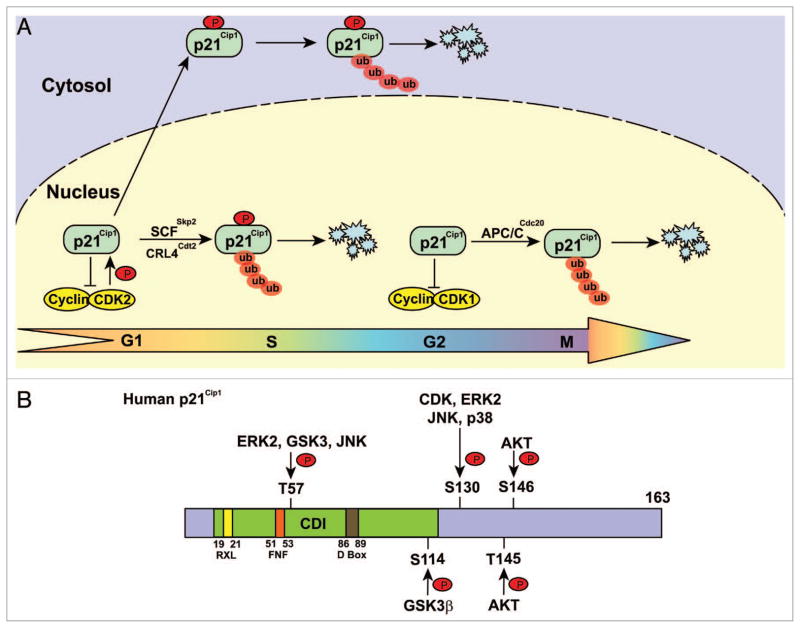
Phosphorylated p21Cip1 is degraded by distinct E3 ligases. (A) E3 ligases involved in p21Cip1 degradation. p21Cip1 is ubiquitylated and degraded in late G1 and S phases by SCFSkp2 and CRL4Cdt2, and in G2 phase by APC/CCdc20 in the nucleus. A portion p21Cip1 is phosphorylated and translocated into the cytosol where it is ubiquitylated and degraded by proteasomes. (B) Schematic structure of p21Cip1 showing the regulatory phosphorylation sites and the cognate protein kinases. CDI: CDK inhibitor domain.
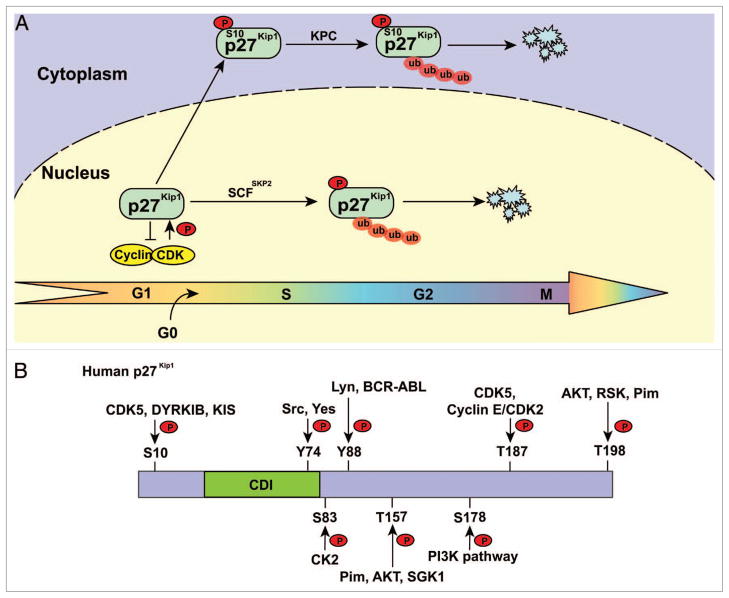
Phosphorylated 27Kip1 is degraded by distinct E3 ligases. (A) E3 ligases involved in p27Kip1 degradation. p27Kip1 is ubiquitylated and degraded in late G1, S and G2 phases by SCFSkp2 in the nucleus. p27Kip1 phosphorylated at S10 is ubiquitylated by the KPC complex when exported to the cytoplasm. (B) Schematic structure of p27Kip1 showing the regulatory phosphorylation sites and the cognate protein kinases. CDI, CDK inhibitor domain.
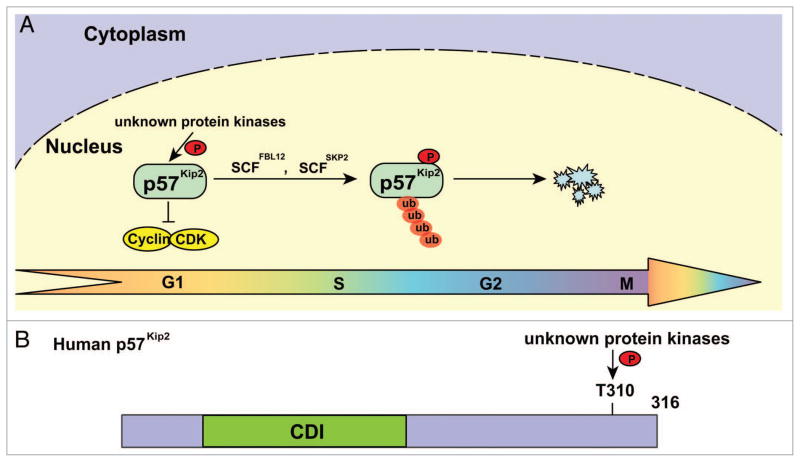
Phosphorylated p57Kip2 is degraded by distinct E3 ligases. (A) E3 ligases involved in p57Kip2 degradation. p57KIP2 phosphorylated at T329 is ubiquitylated and degraded in late G1 and S phases by SCFFBL12 and SCFSkp2. (B) Schematic structure of p57Kip2 showing the single regulatory phosphorylation site. CDI, CDK inhibitor domain.
References
-
- Jackson PK, Eldridge AG, Freed E, Furstenthal L, Hsu JY, Kaiser BK, et al. The lore of the RINGs: substrate recognition and catalysis by ubiquitin ligases. Trends Cell Biol. 2000;10:429–39. - PubMed
-
- Hatakeyama S, Yada M, Matsumoto M, Ishida N, Nakayama KI. U box proteins as a new family of ubiquitin-protein ligases. J Biol Chem. 2001;276:33111–20. - PubMed
-
- Boname JM, Stevenson PG. MHC class I ubiquitination by a viral PHD/LAP finger protein. Immunity. 2001;15:627–36. - PubMed
Publication types
MeSH terms
Substances
Grants and funding
LinkOut - more resources
Full Text Sources
Miscellaneous
