


Stimulation of medial prefrontal cortex serotonin 2C (5-HT(2C)) receptors attenuates cocaine-seeking behavior
- PMID: 20520599
- PMCID: PMC3055305
- DOI: 10.1038/npp.2010.72
Stimulation of medial prefrontal cortex serotonin 2C (5-HT(2C)) receptors attenuates cocaine-seeking behavior
Abstract
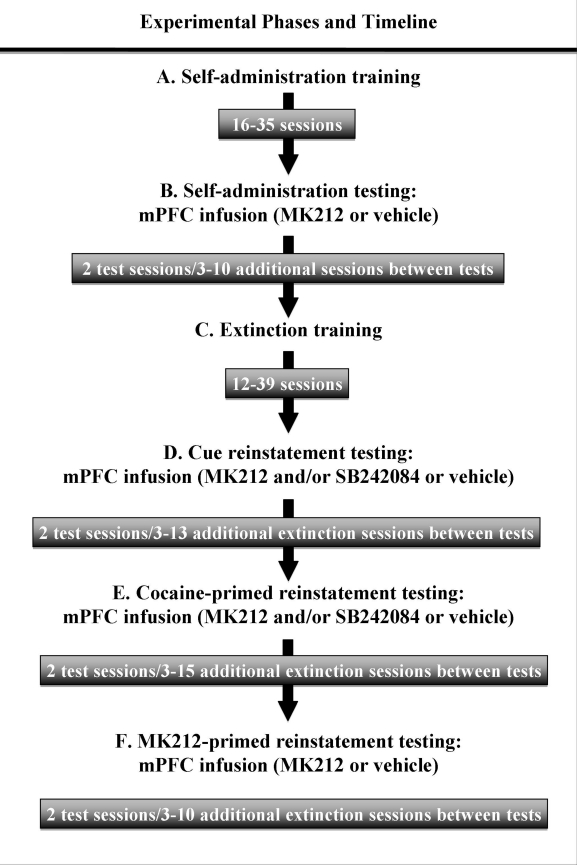
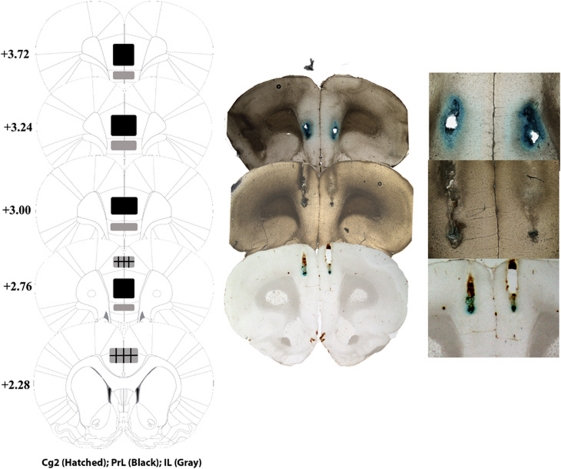
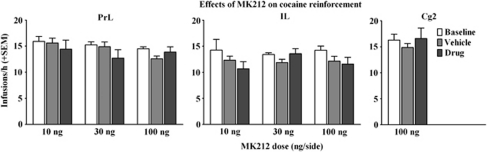
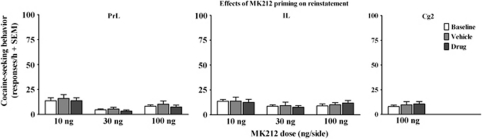
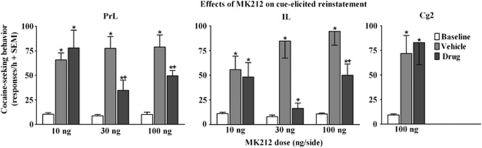
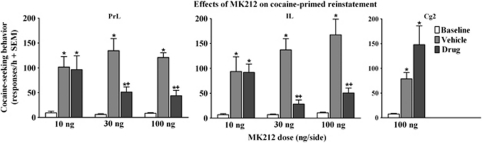
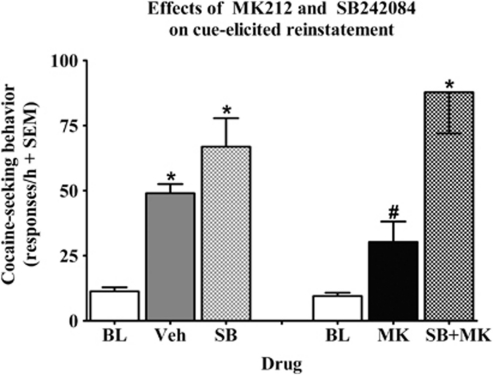
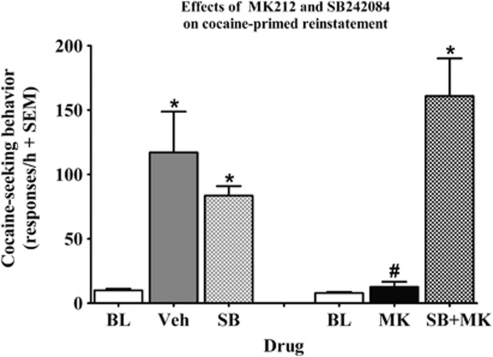
Serotonin 2C receptor (5-HT(2C)R) agonists administered systemically attenuate both cocaine-primed and cue-elicited reinstatement of extinguished cocaine-seeking behavior. To further elucidate the function of these receptors in addiction-like processes, this study examined the effects of microinfusing the 5-HT(2C)R agonist MK212 (0, 10, 30, 100 ng/side/0.2 microl) into the medial prefrontal cortex (mPFC) on cocaine self-administration and reinstatement of extinguished cocaine-seeking behavior. Male Sprague-Dawley rats were trained to self-administer cocaine (0.75 mg/kg, i.v.) paired with light and tone cues. Once responding stabilized, rats received MK212 microinfusions before tests for maintenance of cocaine self-administration. Next, extinction training to reduce cocaine-seeking behavior, defined as responses performed without cocaine reinforcement available, occurred until low extinction baselines were achieved. Rats then received MK212 microinfusions before tests for reinstatement of extinguished cocaine-seeking behavior elicited by cocaine-priming injections (10 mg/kg, i.p.) or response-contingent presentations of the cocaine-associated cues; operant responses during cocaine-primed reinstatement tests produced no consequences. MK212 microinfusions into the prelimbic and infralimbic, but not anterior cingulate, regions of the mPFC dose-dependently attenuated both cocaine-primed and cue-elicited reinstatement of extinguished cocaine-seeking behavior, but did not reliably affect cocaine self-administration. A subsequent experiment showed that the effects of MK212 (100 ng/side/0.2 microl) on reinstatement of extinguished cocaine-seeking behavior were blocked by co-administration of the 5-HT(2C)R antagonist SB242084 (200 ng/side/0.2 microl). MK212 administered alone into the mPFC as a drug prime produced no discernable effects on cocaine-seeking behavior. These findings suggest that stimulation of 5-HT(2C)Rs in the mPFC attenuates the incentive motivational effects produced by sampling cocaine or exposure to drug-paired cues.
Figures
Comment in
-
The serotonin 5-HT2C receptor in medial prefrontal cortex exerts rheostatic control over the motivational salience of cocaine-associated cues: new observations from preclinical animal research.Neuropsychopharmacology. 2010 Nov;35(12):2319-21. doi: 10.1038/npp.2010.119. Neuropsychopharmacology. 2010. PMID: 20948510 Free PMC article. No abstract available.
References
-
- Acosta JI, Thiel KJ, Sanabria F, Browning JR, Neisewander JL. Effect of schedule of reinforcement on cue-elicited reinstatement of cocaine-seeking behavior. Behav Pharmacol. 2008;19:129–136. - PubMed
-
- Aronson SC, Black JE, McDougle CJ, Scanley BE, Jatlow P, Kosten TR, et al. Serotonergic mechanisms of cocaine effects in humans. Psychopharmacology (Berl) 1995;119:179–185. - PubMed
-
- Baker DA, Tran-Nguyen TL, Fuchs RA, Neisewander JL. Influence of individual differences and chronic fluoxetine treatment on cocaine-seeking behavior in rats. Psychopharmacology (Berl) 2001;155:18–26. - PubMed
-
- Barnes NM, Sharp T. A review of central 5-HT receptors and their function. Neuropharmacology. 1999;38:1083–1152. - PubMed
Publication types
MeSH terms
Substances
Grants and funding
LinkOut - more resources
Full Text Sources
Medical
