


Natural allelic variation underlying a major fitness trade-off in Arabidopsis thaliana
- PMID: 20520716
- PMCID: PMC3055268
- DOI: 10.1038/nature09083
Natural allelic variation underlying a major fitness trade-off in Arabidopsis thaliana
Abstract
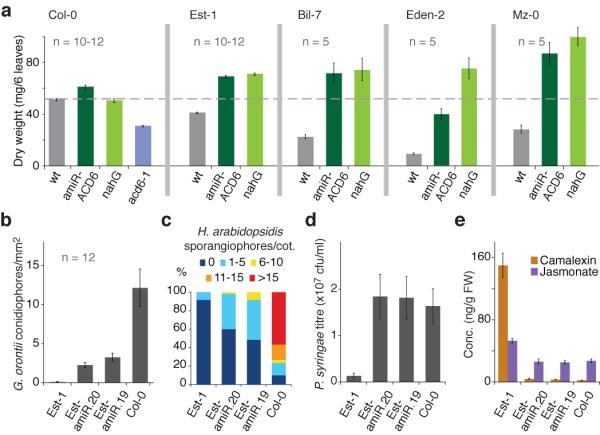
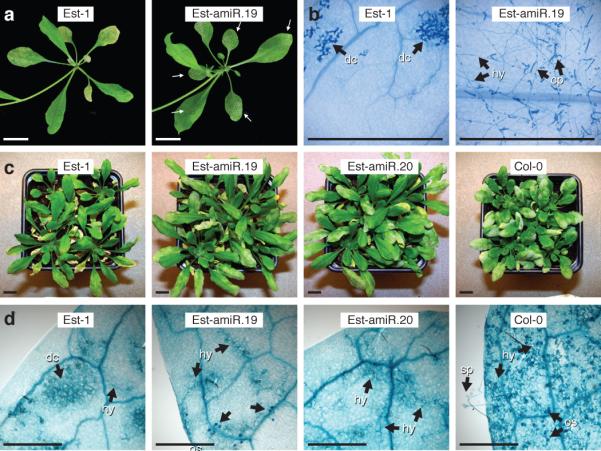
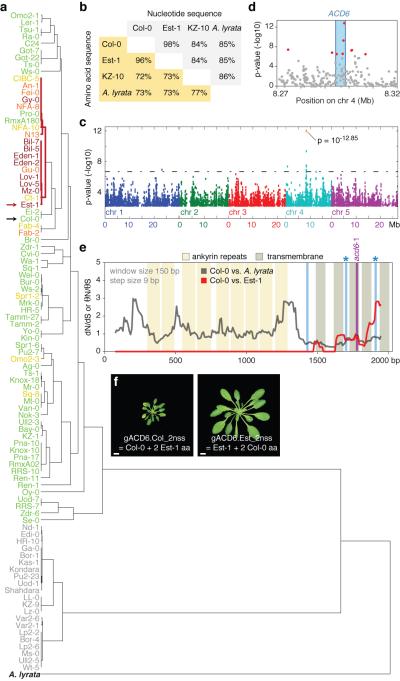
Plants can defend themselves against a wide array of enemies, from microbes to large animals, yet there is great variability in the effectiveness of such defences, both within and between species. Some of this variation can be explained by conflicting pressures from pathogens with different modes of attack. A second explanation comes from an evolutionary 'tug of war', in which pathogens adapt to evade detection, until the plant has evolved new recognition capabilities for pathogen invasion. If selection is, however, sufficiently strong, susceptible hosts should remain rare. That this is not the case is best explained by costs incurred from constitutive defences in a pest-free environment. Using a combination of forward genetics and genome-wide association analyses, we demonstrate that allelic diversity at a single locus, ACCELERATED CELL DEATH 6 (ACD6), underpins marked pleiotropic differences in both vegetative growth and resistance to microbial infection and herbivory among natural Arabidopsis thaliana strains. A hyperactive ACD6 allele, compared to the reference allele, strongly enhances resistance to a broad range of pathogens from different phyla, but at the same time slows the production of new leaves and greatly reduces the biomass of mature leaves. This allele segregates at intermediate frequency both throughout the worldwide range of A. thaliana and within local populations, consistent with this allele providing substantial fitness benefits despite its marked impact on growth.
Figures


References
-
- Glazebrook J. Contrasting mechanisms of defense against biotrophic and necrotrophic pathogens. Annu. Rev. Phytopathol. 2005;43:205–227. - PubMed
-
- Holub EB. The arms race is ancient history in Arabidopsis, the wildflower. Nat. Rev. Genet. 2001;2:516–527. - PubMed
-
- Holub EB. Natural variation in innate immunity of a pioneer species. Curr. Opin. Plant Biol. 2007;10:415–424. - PubMed
-
- Jones JD, Dangl JL. The plant immune system. Nature. 2006;444:323–329. - PubMed
-
- Bent AF, Mackey D. Elicitors, effectors, and R genes: the new paradigm and a lifetime supply of questions. Annu. Rev. Phytopathol. 2007;45:399–436. - PubMed
Publication types
MeSH terms
Substances
Associated data
- Actions
- Actions
- Actions
- Actions
- Actions
- Actions
- Actions
- Actions
- Actions
- Actions
- Actions
- Actions
- Actions
- Actions
- Actions
- Actions
- Actions
- Actions
- Actions
- Actions
- Actions
- Actions
- Actions
- Actions
- Actions
- Actions
- Actions
- Actions
- Actions
- Actions
- Actions
- Actions
- Actions
- Actions
- Actions
- Actions
- Actions
- Actions
- Actions
- Actions
- Actions
- Actions
- Actions
- Actions
- Actions
- Actions
- Actions
- Actions
- Actions
- Actions
- Actions
- Actions
- Actions
- Actions
- Actions
- Actions
- Actions
- Actions
- Actions
- Actions
- Actions
- Actions
- Actions
- Actions
- Actions
- Actions
- Actions
- Actions
- Actions
- Actions
- Actions
- Actions
- Actions
- Actions
- Actions
- Actions
- Actions
- Actions
- Actions
- Actions
- Actions
- Actions
- Actions
- Actions
- Actions
- Actions
- Actions
- Actions
- Actions
- Actions
- Actions
- Actions
- Actions
- Actions
- Actions
Grants and funding
LinkOut - more resources
Full Text Sources
Molecular Biology Databases
Research Materials
