


Increasing support for contraception as HIV prevention: stakeholder mapping to identify influential individuals and their perceptions
- PMID: 20520728
- PMCID: PMC2875395
- DOI: 10.1371/journal.pone.0010781
Increasing support for contraception as HIV prevention: stakeholder mapping to identify influential individuals and their perceptions
Abstract
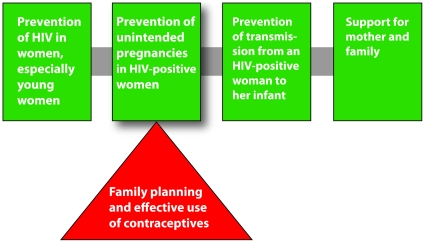
Background: Voluntary contraceptive use by HIV-positive women currently prevents more HIV-positive births, at a lower cost, than anti-retroviral drug (ARV) regimens. Despite this evidence, most prevention of mother-to-child transmission (PMTCT) programs focus solely on providing ARV prophylaxis to pregnant women and rarely include the prevention of unintended pregnancies among HIV-positive women.
Methodology/principal findings: To strengthen support for family planning as HIV prevention, we systematically identified key individuals in the field of international HIV/AIDS-those who could potentially influence the issue-and sought to determine their perceptions of barriers to and facilitators for implementing this PMTCT strategy. We used a criteria-based approach to determine which HIV/AIDS stakeholders have the most significant impact on HIV/AIDS research, programs, funding and policy and stratified purposive sampling to conduct interviews with a subset of these individuals. The interview findings pointed to obstacles to strengthening linkages between family planning and HIV/AIDS, including the need for: resources to integrate family planning and HIV services, infrastructure or capacity to provide integrated services at the facility level, national leadership and coordination, and targeted advocacy to key decision-makers.
Conclusions/significance: The individuals we identified as having regional or international influence in the field of HIV/AIDS have the ability to leverage an increasingly conducive funding environment and a growing evidence base to address the policy, programmatic and operational challenges to integrating family planning with HIV/AIDS. Fostering greater support for implementing contraception for HIV prevention will require the dedication, collaboration and coordination of many such actors. Our findings can inform a targeted advocacy campaign.
Conflict of interest statement
Figures
References
-
- World Health Organization. Strategic Approaches to the Prevention of HIV Infection in Infants: Report of a WHO Meeting. 2002. Presentation at Morges, Switzerland, March 20–22, 2002.
-
- Halperin D, Stover J, Reynolds H. Benefits and costs of expanding access to family planning programs to women living with HIV. AIDS. 2009;23(Suppl 1):S123–S130. - PubMed
-
- Spaulding AB, Brickley DB, Kennedy C, Almers L, Packel L, et al. Linking family planning with HIV/AIDS interventions: a systematic review of the evidence. AIDS. 2009;23(Suppl 1):S79–S88. - PubMed
-
- Sweat MD, O'Reilly KR, Schmid GP, Denison J, de Zoysa I. Cost-effectiveness of nevirapine to prevent mother-to-child HIV transmission in eight African countries. AIDS. 2004;18:1661–1671. - PubMed
Publication types
MeSH terms
LinkOut - more resources
Full Text Sources
Medical
