


The nature of working memory for Braille
- PMID: 20520807
- PMCID: PMC2877075
- DOI: 10.1371/journal.pone.0010833
The nature of working memory for Braille
Abstract
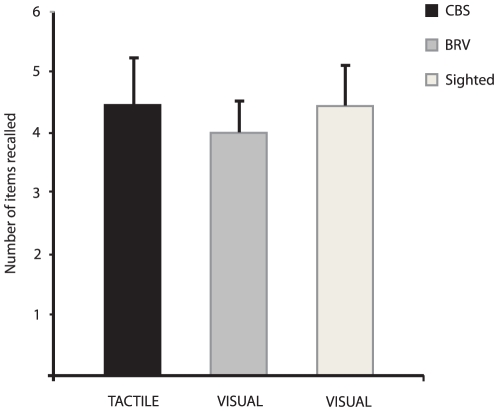
Blind individuals have been shown on multiple occasions to compensate for their loss of sight by developing exceptional abilities in their remaining senses. While most research has been focused on perceptual abilities per se in the auditory and tactile modalities, recent work has also investigated higher-order processes involving memory and language functions. Here we examined tactile working memory for Braille in two groups of visually challenged individuals (completely blind subjects, CBS; blind with residual vision, BRV). In a first experimental procedure both groups were given a Braille tactile memory span task with and without articulatory suppression, while the BRV and a sighted group performed a visual version of the task. It was shown that the Braille tactile working memory (BrWM) of CBS individuals under articulatory suppression is as efficient as that of sighted individuals' visual working memory in the same condition. Moreover, the results suggest that BrWM may be more robust in the CBS than in the BRV subjects, thus pointing to the potential role of visual experience in shaping tactile working memory. A second experiment designed to assess the nature (spatial vs. verbal) of this working memory was then carried out with two new CBS and BRV groups having to perform the Braille task concurrently with a mental arithmetic task or a mental displacement of blocks task. We show that the disruption of memory was greatest when concurrently carrying out the mental displacement of blocks, indicating that the Braille tactile subsystem of working memory is likely spatial in nature in CBS. The results also point to the multimodal nature of working memory and show how experience can shape the development of its subcomponents.
Conflict of interest statement
Figures


References
-
- Rice CE. Early blindness early experience and perceptual enhancement. Res Bull Amer Foundation for the Blind. 1970;22:1–22.
-
- Axelrod S. New York: American Foundation for the Blind; 1959. Effects of early blindness: Performance of blind and sighted children on tactile and auditory tasks (Research Series No. 7).
-
- Jones B. Spatial perception in the blind. Brit J Psychol. 1975;66:461–472. - PubMed
-
- Lewald J. Vertical sound localization in blind humans. Neuropsychologia. 2002;40:1868–1872. - PubMed
Publication types
MeSH terms
LinkOut - more resources
Full Text Sources
