


Investigating the associations among overtime work, health behaviors, and health: a longitudinal study among full-time employees
- PMID: 20521139
- PMCID: PMC3212692
- DOI: 10.1007/s12529-010-9103-z
Investigating the associations among overtime work, health behaviors, and health: a longitudinal study among full-time employees
Abstract
Background: It has often been suggested that high levels of overtime lead to adverse health outcomes. One mechanism that may account for this association is that working overtime leads to elevated levels of stress, which could affect worker's behavioral decisions or habits (such as smoking and lack of physical activity). In turn, this could lead to adverse health.
Purpose: The present study examined this reasoning in a prospective longitudinal design. Data from the prospective 2-year Study on Health at Work (N = 649) were used to test our hypotheses.
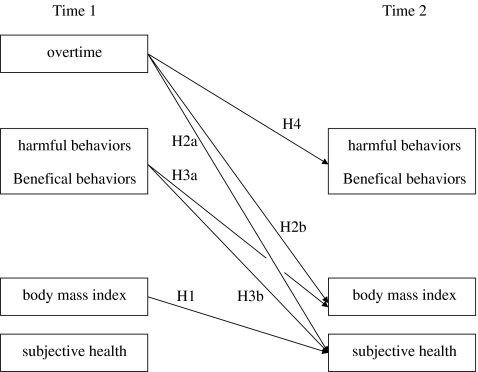
Methods: Structural equation analysis was used to examine the relationships among overtime, beneficial (exercising, intake of fruit and vegetables) and risky (smoking and drinking) health behaviors, and health indicators (BMI and subjective health).
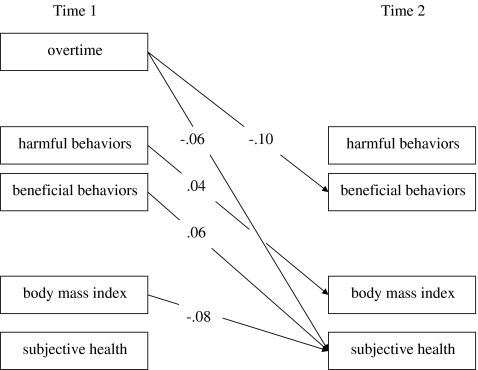
Results: Working overtime was longitudinally related with adverse subjective health, but not with body mass. Moreover, working overtime was associated with lower levels of physical activity and intake of fruit and vegetables, but not with smoking and drinking. Finally, higher levels of risky and lower levels of beneficial health behaviors were longitudinally associated with ill health.
Conclusions: The relation between overtime and ill health is partly accounted for by the unhealthy lifestyle in which overworkers tend to engage. However, a direct longitudinal effect of overtime on health suggested that the effects of overtime on health may also partly be due to the sustained physiological activation that results from working overtime. Whereas working a moderate amount of overtime does not usually entail major health risks, these will increase with increasing overtime.
Figures
References
-
- Jacobs JA, Gerson K. The time divide: work, family, and gender inequality. Cambridge (MA): Harvard University Press; 2004.
-
- Parent-Thirion A, Macias EF, Hurley J, Vermeylen G. Fourth European working conditions survey. Dublin: European Foundation for the Improvement of Working and Living Conditions; 2007.
-
- Stier H, Lewin-Epstein N. Time to work: a comparative analysis of preferences for working hours. Work Occup. 2003;30:302–326. doi: 10.1177/0730888403253897. - DOI
-
- Caruso CC, Hitchcock EM, Dick RB, et al. Overtime and extended work shifts: recent findings on illnesses, injuries, and health behaviors. Cincinnati (OH): National Institute of Health and Human Services (NIOSH); 2004.
MeSH terms
LinkOut - more resources
Full Text Sources
