. 2010 Aug;19(8):1500-12.
doi: 10.1002/pro.429.

Effect of ligand binding on human D-amino acid oxidase: implications for the development of new drugs for schizophrenia treatment

Affiliations

Effect of ligand binding on human D-amino acid oxidase: implications for the development of new drugs for schizophrenia treatment

Laura Caldinelli et al. Protein Sci. 2010 Aug.

Abstract

In human brain the flavoprotein D-amino acid oxidase (hDAAO) is responsible for the degradation of the neuromodulator D-serine, an important effector of NMDA-receptor mediated neurotransmission. Experimental evidence supports the concept that D-serine concentration increase by hDAAO inhibition may represent a valuable therapeutic approach to improve the symptoms in schizophrenia patients. This study investigated the effects on hDAAO conformation and stability of the substrate D-serine (or of the pseudo-substrate trifluoro-D-alanine), the FAD cofactor, and two inhibitors (benzoate, a classical substrate-competitive inhibitor and the drug chlorpromazine (CPZ), which competes with the cofactor). We demonstrated that all these compounds do not alter the interaction of hDAAO with its physiological partner pLG72. The ligands used affect the tertiary structure of hDAAO differently: benzoate or trifluoro-D-alanine binding increases the amount of the holoenzyme form in solution and stabilizes the flavoprotein, while CPZ binding favors a protein conformation resembling that of the apoprotein, which is more sensitive to degradation. Interestingly, the apoprotein form of hDAAO binds the substrate D-serine: this interaction increases FAD binding thus increasing the amount of active holoenzyme in solution. Benzoate and CPZ similarly modify the short-term cellular D-serine concentration but affect the cellular concentration of hDAAO differently. In conclusion, the different alteration of hDAAO conformation and stability by the ligands used represents a further parameter to take into consideration during the development of new drugs to cope schizophrenia.


Figures
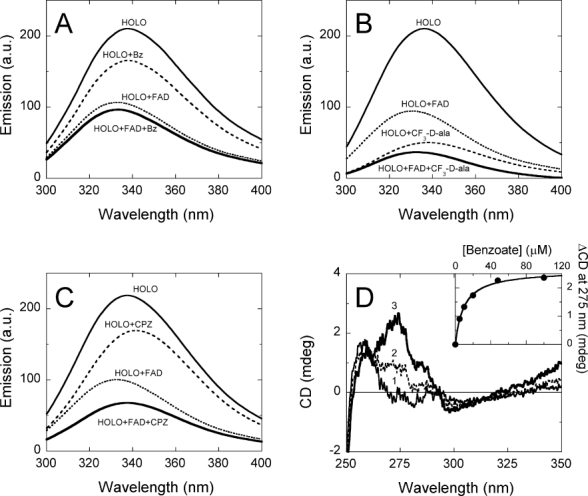
Figure 1
Figure 1
Effect of adding benzoate, CF3-d-Ala or CPZ on the spectral properties of hDAAO holoenzyme. (A) Comparison of protein fluorescence (excitation at 280 nm) of 2.5 μM (= 0.1 mg protein/mL) hDAAO before (formula image, in the absence and formula image, in the presence of 40 μM FAD) and after adding 0.1 mM benzoate (formula image, in the absence and formula image, in the presence of 40 μM FAD). (B) Comparison of protein fluorescence of hDAAO before and after adding 30 mM CF3-d-Ala (conditions as in panel A). (C) Comparison of protein fluorescence of hDAAO before and after adding 0.1 mM CPZ (conditions as in panel A). (D) Effect of benzoate addition on the near-UV CD spectrum of hDAAO (10 μM = 0.4 mg protein/mL): (1, —) no benzoate; (2, formula image) 4.8 μM benzoate; (3, formula image) 48 μM benzoate. Inset: change in CD signal at ≈275 nm at increasing benzoate concentrations.
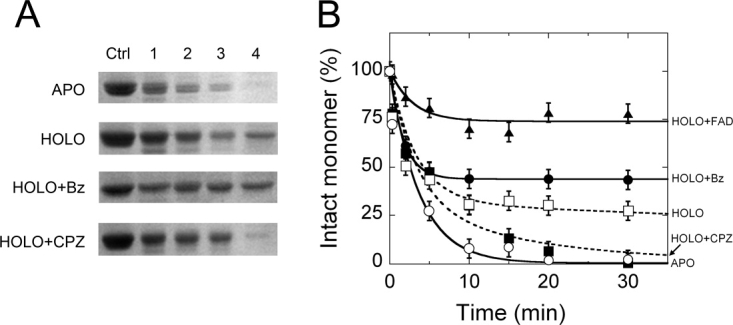
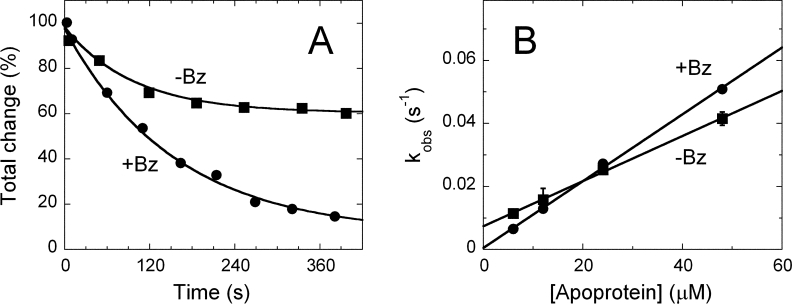
Figure 2
Figure 2
Time course of trypsin digestion of different hDAAO forms (10 μM = 0.4 mg protein/mL) with 10% (w/w) trypsin at 25°C in 20 mM Tris-HCl pH 8.5, 150 mM NaCl, 5% glycerol, 0.06% NLS, and 5 mM 2-mercaptoethanol. Panel A) SDS-PAGE Analysis of samples at different times: (lane Ctrl) control before adding trypsin; (lane 1) immediately after adding trypsin (30 s); (lanes 2–4) 2, 5, and 30 min after adding trypsin. APO = Apoprotein; HOLO = holoenzyme; HOLO+Bz = holoenzyme to which 1 mM benzoate was added; HOLO+CPZ = holoenzyme to which 0.1 mM CPZ was added. B) Time course of the intensity of the 40-kDa band (corresponding to the intact hDAAO monomer) as determined by densitometric analysis of gels such as those reported in panel A. HOLO+FAD is the sample obtained following the addition of 100 μM free FAD to the hDAAO holoenzyme. The intensity of the 40-kDa band of the sample before adding trypsin (sample in lane Ctrl, panel A) is indicated as 100%. Bars indicate S.E. as determined for at least three independent experiments.
Figure 3
Figure 3
Effect of benzoate on the kinetics of hDAAO apoprotein reconstitution with FAD. (A) Overlay of time course of flavin fluorescence quenching in the absence (▪) and in the presence (•) of 1 mM sodium benzoate after mixing a 10-fold excess of apoprotein (0.6 μM FAD to which 6 μM apoprotein solution was added) at pH 8.3 and 15°C. The fits through the data points are obtained according to a single exponential decay equation. (B) Effect of apoprotein concentration on the observed first-order rate constants (kobs) of the reaction of FAD with hDAAO apoprotein. The values of kobs were determined from experiments such as those reported in panel A.
Figure 4
Figure 4
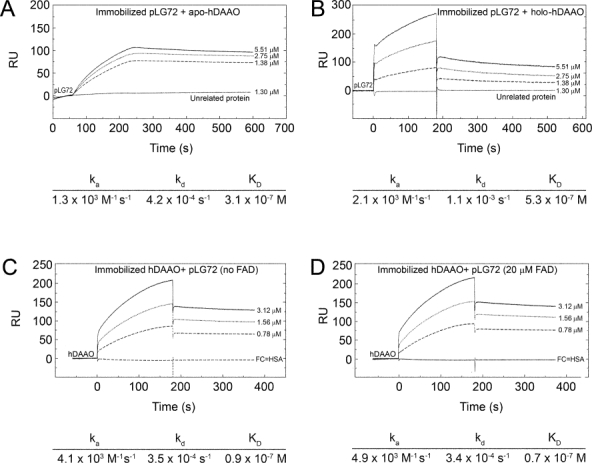
Sensorgrams (Biacore analysis) of the interaction between pLG72 and hDAAO. Panels (A,B) Kinetic evaluation of hDAAO apoprotein and holoenzyme binding to immobilized pLG72. Apo- (panel A) and holoprotein of hDAAO (panel B) diluted in HBS EP+ buffer at concentration of 1.38, 2.75, and 5.51 μM was injected at a flow rate of 20 μL/min over pLG72 previously immobilized on a CM5 sensor chip. The “on” and “off” rates were calculated with Biacore T100 BIAevaluation software. An unrelated protein at a concentration of 1.3 μM was injected under the same conditions. Panels (C,D) Kinetic evaluation of pLG72 binding to immobilized hDAAO. pLG72 diluted in HBS EP+ buffer at concentrations of 0.78, 1.56, and 3.12 μM was injected at a flow rate of 20 μL/min over hDAAO previously immobilized on a CM5 sensor chip (panel C). To investigate FAD effect on interaction, the same experiment was performed by diluting pLG72 in the presence of different concentrations of FAD (20 μM in panel D). As negative control a flow cell with previously immobilized human serum albumin was used. The rate constants for binding (ka) and dissociation (kd) as well as the Kd (= kd/ka) values for each single experimental are reported below each single panel.
Figure 5
Figure 5
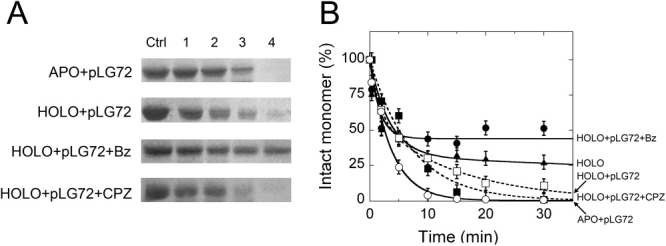
Time course of trypsin digestion of the hDAAO-pLG72 complex (10 μM = 0.4 mg protein/mL of hDAAO and 10 μM = 0.18 mg protein/mL of pLG72) with 10% (w/w) trypsin at 25°C in 20 mM Tris-HCl pH 8.5, 150 mM NaCl, 5% glycerol, 0.06% NLS, and 5 mM 2-mercaptoethanol. Panel (A) SDS-PAGE Analysis of samples at different times (see legend to Fig. 2 for details). APO+pLG72 = apoprotein + pLG72; HOLO+pLG72 = holoenzyme + pLG72; HOLO+pLG72+Bz = holoenzyme + pLG72 to which 1 mM benzoate was added; HOLO+pLG72+CPZ = holoenzyme + pLG72 to which 0.1 mM CPZ was added. (B) Time course of the intensity of the 40-kDa band (corresponding to the intact hDAAO monomer) as determined by densitometric analysis of gels such as those reported in panel (A). The intensity of the 40-kDa band of the sample before adding trypsin (sample in lane Ctrl, panel A) is indicated as 100%. Bars indicate S.E. as determined for at least three independent experiments.
Figure 6
Figure 6
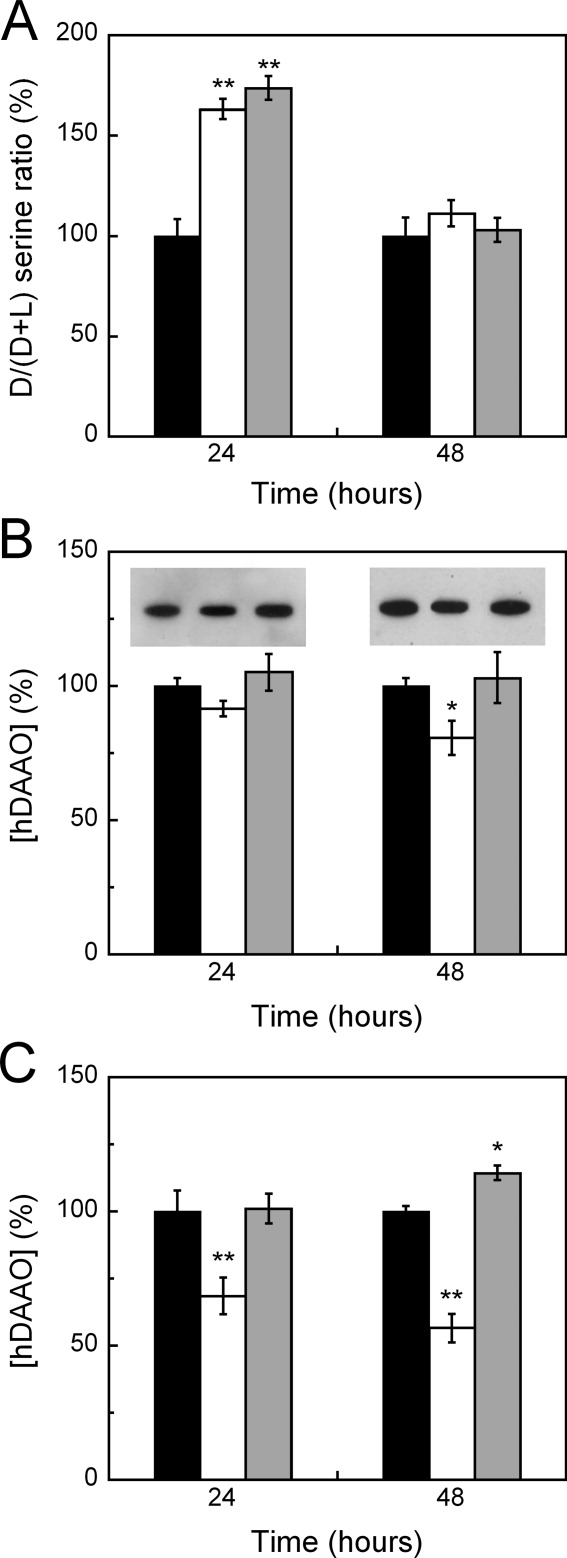
Dependence of d-serine and EGFP-hDAAO concentrations on treatment with benzoate or CPZ in U87 glioblastoma cells stably transfected with pEGFP-hDAAO-C3 expression vector. (A) Histogram reporting the time course of the D/(D+L) serine concentration ratio in U87 cells transfected with EGFP-hDAAO and treated without (control, black bars) or with 10 μM CPZ (white bars) or with 10–100 μM benzoate (gray bars). The values are expressed as a percentage, taking as 100% the ratio determined for the control at each time point (0 hours: 2.40 ± 0.34; 24 hours: 1.89 ± 0.16; 48 hours: 1.93 ± 0.18). The change in D/(D+L) serine ratio was demonstrated to be significant for CPZ and benzoate treatments at 24 hours (P < 0.001, see double asterisk) and not significant at 48 hours. (B) Histogram reporting the time course of the hDAAO concentration in the same cell samples as in panel A, as determined by means of Western blot analysis (the bands detected using anti-GFP antibodies are shown at the top) and activity assay using the Amplex UltraRed system (see “Materials and Methods” section). The values are expressed as a percentage, taking as 100% the amount of EGFP-hDAAO determined for the control at each time point (24 hours: 0.059 μg hDAAO/5 x 104 cells and 40 mU hDAAO/mg protein; 48 hours: 0.058 μg hDAAO/5 x 104 cells and 43 mU hDAAO/mg protein). The change in hDAAO concentration with respect to the control was demonstrated to be statistically significant for CPZ-treated samples at 48 hours (P = 0.017, see asterisk) and not statistically significant for all the remaining samples (P > 0.05). (C) Same analysis as reported in panel B performed on U87 glioblastoma cells stably expressing EGFP-hDAAO and transiently transfected with pLG72. The change in hDAAO concentration with respect to the control is statistically significant for CPZ-treated samples at 24 and 48 hours (P < 0.007, see double asterisk) and for the benzoate-treated sample at 48 hours (P = 0.017, see asterisk). The data are reported as means ± S.E.; for each point at least six independent determinations were performed.

References

    1. Pollegioni L, Piubelli L, Sacchi S, Pilone MS, Molla G. Physiological functions of D-amino acid oxidases: from yeast to humans. Cell Mol Life Sci. 2007;64:1373–1394. - PMC - PubMed
    1. Oliet SH, Mothet JP. Regulation of N-methyl-d-aspartate receptors by astrocytic D-serine. Neuroscience. 2009;158:275–283. - PubMed
    1. Pollegioni L, Sacchi S. Metabolism of the neuromodulator D-serine. Cell Mol Life Sci. (in press) - PMC - PubMed
    1. Harrison PJ, Weinberger DR. Schizophrenia genes, gene expression, and neuropathology: on the matter of their convergence. Mol Psychiatry. 2005;10:40–68. - PubMed
    1. Ross CA, Margolis RL, Reading SA, Pletnikov M, Coyle JT. Neurobiology of schizophrenia. Neuron. 2006;52:139–153. - PubMed

Publication types