


Review
doi: 10.1074/jbc.R110.144618.
Epub 2010 Jun 3.
Programming of erythromycin biosynthesis by a modular polyketide synthase
Affiliations
- PMID: 20522551
- PMCID: PMC2934617
- DOI: 10.1074/jbc.R110.144618
Item in Clipboard
Review
Programming of erythromycin biosynthesis by a modular polyketide synthase
J Biol Chem.
.
No abstract available
Figures

Modular organization of DEBS. In addition to the KS, AT, and ACP domains, individual extension modules carry varying combinations of KR, DH, and ER domains. The loading didomain primes DEBS module 1 with the propionyl starter unit, and the thioesterase (TE) domain at the C terminus of module 6 catalyzes release and cyclization of the full-length polyketide to give the parent macrolide aglycon, 6-dEB. Two dedicated P450 oxygenases, two glycosyltransferases, and a methyltransferase then generate the mature antibiotic, erythromycin A. (2S)-MeMal-CoA, (2S)-methylmalonyl-CoA.
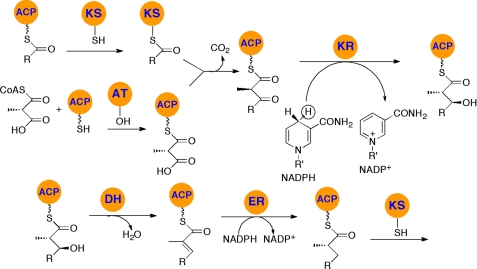
Biochemical function of individual PKS domains, illustrated by polyketide chain extension and functional group modification mediated by the domains of DEBS module 4. The AT domain loads the (2S)-methylmalonyl group onto the pantetheinyl side chain of the ACP domain, whereas the KS domain catalyzes self-acylation of its active-site Cys residue by the tetraketide chain donated by the upstream ACP domain. The KS domain then catalyzes a decarboxylative condensation to generate a d -2-methyl-3-ketoacyl-ACP intermediate, which then undergoes successive KR-catalyzed reduction, DH-catalyzed dehydration, and ER-catalyzed reduction to the reduced pentaketide, which is then transferred to the KS domain of DEBS module 5. Configurational assignments are based on the known or predicted stereochemistry of individual PKS reactions.

Structures of DEBS catalytic domains. a, DEBS [KS5][AT5] didomain, including the homodimeric KS domain (light blue and dark blue), AT domains (green), N-terminal docking domain (orange-brown), KS-AT linkers (yellow), and post-AT linkers (red). b, DEBS KR1, with the structural domain (cyan), catalytic domain (blue), and Leu-Asp-Asp (LDD) loop. c, DEBS DH4, with the double hot dog fold and catalytic His-Asp dyad. d, DEBS apo-ACP2. e, predicted organization and topology of DEBS module 4, analogous to the structure of porcine FAS. Each ACP domain (not shown) must be able to interact with the individual KS, AT, KR, DH, and ER domains. ppant, phosphopantetheine; act, active.

Stereochemistry of DEBS KR-catalyzed reduction and methyl group epimerization using mixtures of individual recombinant domains and didomains and gas chromatography-mass spectrometry analysis of the derived triketide lactones (a) and diketide acids (b).
References
-
- Hopwood D. A. (ed) (2009) Methods in Enzymology: Complex Enzymes in Microbial Natural Product Biosynthesis, part B: Polyketides, Aminocoumarins, and Carbohydrates, Vol. 459, Academic Press, New York - PubMed
-
- Khosla C., Tang Y., Chen A. Y., Schnarr N. A., Cane D. E. (2007) Annu. Rev. Biochem. 76, 195–221 - PubMed
-
- Khosla C. (2009) J. Org. Chem. 74, 6416–6420 - PubMed
-
- Meier J. L., Burkart M. D. (2009) Chem. Soc. Rev. 38, 2012–2045 - PubMed
Publication types
MeSH terms
Substances
Grants and funding
LinkOut - more resources
Full Text Sources
