Higher plasma soluble Receptor for Advanced Glycation End Products (sRAGE) levels are associated with incident cardiovascular disease and all-cause mortality in type 1 diabetes: a 12-year follow-up study
- PMID: 20522598
- PMCID: PMC2911054
- DOI: 10.2337/db09-1509
Higher plasma soluble Receptor for Advanced Glycation End Products (sRAGE) levels are associated with incident cardiovascular disease and all-cause mortality in type 1 diabetes: a 12-year follow-up study
Abstract
Objective: To investigate the associations of plasma levels of soluble receptor for advanced glycation end products (sRAGE) with incident cardiovascular disease (CVD) and all-cause mortality in type 1 diabetes and the extent to which any such associations could be explained by endothelial and renal dysfunction, low-grade inflammation, arterial stiffness, and advanced glycation end products (AGEs).
Research design and methods: We prospectively followed 169 individuals with diabetic nephropathy and 170 individuals with persistent normoalbuminuria who were free of CVD at study entry and in whom levels of sRAGE and other biomarkers were measured at baseline. The median follow-up duration was 12.3 years (7.6-12.5).
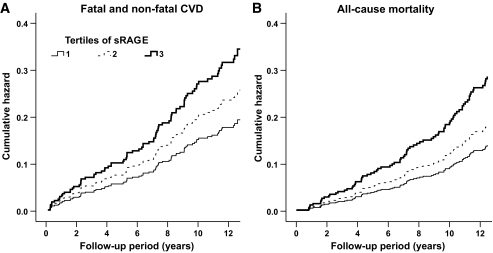
Results: The incidence of fatal and nonfatal CVD and all-cause mortality increased with higher baseline levels of log-transformed sRAGE (Ln-sRAGE) independently of other CVD risk factors: hazard ratio (HR) 1.90 (95% CI 1.13-3.21) and 2.12 (1.26-3.57) per 1-unit increase in Ln-sRAGE, respectively. Adjustments for estimated glomerular filtration rate (eGFR(MDRD)), but not or to a smaller extent for markers of endothelial dysfunction, low-grade inflammation, arterial stiffness, and AGEs, attenuated these associations to HR 1.59 (95% CI 0.91-2.77) for fatal and nonfatal CVD events and to 1.90 (1.09-3.31) for all-cause mortality. In addition, in patients with nephropathy, the rate of decline of GFR was 1.38 ml/min/1.73 m(2) per year greater per 1-unit increase of Ln-sRAGE at baseline (P = 0.036).
Conclusions: Higher levels of sRAGE are associated with incident fatal and nonfatal CVD and all-cause mortality in individuals with type 1 diabetes. sRAGE-associated renal dysfunction may partially explain this association.
Figures
References
-
- Kalea AZ, Schmidt AM, Hudson BI: RAGE: a novel biological and genetic marker for vascular disease. Clin Sci (Lond) 2009;116:621–637 - PubMed
-
- Cipollone F, Iezzi A, Fazia M, Zucchelli M, Pini B, Cuccurullo C, De Cesare D, De Blasis G, Muraro R, Bei R, Chiarelli F, Schmidt AM, Cuccurullo F, Mezzetti A: The receptor RAGE as a progression factor amplifying arachidonate-dependent inflammatory and proteolytic response in human atherosclerotic plaques: role of glycemic control. Circulation 2003;108:1070–1077 - PubMed
-
- Kislinger T, Fu C, Huber B, Qu W, Taguchi A, Du Yan S, Hofmann M, Yan SF, Pischetsrieder M, Stern D, Schmidt AM: N(epsilon)-(carboxymethyl) lysine adducts of proteins are ligands for receptor for advanced glycation end products that activate cell signaling pathways and modulate gene expression. J Biol Chem 1999;274:31740–31749 - PubMed
-
- Harja E, Bu DX, Hudson BI, Chang JS, Shen X, Hallam K, Kalea AZ, Lu Y, Rosario RH, Oruganti S, Nikolla Z, Belov D, Lalla E, Ramasamy R, Yan SF, Schmidt AM: Vascular and inflammatory stresses mediate atherosclerosis via RAGE and its ligands in apoE-/- mice. J Clin Invest 2008;118:183–194 - PMC - PubMed
-
- Basta G, Lazzerini G, Massaro M, Simoncini T, Tanganelli P, Fu C, Kislinger T, Stern DM, Schmidt AM, De Caterina R: Advanced glycation end products activate endothelium through signal-transduction receptor RAGE: a mechanism for amplification of inflammatory responses. Circulation 2002;105:816–822 - PubMed
Publication types
MeSH terms
Substances
LinkOut - more resources
Full Text Sources
Other Literature Sources
Medical
Research Materials
Miscellaneous