


Polyamine transport is mediated by both endocytic and solute carrier transport mechanisms in the gastrointestinal tract
- PMID: 20522643
- PMCID: PMC2928537
- DOI: 10.1152/ajpgi.00169.2010
Polyamine transport is mediated by both endocytic and solute carrier transport mechanisms in the gastrointestinal tract
Abstract
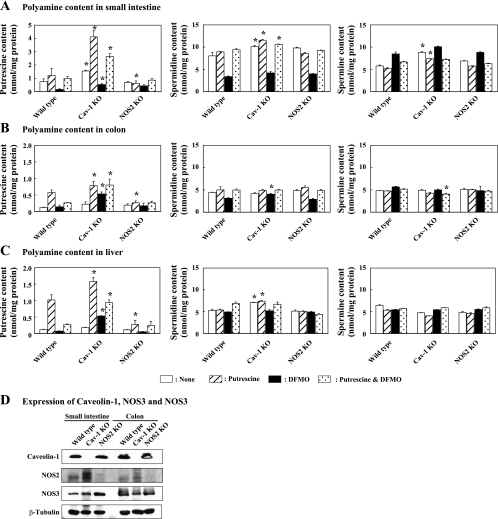
The polyamines spermidine and spermine, and their precursor putrescine, are required for cell growth and cellular functions. The high levels of tissue polyamines are implicated in carcinogenesis. The major sources of exogenous polyamines are diet and intestinal luminal bacteria in gastrointestinal (GI) tissues. Both endocytic and solute carrier-dependent mechanisms have been described for polyamine uptake. Knocking down of caveolin-1 protein increased polyamine uptake in colon cancer-derived HCT116 cells. Dietary supplied putrescine was accumulated in GI tissues and liver in caveolin-1 knockout mice more than wild-type mice. Knocking out of nitric oxide synthase (NOS2), which has been implicated in the release of exogenous polyamines from internalized vesicles, abolished the accumulation of dietary putrescine in GI tissues. Under conditions of reduced endogenous tissue putrescine contents, caused by treatment with the polyamine synthesis inhibitor difluoromethylornithine (DFMO), small intestinal and colonic mucosal polyamine contents increased with dietary putrescine levels, even in mice lacking NOS2. Knocking down the solute carrier transporter SLC3A2 in HCT116-derived Hkh2 cells reduced the accumulation of exogenous putrescine and total polyamine contents in DFMO treated cells, relative to non-DFMO-treated cells. These data demonstrate that exogenous putrescine is transported into GI tissues by caveolin-1- and NOS2-dependent mechanisms, but that the solute carrier transporter SLC3A2 can function bidirectionally to import putrescine under conditions of low tissue polyamines.
Figures



References
-
- Belting M, Mani K, Jonsson M, Cheng F, Sandgren S, Jonsson S, Ding K, Delcros JG, Fransson LA. Glypican-1 is a vehicle for polyamine uptake in mammalian cells: a pivotal role for nitrosothiol-derived nitric oxide. J Biol Chem 278: 47181–47189, 2003 - PubMed
-
- Casero RAJ, Frydman B, Stewart TM, Woster PM. Significance of targeting polyamine metabolism as an antineoplastic strategy: unique targets for polyamine analogues. Proc West Pharmacol Soc 48: 24–30, 2005 - PubMed
-
- Cavallo-Medved D, Mai J, Dosescu J, Sameni M, Sloane BF. Caveolin-1 mediates the expression and localization of cathepsin B, pro-urokinase plasminogen activator and their cell-surface receptors in human colorectal carcinoma cells. J Cell Sci 118: 1493–1503, 2005. - PubMed
-
- Cohen SS. A Guide to the Polyamines. Oxford, UK: Oxford University Press, 1998
-
- Garvey EP, Oplinger JA, Furfine ES, Kiff RJ, Laszlo F, Whittle BJ, Knowles RG. 1400W is a slow, tight binding, and highly selective inhibitor of inducible nitric-oxide synthase in vitro and in vivo. J Biol Chem 272: 4959–4963, 1997 - PubMed
Publication types
MeSH terms
Substances
Grants and funding
LinkOut - more resources
Full Text Sources
Other Literature Sources
Molecular Biology Databases
