


Alcohol may not cause partner violence but it seems to make it worse: a cross national comparison of the relationship between alcohol and severity of partner violence
- PMID: 20522883
- PMCID: PMC3142677
- DOI: 10.1177/0886260510370596
Alcohol may not cause partner violence but it seems to make it worse: a cross national comparison of the relationship between alcohol and severity of partner violence
Abstract
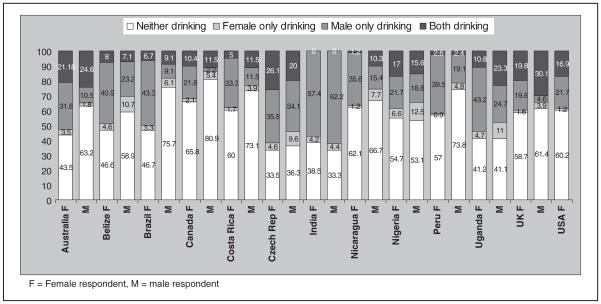
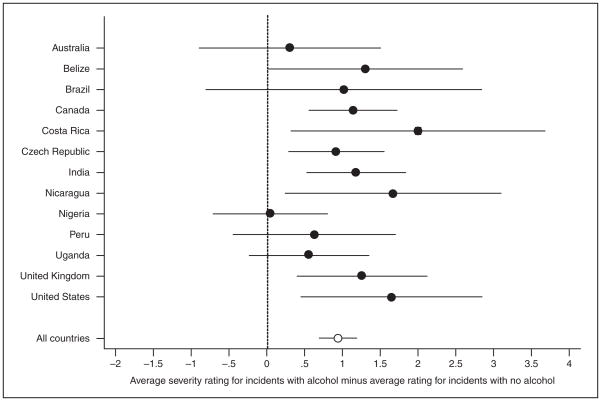
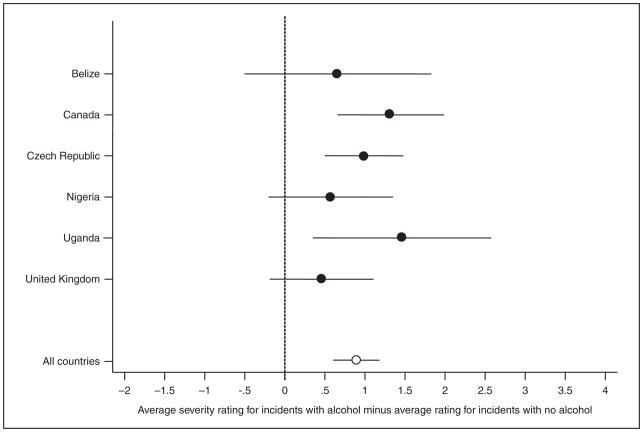
This study assesses whether severity of physical partner aggression is associated with alcohol consumption at the time of the incident, and whether the relationship between drinking and aggression severity is the same for men and women and across different countries. National or large regional general population surveys were conducted in 13 countries as part of the GENACIS collaboration. Respondents described the most physically aggressive act done to them by a partner in the past 2 years, rated the severity of aggression on a scale of 1 to 10, and reported whether either partner had been drinking when the incident occurred. Severity ratings were significantly higher for incidents in which one or both partners had been drinking compared to incidents in which neither partner had been drinking. The relationship did not differ significantly for men and women or by country. We conclude that alcohol consumption may serve to potentiate violence when it occurs, and this pattern holds across a diverse set of cultures. Further research is needed that focuses explicitly on the nature of alcohol's contribution to intimate partner aggression. Prevention needs to address the possibility of enhanced dangers of intimate partner violence when the partners have been drinking and eliminate any systemic factors that permit alcohol to be used as an excuse. Clinical services for perpetrators and victims of partner violence need to address the role of drinking practices, including the dynamics and process of aggressive incidents that occur when one or both partners have been drinking.
Conflict of interest statement
The authors declared no potential conflicts of interest with respect to the authorship and/or publication of this article.
Figures
References
-
- Archer J. Sex differences in aggression in real-world settings: A meta-analytic review. Review of General Psychology. 2004;8(4):1–32.
-
- Archer J. Cross-cultural differences in physical aggression between partners: A social-role analysis. Personality and Social Psychology Review. 2006;10:133–153. - PubMed
-
- Brecklin LR. The role of perpetrator alcohol use in the injury outcomes of intimate assaults. Journal of Family Violence. 2002;17:185–197.
-
- Bushman BJ. Effects of alcohol on human aggression: Validity of proposed explanations. In: Galanter M, editor. Recent developments in alcoholism: Vol. 13: Alcohol and violence. New York: Plenum Press; 1997. pp. 227–243. - PubMed
-
- Desjardins N, Hotton T. Trends in drug offences and the role of alcohol and drugs in crime (No. 85-002-XPE) Ottawa, Ontario, Canada: Juristat Canadian Centre for Justice Statistics, Statistics Canada; 2004.
Publication types
MeSH terms
Grants and funding
LinkOut - more resources
Full Text Sources
Medical
Miscellaneous
