. 2010 May 27;6(5):e1000922.
doi: 10.1371/journal.ppat.1000922.

The early stage of bacterial genome-reductive evolution in the host

Affiliations

The early stage of bacterial genome-reductive evolution in the host

Han Song et al. PLoS Pathog. .

Abstract

The equine-associated obligate pathogen Burkholderia mallei was developed by reductive evolution involving a substantial portion of the genome from Burkholderia pseudomallei, a free-living opportunistic pathogen. With its short history of divergence (approximately 3.5 myr), B. mallei provides an excellent resource to study the early steps in bacterial genome reductive evolution in the host. By examining 20 genomes of B. mallei and B. pseudomallei, we found that stepwise massive expansion of IS (insertion sequence) elements ISBma1, ISBma2, and IS407A occurred during the evolution of B. mallei. Each element proliferated through the sites where its target selection preference was met. Then, ISBma1 and ISBma2 contributed to the further spread of IS407A by providing secondary insertion sites. This spread increased genomic deletions and rearrangements, which were predominantly mediated by IS407A. There were also nucleotide-level disruptions in a large number of genes. However, no significant signs of erosion were yet noted in these genes. Intriguingly, all these genomic modifications did not seriously alter the gene expression patterns inherited from B. pseudomallei. This efficient and elaborate genomic transition was enabled largely through the formation of the highly flexible IS-blended genome and the guidance by selective forces in the host. The detailed IS intervention, unveiled for the first time in this study, may represent the key component of a general mechanism for early bacterial evolution in the host.


Conflict of interest statement

The authors have declared that no competing interests exist.

Figures

Figure 1
Figure 1. Expansion of a set of IS elements in the B. mallei genome.
A. Average copy number of IS elements commonly present in B. mallei and B. pseudomallei. Three species of IS elements showed significant proliferation in B. mallei compared with their levels in B. pseudomallei. The number of representative IS elements, both as intact and degenerate (i.e., partly deleted) forms, are shown in graph. B. Distribution of the three types of IS element in the strains of B. mallei. The IS elements ISBma1, ISBma2, and IS407A can be divided into three groups depending on their distribution patterns in the B. mallei strains: 1) “Core” IS elements that are present in all the strains; 2) those IS elements present in more than two strains but not in all; and 3) those elements in only one strain. Groups 2 and 3 are collectively called “accessory IS elements” (for a scaled map with the IS insertion sites in all B. mallei and B. pseudomallei strains, see Fig. S1; for the patterns of genomic rearrangements in the strains of each species, see Fig. S2; for the actual comparative blast data, see Tables S1 and S2).
Figure 2
Figure 2. IS-blended B. mallei genomes.
Locations of ISBma1, ISBma2, and IS407A and large deletions in each B. mallei strain were mapped back to the reference genome of B. pseudomallei K96243 to show their relative positions. For simplicity, these features are not displayed to scale, but are shown in boxes of equal sizes (for a scaled view of the same data, see Fig. S1). The IS elements were numbered in the order in which they appear in the reference chromosomes. The 2nd element in chromosome 1 is denoted by an *, and is the IS407A insertion that disrupted fliP, which encodes a key factor for flagella formation. The numbers in red indicate the IS elements that were disrupted by a neighboring IS407A element. Each BRU is denoted as an open box and by sequential numbers, which are preceded by A or B for chromosome 1 or chromosome 2, respectively. For additional information, see Figure S1 and Tables S1 and S2, in which the IS elements are listed with their names, composed of the sequential numbers, the IS species to which they belong (i.e. ISBma1, ISBma2, and IS407A), and their distribution patterns among the B. mallei strains (i.e., _A: present in all the strains; _B: present in only some strains; and _C: present in a single strain).
Figure 3
Figure 3. Patterns of IS-mediation in genomic deletions and rearrangements.
A. Association of IS407A and ISBma2 with genomic deletions and rearrangements. Core elements played a major role in such genomic modifications compared with the accessory elements. The latter elements had a more active role in chromosome 2 than in chromosome 1. B. A phylogenetic relationship of the B. mallei and B. pseudomallei strains based on the presence of the IS insertions and their association with the genomic deletions and rearrangements. Two strains of B. pseudomallei from Australia, 1655 and 668, are labeled in orange. The B. mallei strains of European origins, NCTC 10247, NCTC 10229, and 2002721280, are labeled in green, while ATCC 23344 and its direct derivatives are shown in red.
Figure 4
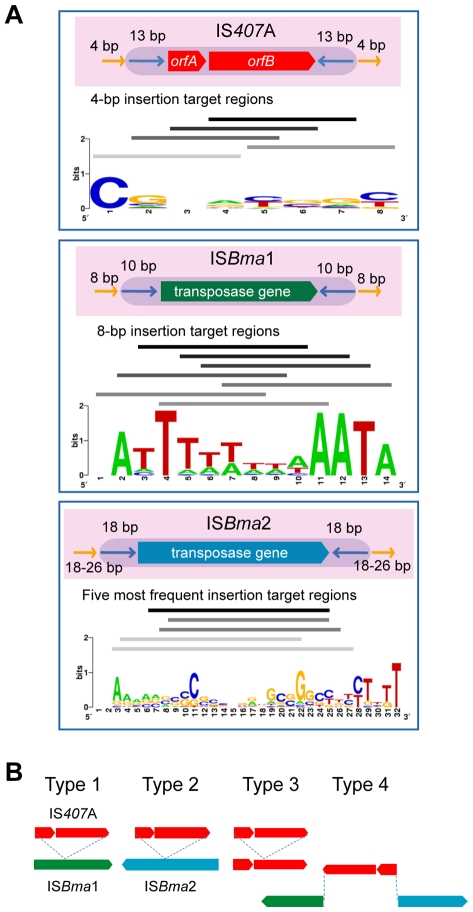
Figure 4. The main IS elements and their insertion target sequences.
A. The structures of ISBma1, ISBma2, and IS407A and their duplicated target sequences in the B. mallei genomes. IS407A has a pair of two transposase genes, orfA and orfB, while ISBma1 and ISBma2 each contain a single transposase gene. These genes in each type of IS element are flanked by inverted repeats, which are denoted by blue arrows, and then by duplicated insertion target sequences, denoted by yellow arrows. Sequence logo displays of the duplicated insertion target sequences are shown below the corresponding IS element. Solid lines above the Sequence logo display represent the specific regions to which actual target sequences matched, with the most abundant groups at the top. B. Patterns of a disruption of one type of core IS elements by another in B. mallei. Colored solid arrows represent transposases in each IS element. Four types of pattern were found (see Table S1 for details).
Figure 5
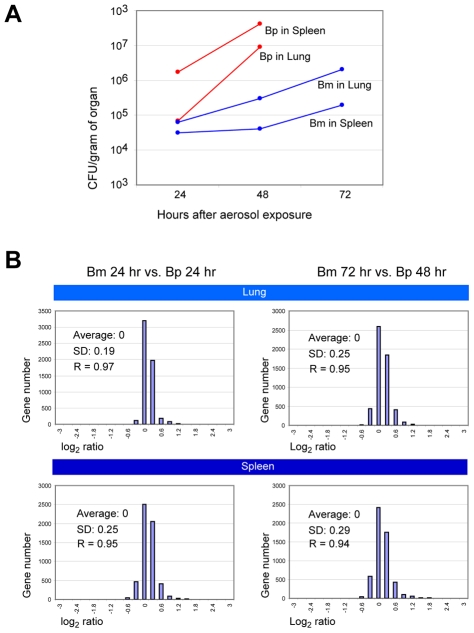
Figure 5. Comparison of in vivo gene expression patterns between B. mallei and B. pseudomallei.
A. Bacterial loads within the lung and the spleen of B. mallei and B. pseudomallei aerosol-challenged mice. Bacterial loads are reported as the average cfu/g of tissue from two animals challenged with either B. mallei or B. pseudomallei. Due to animal mortality in the B. pseudomallei experimental group, only organ loads from 24 hr and 48 hr are reported. B. Histograms depicting the relative gene expression of B. mallei and B. pseudomallei in infected mouse organs. Comparison data from middle- and late stages of infection in two tissue types, spleen and lung, are displayed. Average ratios in the log2 scale, standard deviations of the ratios (SD), and the Pearson correlation coefficients (R's) between the B. mallei and B. pseudomallei samples are shown.
Figure 6
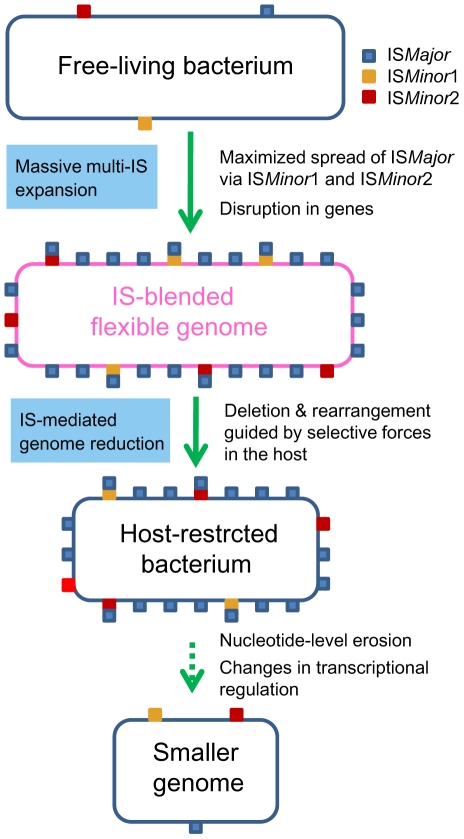
Figure 6. A proposed general model for the bacterial genome-reductive evolution in a specialized niche.
Massive expansion of (multiple types of) IS elements may set the stage for extensive genome-reductive evolution in bacteria. When multiple elements are involved, expansion of some elements (e.g. ISMinor1 and ISMinor2) may lead to further spread of a major element (e.g. ISMajor), by providing additional insertion sites in the regions, where the major element itself may rarely target. Gene deactivations by intersecting IS insertions can take place and extensive genomic deletions and rearrangements can occur through recombination reactions among the homologous IS copies. These processes can result in highly efficient deletions of dispensable genomic regions via the intrinsic high flexibility of the compactly IS-blended genome, guided by selective forces in the host. Slow and steady nucleotide-level mutations can accumulate after the IS-mediated genomic changes, eventually also contributing to the genome reduction and divergence in transcriptional regulatory patterns over time.

References

    1. Moran NA. Tracing the evolution of gene loss in obligate bacterial symbionts. Current Opinion in Microbiology. 2003;6:512–518. - PubMed
    1. Moran NA, Mira A. The process of genome shrinkage in the obligate symbiont Buchnera aphidicola. Genome Biology. 2001;2:research0054.0051–0054.0012. - PMC - PubMed
    1. Moran NA, Plague GR. Genomic changes following host restriction in bacteria. Current Opinion in Genetics & Development. 2004;14:627–633. - PubMed
    1. Nilsson AI, Koskiniemi S, Eriksson S, Kugelberg E, Hinton JCD, et al. Bacterial genome size reduction by experimental evolution. Proc Natl Acad Sci U S A. 2005;102:12112–12116. - PMC - PubMed
    1. Sallstrom B, Andersson SGE. Genome reduction in the [alpha]-Proteobacteria. Current Opinion in Microbiology. 2005;8:579–585. - PubMed

Publication types

MeSH terms