


Long-term effect of carbodiimide on dentin matrix and resin-dentin bonds
- PMID: 20524201
- PMCID: PMC2882877
- DOI: 10.1002/jbm.b.31649
Long-term effect of carbodiimide on dentin matrix and resin-dentin bonds
Abstract
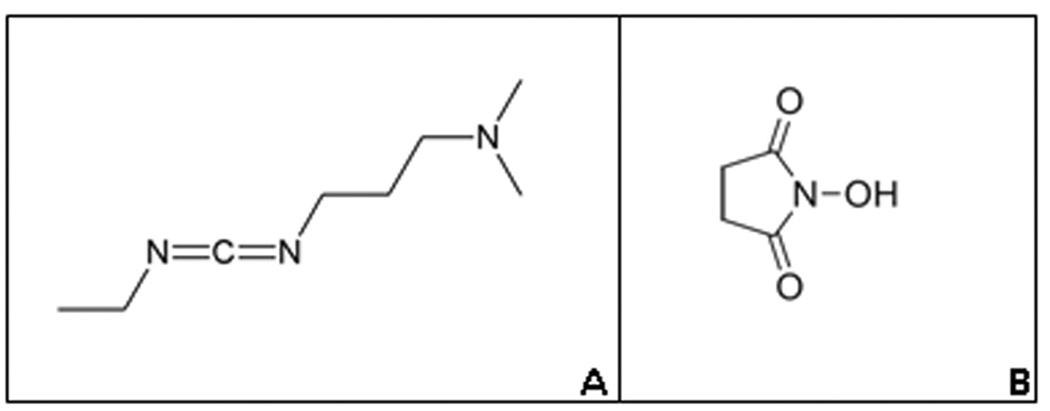
Objectives: To characterize the interaction of 1-Ethyl-3-[3-dimethylaminopropyl] carbodiimide Hydrochloride (EDC) with dentin matrix and its effect on the resin-dentin bond.
Methods: Changes to the stiffness of demineralized dentin fragments treated with EDC/N-hydroxysuccinimide (NHS) in different solutions were evaluated at different time points. The resistance against enzymatic degradation was indirectly evaluated by ultimate tensile strength (UTS) test of demineralized dentin treated or not with EDC/NHS and subjected to collagenase digestion. Short- and long-term evaluations of the strength of resin-dentin interfaces treated with EDC/NHS for 1 h were performed using microtensile bond strength (microTBS) test. All data (MPa) were individually analyzed using ANOVA and Tukey HSD tests (alpha = 0.05).
Results: The different exposure times significantly increased the stiffness of dentin (p < 0.0001, control-5.15 and EDC/NHS-29.50), while no differences were observed among the different solutions of EDC/NHS (p = 0.063). Collagenase challenge did not affect the UTS values of EDC/NHS group (6.08) (p > 0.05), while complete degradation was observed for the control group (p = 0.0008, control-20.84 and EDC/NHS-43.15). EDC/NHS treatment did not significantly increase resin-dentin muTBS, but the values remained stable after 12 months water storage (p < 0.05).
Conclusions: Biomimetic use of EDC/NHS to induce exogenous collagen cross-links resulted in increased mechanical properties and stability of dentin matrix and dentin-resin interfaces.
(c) 2010 Wiley Periodicals, Inc.
Figures

References
-
- Timkovich R. Detection of the stable addition of carbodiimide to proteins. Anal Biochem. 1977;79:135–143. - PubMed
-
- Olde Damink LH, Dijkstra PJ, van Luyn MJ, van Wachem PB, Nieuwenhuis P, Feijen J. In vitro degradation of dermal sheep collagen cross-linked using a water-soluble carbodiimide. Biomaterials. 1996;17:679–684. - PubMed
-
- Staros JV, Wright RW, Swingle DM. Enhancement by N-hydroxysulfosuccinimide of water-soluble carbodiimide-mediated coupling reactions. Anal Biochem. 1986;156:220–222. - PubMed
-
- Caruso AB, Dunn MG. Functional evaluation of collagen fiber scaffolds for ACL reconstruction: cyclic loading in proteolytic enzyme solutions. J Biomed Mater Res A. 2004;69:164–171. - PubMed
-
- Powell HM, Boyce ST. EDC cross-linking improves skin substitute strength and stability. Biomaterials. 2006;27:5821–5827. - PubMed
Publication types
MeSH terms
Substances
Grants and funding
LinkOut - more resources
Full Text Sources
Other Literature Sources
