


Review
doi: 10.1186/1741-7007-8-50.
Unraveling bovin phylogeny: accomplishments and challenges
Affiliations
- PMID: 20525112
- PMCID: PMC2861646
- DOI: 10.1186/1741-7007-8-50
Item in Clipboard
Review
Unraveling bovin phylogeny: accomplishments and challenges
BMC Biol.
.
Abstract
The phylogenetic systematics of bovin species forms a common basis for studies at multiple scales, from the level of domestication in populations to major cladogenesis. The main big-picture accomplishments of this productive field, including two recent works, one in BMC Genomics, are reviewed with an eye for some of the limitations and challenges impeding progress.
Figures
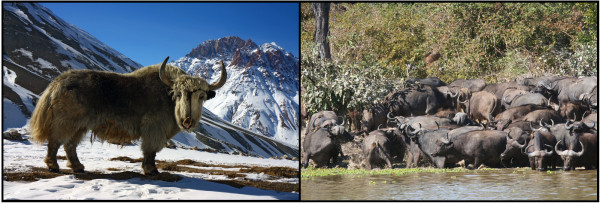
Bovins stand apart from other antelopes (Bovidae) in the wide range of environments they inhabit, from high montane to wet tropical. Bovini today comprises 12 species found on four continents. (Yak: iStockphoto.com/kodda; African buffaloes: iStockphoto.com/dawnn).
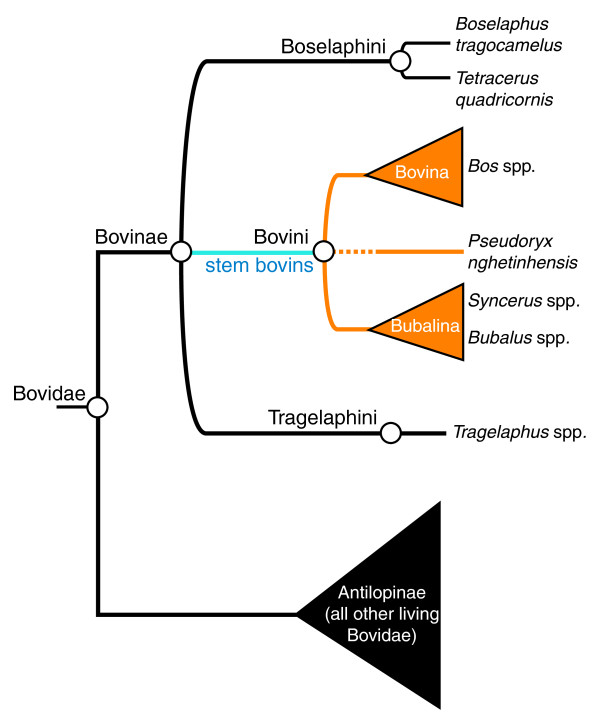
Phylogeny showing the position of Bovini in Bovidae and Bovinae, the division of Bovini into Bovina and Bubalina, and the uncertain placement of the saola (Pseudoryx nghetinhensis).
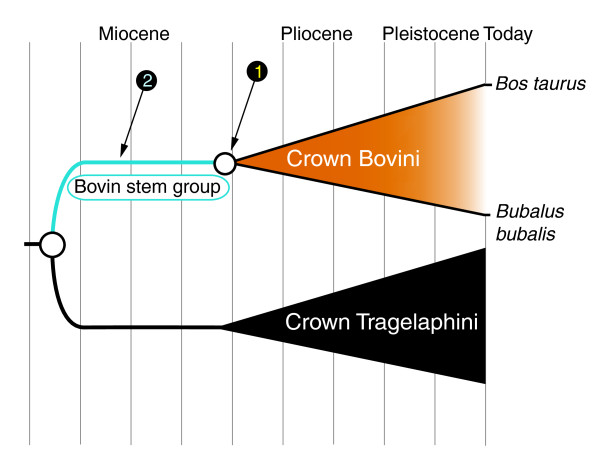
Fossil taxa relied upon for molecular clock calibrations may produce highly spurious dates if their phylogenetic position is not precisely known. In this example, an early fossil taxon attributed simply to 'Bovini' might be assumed to be close to the most recent common ancestor of the living bovins (point 1, node of origin of crown Bovini as defined by the most recent common ancestor of Bos taurus and Bubalus bubalis) when in fact it may be a stem bovin of much older age (point 2).
References
-
- Decker JE, Pires JC, Conant GC, McKay SD, Heaton MP, Chen K, Cooper A, Vilkki J, Seabury CM, Caetano AR, Johnson GS, Brenneman RA, Hanotte O, Eggert LS, Wiener P, Kim JJ, Kim KS, Sonstegard TS, Van Tassell CP, Neibergs HL, McEwan JC, Brauning R, Coutinho LL, Babar ME, Wilson GA, McClure MC, Rolf MM, Kim J, Schnabel RD, Taylor JF. Resolving the evolution of extant and extinct ruminants with high-throughput phylogenomics. Proc Natl Acad Sci USA. 2009;106:18644–18649. doi: 10.1073/pnas.0904691106. - DOI - PMC - PubMed
-
- Edwards CJ, Magee DA, Park SD, McGettigan PA, Lohan AJ, Murphy A, Finlay EK, Shapiro B, Chamberlain AT, Richards MB, Bradley DG, Loftus BJ, Machugh DE. A complete mitochondrial genome sequence from a mesolithic wild aurochs (Bos primigenius) Plos One. 2010;5:e9255. doi: 10.1371/journal.pone.0009255. - DOI - PMC - PubMed
-
- Gentry A, Clutton-Brock J, Groves CP. The naming of wild species and their domestic derivatives. J Archaeol Sci. 2004;31:645–651. doi: 10.1016/j.jas.2003.10.006. - DOI
Publication types
MeSH terms
LinkOut - more resources
Full Text Sources
