


Multilocus genotyping reveals high heterogeneity and strong local population structure of the Plasmodium vivax population in the Peruvian Amazon
- PMID: 20525233
- PMCID: PMC2898784
- DOI: 10.1186/1475-2875-9-151
Multilocus genotyping reveals high heterogeneity and strong local population structure of the Plasmodium vivax population in the Peruvian Amazon
Abstract
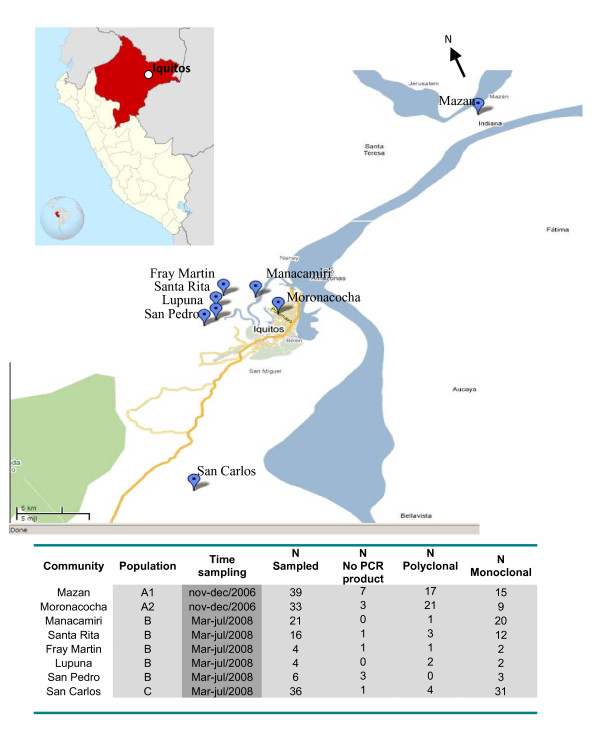
Background: Peru is one of the Latin American countries with the highest malaria burden, mainly due to Plasmodium vivax infections. However, little is known about P. vivax transmission dynamics in the Peruvian Amazon, where most malaria cases occur. The genetic diversity and population structure of P. vivax isolates collected in different communities around Iquitos city, the capital of the Peruvian Amazon, was determined.
Methods: Plasmodium vivax population structure was determined by multilocus genotyping with 16 microsatellites on 159 P. vivax infected blood samples (mono-infections) collected in four sites around Iquitos city. The population characteristics were assessed only in samples with monoclonal infections (n = 94), and the genetic diversity was determined by calculating the expected heterozygosity and allelic richness. Both linkage disequilibrium and the genetic differentiation (theta) were estimated.
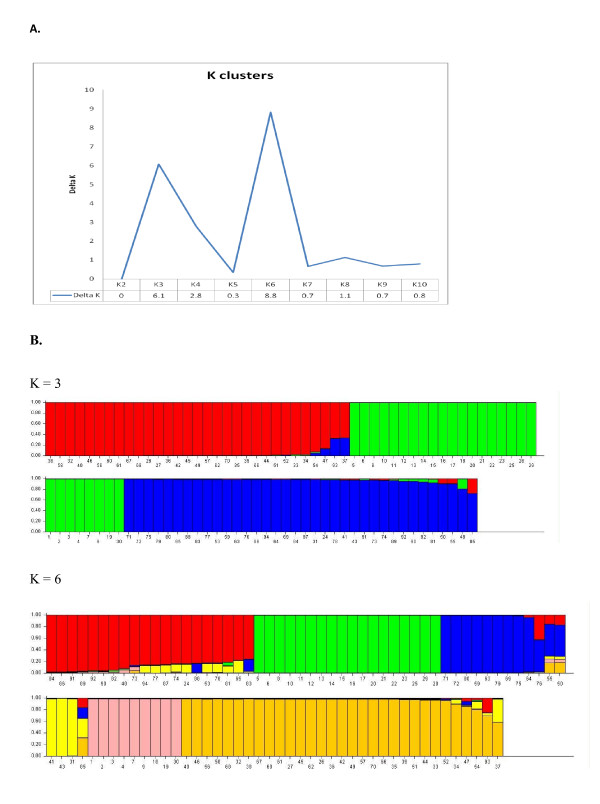
Results: The proportion of polyclonal infections varied substantially by site (11% - 70%), with the expected heterozygosity ranging between 0.44 and 0.69; no haplotypes were shared between the different populations. Linkage disequilibrium was present in all populations (IAS 0.14 - 0.61) but was higher in those with fewer polyclonal infections, suggesting inbreeding and a clonal population structure. Strong population differentiation (theta = 0.45) was found and the Bayesian inference cluster analysis identified six clusters based on distinctive allele frequencies.
Conclusion: The P. vivax populations circulating in the Peruvian Amazon basin are genetically diverse, strongly differentiated and they have a low effective recombination rate. These results are in line with the low and clustered pattern of malaria transmission observed in the region around Iquitos city.
Figures
References
-
- Mendis K, Sina BJ, Marchesini P, Carter R. The neglected burden of Plasmodium vivax malaria. Am J Trop Med Hyg. 2001;64(1-2 suppl):97–106. - PubMed
-
- Pan American Health Organization (PAHO) Malaria in the Americas: Time Series Epidemiological Data from 2000 to. http://www.paho.org/English/AD/DPC/CD/mal-reg-country-epi-data-2007.pdf (accessed 20 October 2009)
-
- Roper MH, Torres RS, Goicochea CG, Andersen EM, Guarda JS, Calampa C, Hightower AW, Magill AJ. The epidemiology of malaria in an epidemic area of the Peruvian Amazon. Am J Trop Med Hyg. 2000;62:247–256. - PubMed
-
- Branch O, Casapia WM, Gamboa DV, Hernandez JN, Alava FF, Roncal N, Alvarez E, Perez EJ, Gotuzzo E. Clustered local transmission and asymptomatic Plasmodium falciparum and Plasmodium vivax malaria infections in a recently emerged, hypoendemic Peruvian Amazon community. Malar J. 2005;4:27. doi: 10.1186/1475-2875-4-27. - DOI - PMC - PubMed
-
- Ministry of Health Peru. http://www.ins.gob.pe/vigilancia/Malaria/ESQUEMAS_TERAPEUTICOS_P.%20viva... (accessed 24, February 2010)
Publication types
MeSH terms
Substances
LinkOut - more resources
Full Text Sources
