


Circulating lymphocyte number has a positive association with tumor response in neoadjuvant chemoradiotherapy for advanced rectal cancer
- PMID: 20525293
- PMCID: PMC2894847
- DOI: 10.1186/1748-717X-5-47
Circulating lymphocyte number has a positive association with tumor response in neoadjuvant chemoradiotherapy for advanced rectal cancer
Abstract
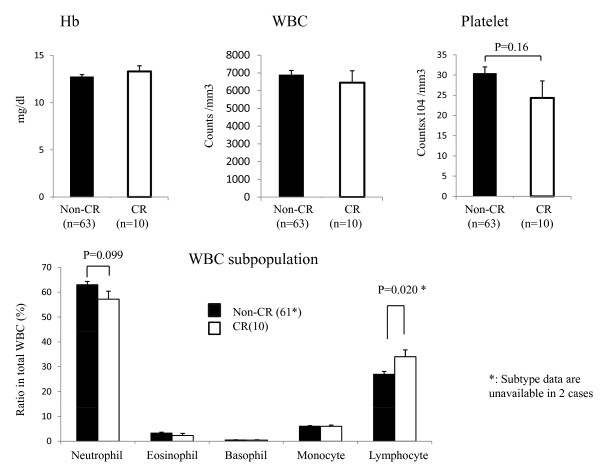
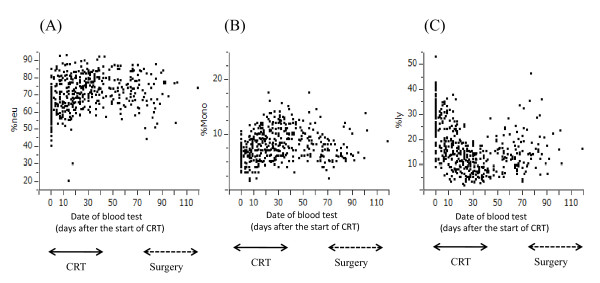
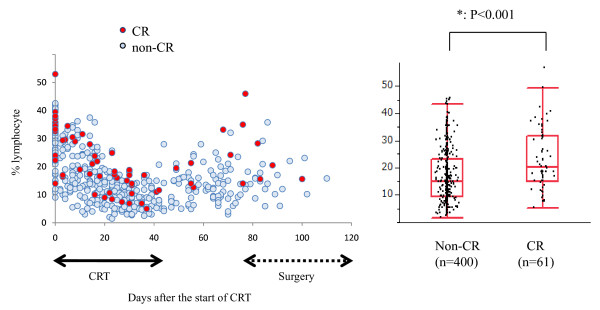
Although neoadjuvant chemoradiotherapy (CRT) is the standard treatment for advanced rectal cancer (RC), markers to predict the treatment response have not been fully established. In 73 patients with advanced RC who underwent CRT in a neoadjuvant setting, we retrospectively examined the associations between the clinical effects of CRT and blood cell counts before and after CRT. Clinical or pathological complete response (CR) was observed in 10 (14%) cases. The CR rate correlated significantly with the size and the circumferential extent of the tumor. Hemoglobin level, white blood cell (WBC) count and platelet count before CRT did not show a significant difference between CR and non-CR cases. Interestingly, however, lymphocyte ratio in WBC was significantly higher (p = 0.020), while neutrophil ratio tended to be lower (p = 0.099), in CR cases, which was shown to be an independent association by multivariate analysis. When all the blood data obtained in the entire treatment period were evaluated, circulating lymphocyte count was most markedly decreased in the CRT period and gradually recovered by the time of surgery, while the numbers of neutrophils and monocytes were comparatively stable. Moreover, the lymphocyte percentage in samples obtained from CR patients was maintained at a relatively higher level than that from non-CR patients. Since tumor shrinkage is known to be dependent not only on the characteristics of tumor cells but also on various host conditions, our data raise the possibility that a lymphocyte-mediated immune reaction may have a positive role in achieving complete eradication of tumor cells. Maintenance of circulating lymphocyte number may improve the response to CRT in rectal cancer.
Figures
References
-
- Sauer R, Becker H, Hohenberger W, Rodel C, Wittekind C, Fietkau R, Martus P, Tschmelitsch J, Hager E, Hess CF, Karstens JH, Liersch T, Schmidberger H, Raab R. Preoperative versus postoperative chemoradiotherapy for rectal cancer. N Engl J Med. 2004;351(17):1731–1740. doi: 10.1056/NEJMoa040694. - DOI - PubMed
-
- Park HC, Janjan NA, Mendoza TR, Lin EH, Vadhan-Raj S, Hundal M, Zhang Y, Delclos ME, Crane CH, Das P, Wang XS, Cleeland CS, Krishnan S. Temporal Patterns of Fatigue Predict Pathologic Response in Patients Treated with Preoperative Chemoradiation Therapy for Rectal Cancer. Int J Radiat Oncol Biol Phys. 2009. - PMC - PubMed
Publication types
MeSH terms
Substances
LinkOut - more resources
Full Text Sources
Research Materials
