. 2010 Sep;12(9):917-27.
doi: 10.1093/neuonc/noq044. Epub 2010 Jun 4.

Levetiracetam enhances p53-mediated MGMT inhibition and sensitizes glioblastoma cells to temozolomide

Affiliations

Levetiracetam enhances p53-mediated MGMT inhibition and sensitizes glioblastoma cells to temozolomide

George C Bobustuc et al. Neuro Oncol. 2010 Sep.

Abstract

Antiepileptic drugs (AEDs) are frequently used to treat seizures in glioma patients. AEDs may have an unrecognized impact in modulating O(6)-methylguanine-DNA methyltransferase (MGMT), a DNA repair protein that has an important role in tumor cell resistance to alkylating agents. We report that levetiracetam (LEV) is the most potent MGMT inhibitor among several AEDs with diverse MGMT regulatory actions. In vitro, when used at concentrations within the human therapeutic range for seizure prophylaxis, LEV decreases MGMT protein and mRNA expression levels. Chromatin immunoprecipitation analysis reveals that LEV enhances p53 binding on the MGMT promoter by recruiting the mSin3A/histone deacetylase 1 (HDAC1) corepressor complex. However, LEV does not exert any MGMT inhibitory activity when the expression of either p53, mSin3A, or HDAC1 is abrogated. LEV inhibits malignant glioma cell proliferation and increases glioma cell sensitivity to the monofunctional alkylating agent temozolomide. In 4 newly diagnosed patients who had 2 craniotomies 7-14 days apart, prior to the initiation of any tumor-specific treatment, samples obtained before and after LEV treatment showed the inhibition of MGMT expression. Our results suggest that the choice of AED in patients with malignant gliomas may have an unrecognized impact in clinical practice and research trial design.


Figures
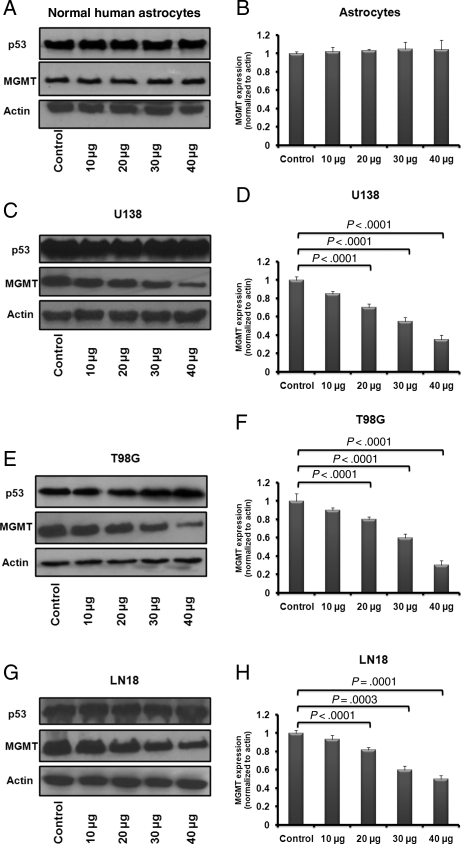
Fig. 1.
Fig. 1.
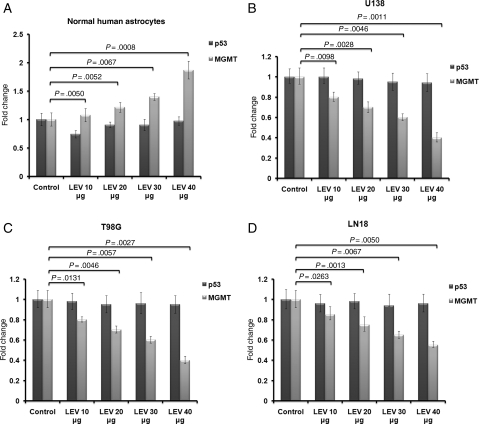
The effect of LEV on MGMT protein expression in normal human astrocytes and glioblastoma cells. The effect of LEV on MGMT and p53 protein expression in normal human astrocytes and 3 MGMT-expressing glioblastoma cell lines (U138, LN18, and T98G) was analyzed by Western blotting. Cells were treated daily with LEV-enriched specific medium for 96 hours at concentrations covering the serum therapeutic range for seizures of 10, 20, 30, or 40 µg/mL.
Fig. 2.
Fig. 2.
The effect of LEV on MGMT transcription in normal human astrocytes and in glioblastoma cells. The effect of LEV on MGMT and p53 transcription in normal human astrocytes and 3 MGMT-expressing glioblastoma cell lines (U138, LN18, and T98G) was analyzed by qRT-PCR. Cells were treated daily with LEV-enriched specific medium for 96 hours at concentrations covering the serum therapeutic range for seizures of 10, 20, 30, or 40 µg/mL.
Fig. 3.
Fig. 3.
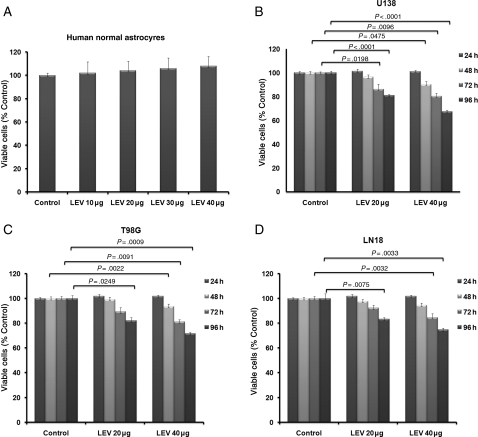
The effect of LEV on glioma cell growth. Growth inhibition assays (MTT) were performed on normal human astrocytes and 3 MGMT-expressing glioblastoma cell lines (U138, LN18 and T98G) after daily treatment with 2 different concentrations (20 and 40 µg/mL) of LEV at 4 different time points (24, 48, 72, and 96 hours).
Fig. 4.
Fig. 4.
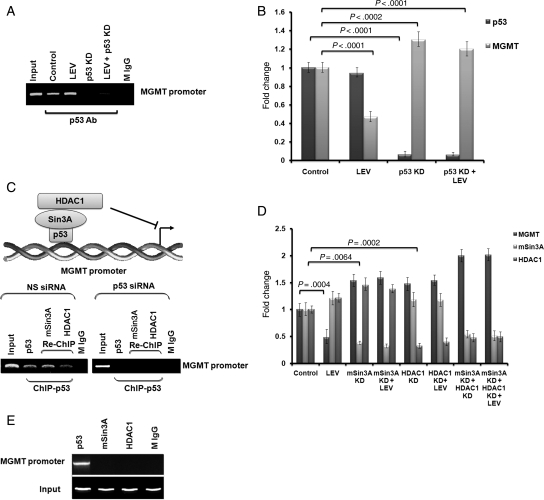
The effect of LEV on p53 binding on the MGMT promoter and on the role of the mSinA/HDAC1 transcriptional corepressor system. U138 cells were treated daily with LEV (40 µg/mL)-enriched specific medium for 96 hours. ChIP assays were performed in the presence or the absence of knock-down p53 (A). p53 and MGMT transcription was measured by qRT-PCR in knock-down p53 U138 cells in the presence or the absence of LEV (B). Re-Chip assays were performed in the presence or absence of knock-down p53 (C). MGMT, mSin3A, and HDAC1 transcription were measured by qRT-PCR in knock-down mSin3A or/and knock-down HDAC1 U138 cells in the presence or the absence of LEV (D). Direct ChIP analysis was performed using U138 cell lysates to investigate the recruitment of p53, mSin3A, and HDAC1 on MGMT promoter (E).
Fig. 5.
Fig. 5.
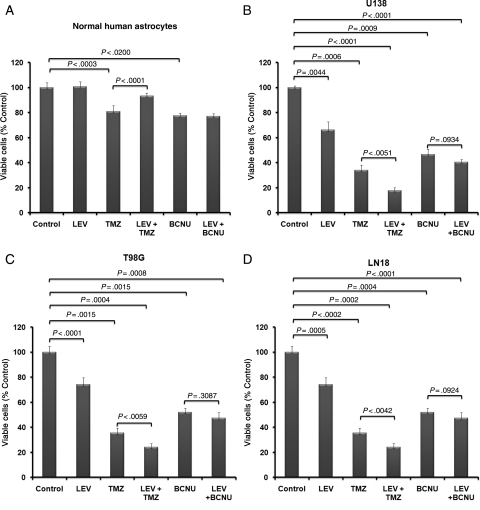
LEV sensitizes glioma cells to TMZ. MGMT-expressing glioblastoma cell lines T98G, U138, and LN18 and normal human astrocytes were treated daily with LEV (40 µg/mL) for 72 hours and then treated with TMZ (150 µg/mL) or BCNU (50 µg/mL) for another 48 hours before MTT assays were performed.
Fig. 6.
Fig. 6.
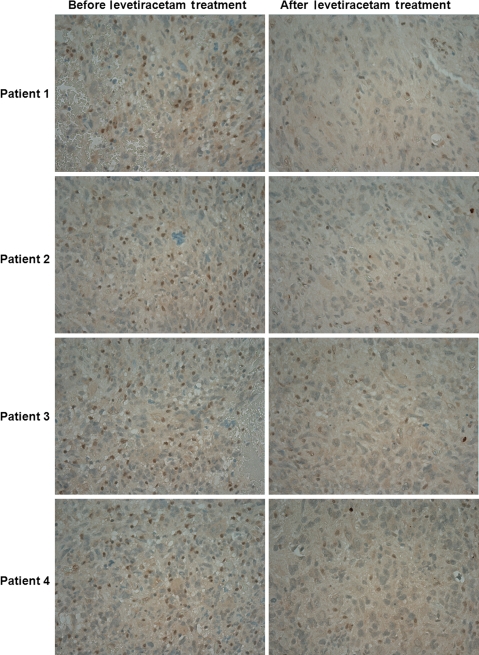
LEV effect on the MGMT expression in glioblastoma samples. MGMT immunohistochemistry was performed on glioblastoma samples from 4 newly diagnosed patients who had 2 craniotomies 7–14 days apart, prior to initiation of any tumor-specific treatment, samples were obtained before and after LEV treatment. LEV was used at a dose of 500–1000 mg twice daily, which correlated with serum levels of 20–40 µg/mL.

References

    1. Stupp R, Mason WP, van den Bent MJ, et al. Radiotherapy plus concomitant and adjuvant temozolomide for glioblastoma. N Engl J Med. 2005;352(10):987–996. doi:10.1056/NEJMoa043330. - DOI - PubMed
    1. Burton EC, Prados M. Malignant gliomas. Curr Treat Options Oncol. 2000;1(5):459–468. - PubMed
    1. Erickson LC, Bradley MO, Ducore JM, Ewig RA, Kohn KW. DNA crosslinking and cytotoxicity in normal and transformed human cells treated with antitumor nitrosoureas. Proc Natl Acad Sci USA. 1980;77(1):467–471. doi:10.1073/pnas.77.1.467. - DOI - PMC - PubMed
    1. Erickson LC, Laurent G, Sharkey NA, Kohn KW. DNA cross-linking and monoadduct repair in nitrosourea-treated human tumour cells. Nature. 1980;288(5792):727–729. doi:10.1038/288727a0. - DOI - PubMed
    1. Pegg AE. Repair of O(6)-alkylguanine by alkyltransferases. Mutat Res. 2000;462(2–3):83–100. - PubMed

MeSH terms