


Serum urate and its relationship with alcoholic beverage intake in men and women: findings from the Coronary Artery Risk Development in Young Adults (CARDIA) cohort
- PMID: 20525839
- PMCID: PMC5404888
- DOI: 10.1136/ard.2010.129429
Serum urate and its relationship with alcoholic beverage intake in men and women: findings from the Coronary Artery Risk Development in Young Adults (CARDIA) cohort
Abstract
Objective: To investigate if beer, liquor (spirits), wine and total alcohol intakes have different associations with serum urate (SU) concentrations at different ages in a cohort of young men and women.
Methods: Data from 3123 participants at baseline and follow-up at 20 years were used, with balanced proportions of Caucasians and African Americans. The relationships of SU with categories of beer, liquor, wine and total alcohol intake referent to no intake were examined in sex-specific, cross-sectional analyses.
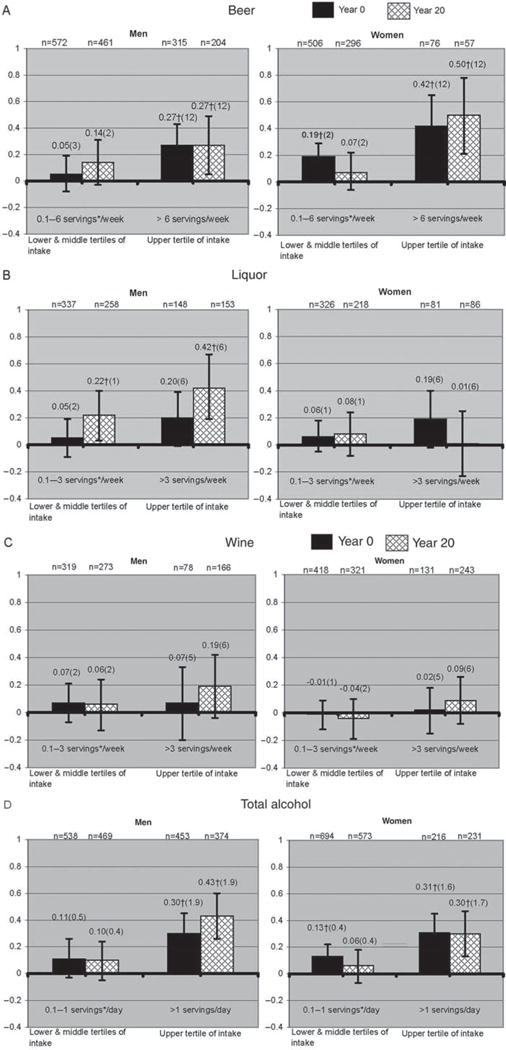
Results: Mean age (SD) at the beginning of follow-up was 25.1 (3.6) years. Compared with non-drinkers, significant associations between higher SU concentrations and greater beer intake were observed among men and women, with more pronounced and consistent associations for women. An association between greater liquor intake and higher SU concentrations was only seen for men at the year 20 evaluation. Wine intake was not associated with SU in either sex and total alcohol was associated with higher SU concentrations in both men and women. The magnitude of the associations between alcoholic beverages intake and SU was modest (≤0.03 mg/dl/alcoholic beverage serving).
Conclusion: An association between higher SU concentrations and greater beer intake was consistent and pronounced among women, but also present in men. Despite the small magnitude of the increases in SU associated with alcohol intake, clinical implications in conditions such as cardiovascular disease and gout in young adults who are moderate and heavy drinkers cannot be ruled out.
Conflict of interest statement
Figures
References
-
- Ford ES, Giles WH. findings from the third National Health and Nutrition Examination Survey. JAMA. 2002;287:356–9. - PubMed
-
- Kang DH, Nakagawa T, Feng L, et al. A role for uric acid in the progression of renal disease. J Am Soc Nephrol. 2002;13:2888–97. - PubMed
-
- Masuo K, Kawaguchi H, Mikami H, et al. Serum uric acid and plasma norepinephrine concentrations predict subsequent weight gain and blood pressure elevation. Hypertension. 2003;42:474–80. - PubMed
-
- Delbarre F, Auscher C, Brouilhet H, et al. The action of ethanol in gout and on the metabolism of uric acid. Sem Hop. 1967;43:659–64. - PubMed
-
- Lieber CS. Hyperuricemia induced by alcohol. Arthritis Rheum. 1965;8:786–98. - PubMed
Publication types
MeSH terms
Substances
Grants and funding
LinkOut - more resources
Full Text Sources
Medical
