


Galectin-3, cardiac structure and function, and long-term mortality in patients with acutely decompensated heart failure
- PMID: 20525986
- PMCID: PMC2913048
- DOI: 10.1093/eurjhf/hfq091
Galectin-3, cardiac structure and function, and long-term mortality in patients with acutely decompensated heart failure
Abstract
Aims: To determine the relationship between galectin-3 concentrations and cardiac structure in patients with acute dyspnoea, and to evaluate the impact of galectin-3 independent of echocardiographic measurements on long-term mortality.
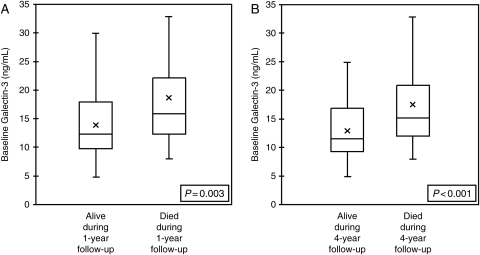
Methods and results: One hundred and fifteen patients presenting to the emergency department with acute dyspnoea who had galectin-3 levels and detailed echocardiographic studies on admission were studied. Galectin-3 levels were associated with older age (r = 0.26, P = 0.006), lower creatinine clearance (r = -0.42, P < 0.001), and higher levels of N-terminal-proBNP (r = 0.39, P < 0.001). Higher galectin-3 levels were associated with tissue Doppler E/E(a) ratio (r = 0.35, P = 0.01), a lower right ventricular (RV) fractional area change (r = -0.19, P = 0.05), higher RV systolic pressure (r = 0.37, P < 0.001), and more severe mitral (r = 0.30, P = 0.001) or tricuspid regurgitation (r = 0.26, P = 0.005). In patients diagnosed with heart failure (HF), the association between galectin-3 and valvular regurgitation and RV systolic pressure persisted. In a multivariate Cox regression model, galectin-3 remained a significant predictor of 4-year mortality independent of echocardiographic markers of risk. Dyspnoeic patients with HF and galectin-3 levels above the median value had a 63% mortality; patients less than the median value had a 37% mortality (P = 0.003).
Conclusion: Among dyspnoeic patients with and without ADHF, galectin-3 concentrations are associated with echocardiographic markers of ventricular function. In patients with ADHF, a single admission galectin-3 level predicts mortality to 4 years, independent of echocardiographic markers of disease severity.
Figures
References
-
- Bleumink GS, Knetsch AM, Sturkenboom MC, Straus SM, Hofman A, Deckers JW, Witteman JC, Stricker BH. Quantifying the heart failure epidemic: prevalence, incidence rate, lifetime risk and prognosis of heart failure The Rotterdam Study. Eur Heart J. 2004;25:1614–1619. doi:10.1016/j.ehj.2004.06.038. - DOI - PubMed
-
- Januzzi JL, van Kimmenade R, Lainchbury J, Bayes-Genis A, Ordonez-Llanos J, Santalo-Bel M, Pinto YM, Richards M. NT-proBNP testing for diagnosis and short-term prognosis in acute destabilized heart failure: an international pooled analysis of 1256 patients. Eur Heart J. 2006;27:330–337. doi:10.1093/eurheartj/ehi631. - DOI - PubMed
-
- Peacock W, De Marco T, Fonarow GC, Diercks D, Wynne J, Apple FS, Wu AH ADHERE Investigators. Cardiac troponin and outcome in acute heart failure. N Engl J Med. 2008;358:2117–2126. doi:10.1056/NEJMoa0706824. - DOI - PubMed
-
- Januzzi J, Peacock WF, Maisel AS, Chae CU, Jesse RL, Baggish AL, O'Donoghue M, Sakhuja R, Chen AA, van Kimmenade RR, Lewandrowski KB, Lloyd-Jones DM, Wu AH. Measurement of the interleukin family member ST2 in patients with acute dyspnea: results from the PRIDE (Pro-Brain Natriuretic Peptide Investigation of Dyspnea in the Emergency Department) study. J Am Coll Cardiol. 2007;50:607–613. - PubMed
-
- Braunwald E. Biomarkers in heart failure. N Engl J Med. 2008;358:2148–2159. doi:10.1056/NEJMra0800239. - DOI - PubMed
Publication types
MeSH terms
Substances
LinkOut - more resources
Full Text Sources
Other Literature Sources
Medical
Research Materials
Miscellaneous
