


Double blinding with a new placebo needle: a further validation study
- PMID: 20530096
- PMCID: PMC2933308
- DOI: 10.1136/aim.2009.001230
Double blinding with a new placebo needle: a further validation study
Abstract
Background: The masking properties of a new, non-penetrating, double-blind placebo acupuncture needle were demonstrated. Practitioners correctly identified some of the needles; if they were confident in this opinion, they would be unblinded.
Objective: To investigate the clues that led to correct identification, and the confidence in this decision.
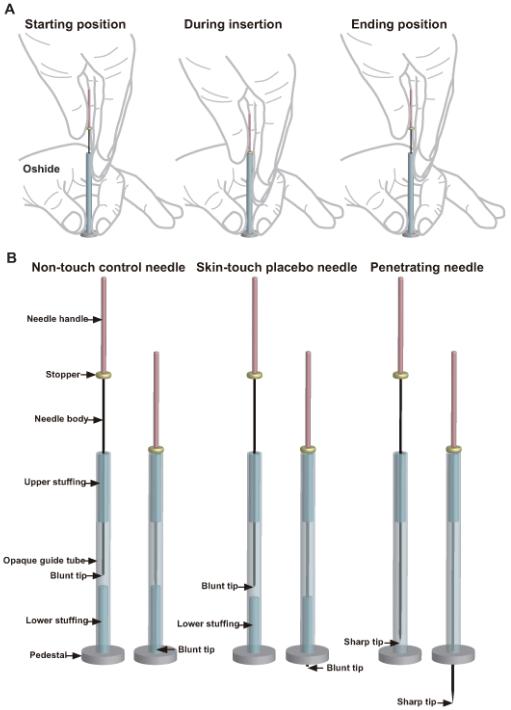
Methods: Ten acupuncture practitioners, blindly and randomly, applied 10 each of three types of needle to the shoulder: blunt, non-penetrating needles that pressed the skin ('skin-touch placebo needle'); new non-penetrating needles that penetrated soft material (stuffing) but did not reach the skin ('non-touch control needle'); matching penetrating needles. Afterwards, practitioners were asked to judge the type of needle, their confidence in their decision and what clues led them to their judgements.
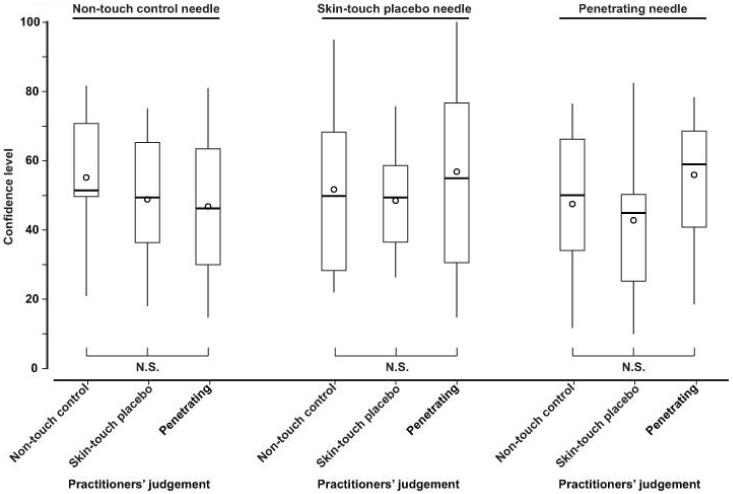
Results: Of the 30 judgements made by each practitioner, the mean number of correct, incorrect and unidentifiable answers were 10.4 (SD 3.7), 15.2 (SD 4.9) and 4.4 (SD 6.1), respectively. There was no significant difference in the confidence scores for 104 correct (mean, 54.0 (SD 20.2)%) and 152 incorrect (mean, 50.3 (SD 24.3)%) judgements. Twelve needles were identified with 100% confidence-three correct, and nine incorrect. For needles correctly identified, the proportions of non-touch (p = 0.14) and skin-touch (p = 0.17), needles were no greater than chance, but the proportion of penetrating needles correctly identified exceeded chance (p < 0.01). 53% of judgements were made from the "feeling of needle insertion", but 57% of these were wrong.
Conclusion: Practitioners had a slight tendency to guess the penetrating needles correctly, but were uncertain about most of their judgments, posing only a very small risk to double blinding.
Figures
References
-
- Kaptchuk TJ. Placebo needle for acupuncture. Lancet [Letter] 1998;352:992. - PubMed
-
- Kaptchuk TJ, Frank E, Shen J, Wenger N, Glaspy J, Hays RD, et al. Methodological issues in trials of acupuncture. JAMA [Letter] 2001;285:1015–6. - PubMed
-
- Shapiro AK, Shapiro E. The powerful placebo: From ancient priest to modern physician. The Johns Hopkins University Press; London: 1997. pp. 137–74.pp. 190–216.
-
- Shapiro AK, Shapiro E. The placebo: Is it much ado about nothing? In: Harrington A, editor. The placebo effect An interdisciplinary exploration. Harvard University Press; Cambridge, Massachusetts, London, England: 1997. pp. 12–36.
-
- Kaptchuk TJ. The placebo effect in alternative medicine: can the performance of a healing ritual have clinical significance? Ann Intern Med. 2002;136:817–25. - PubMed
Publication types
MeSH terms
Substances
Grants and funding
LinkOut - more resources
Full Text Sources
Medical
