Primary care practice development: a relationship-centered approach
- PMID: 20530396
- PMCID: PMC2885724
- DOI: 10.1370/afm.1089
Primary care practice development: a relationship-centered approach
Erratum in
- Ann Fam Med. 2010 Jul-Aug;8(4):369
Abstract
Purpose: Numerous primary care practice development efforts, many related to the patient-centered medical home (PCMH), are emerging across the United States with few guides available to inform them. This article presents a relationship-centered practice development approach to understand practice and to aid in fostering practice development to advance key attributes of primary care that include access to first-contact care, comprehensive care, coordination of care, and a personal relationship over time.
Methods: Informed by complexity theory and relational theories of organizational learning, we built on discoveries from the American Academy of Family Physicians' National Demonstration Project (NDP) and 15 years of research to understand and improve primary care practice.
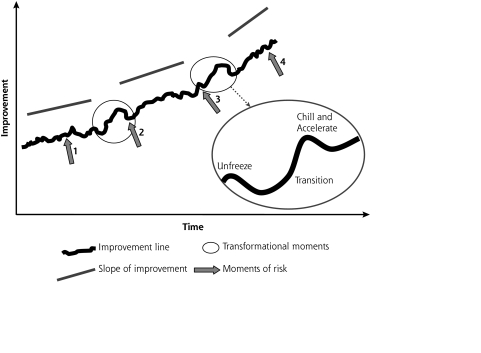
Results: Primary care practices can fruitfully be understood as complex adaptive systems consisting of a core (a practice's key resources, organizational structure, and functional processes), adaptive reserve (practice features that enhance resilience, such as relationships), and attentiveness to the local environment. The effectiveness of these attributes represents the practice's internal capability. With adequate motivation, healthy, thriving practices advance along a pathway of slow, continuous developmental change with occasional rapid periods of transformation as they evolve better fits with their environment. Practice development is enhanced through systematically using strategies that involve setting direction and boundaries, implementing sensing systems, focusing on creative tensions, and fostering learning conversations.
Conclusions: Successful practice development begins with changes that strengthen practices' core, build adaptive reserve, and expand attentiveness to the local environment. Development progresses toward transformation through enhancing primary care attributes.
Figures


Comment in
-
Successful health information technology implementation requires practice and health care system transformation.Ann Fam Med. 2011 Sep-Oct;9(5):388-9. doi: 10.1370/afm.1307. Ann Fam Med. 2011. PMID: 21911755 Free PMC article. No abstract available.
References
-
- Meads G. Primary Care in the Twenty-first Century. Seattle, WA: Radcliffe; 2006.
-
- Bodenheimer T. Primary care—will it survive? N Engl J Med. 2006; 355(9):861–864. - PubMed
-
- Rittenhouse DR, Shortell SM. The patient-centered medical home: will it stand the test of health reform? JAMA. 2009;30 1(19):2038–2040. - PubMed
-
- Patient-Centered Primary Care Collaborative. Joint Principles of the Patient-Centered Medical Home. http://www.pcpcc.net/node/14. Accessed Jun 13, 2009.
Publication types
MeSH terms
Grants and funding
LinkOut - more resources
Full Text Sources
Medical