


Disposition of cannabinoids in oral fluid after controlled around-the-clock oral THC administration
- PMID: 20530732
- PMCID: PMC3171507
- DOI: 10.1373/clinchem.2009.141853
Disposition of cannabinoids in oral fluid after controlled around-the-clock oral THC administration
Abstract
Background: Oral fluid, a promising alternative matrix for drug monitoring in clinical and forensic investigations, offers noninvasive sample collection under direct observation. Cannabinoid distribution into oral fluid is complex and incompletely characterized due to the lack of controlled drug administration studies.
Methods: To characterize cannabinoid disposition in oral fluid, we administered around-the-clock oral Delta(9)-tetrahydrocannabinol (THC) (Marinol) doses to 10 participants with current daily cannabis use. We obtained oral fluid samples (n=440) by use of Quantisal collection devices before, during, and after 37 20-mg THC doses over 9 days. Samples were extracted with multiple elution solvents from a single SPE column and analyzed by 2-dimensional GC-MS with electron-impact ionization for THC, 11-hydroxy-THC (11-OH-THC), cannabidiol, and cannabinol and negative chemical ionization for 11-nor-9-carboxy-THC (THCCOOH). Linear ranges were 0.5-50 microg/L, with the exception of cannabinol (1-50 microg/L) and THCCOOH (7.5-500 ng/L).
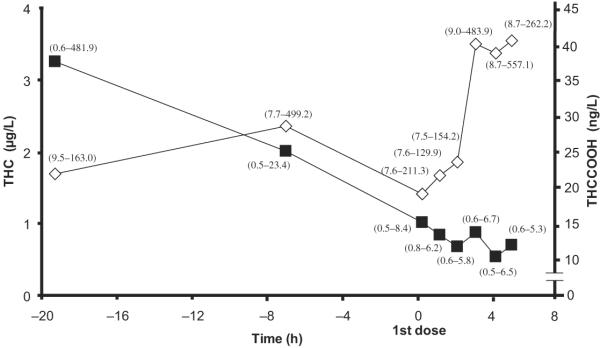
Results: THCCOOH was the most prevalent analyte in 432 samples (98.2%), with concentrations up to 1117.9 ng/L. In contrast, 11-OH-THC was not identified in any sample; cannabidiol and cannabinol were quantified in 3 and 8 samples, respectively, with maximum concentrations of 2.1 and 13 microg/L. THC was present in only 20.7% of samples, with highest concentrations near admission (median 4.2 microg/L, range 0.6-481.9) from previously self-administered smoked cannabis.
Conclusions: Measurement of THCCOOH in OF not only identifies cannabis exposure, but also minimizes the possibility of passive inhalation. THCCOOH may be a better analyte for detection of cannabis use.
Figures
References
-
- Verstraete AG. Oral fluid testing for driving under the influence of drugs: history, recent progress and remaining challenges. Forensic Sci Int. 2005;150:143–50. - PubMed
-
- Halldin MM, Widman M, Bahr CV, Lindgren JE, Martin BR. Identification of in vitro metabolites of delta-tetrahydrocannabinol formed by human livers. Drug Metab Dispos. 1982;10:297–301. - PubMed
-
- Huestis MA. Pharmacokinetics and metabolism of the plant cannabinoids, Δ9-tetrahydrocannabinol, cannabidiol and cannabinol. In: Pertwee RG, editor. Cannabinoids. vol. 168. Springer; New York: 2005. pp. 657–90. Handbook of experimental pharmacology. - PubMed
-
- Harvey DJ, Paton WDM. Metabolism of the cannabinoids. Rev Biochem Toxicol. 1986;6:221–64.
Publication types
MeSH terms
Substances
Grants and funding
LinkOut - more resources
Full Text Sources
Medical
Research Materials
Miscellaneous
