. 2010 Jul 31;42(7):477-83.
doi: 10.3858/emm.2010.42.7.049.

IQGAP1 is overexpressed in hepatocellular carcinoma and promotes cell proliferation by Akt activation

Affiliations

IQGAP1 is overexpressed in hepatocellular carcinoma and promotes cell proliferation by Akt activation

Feng Chen et al. Exp Mol Med. .

Abstract

The scaffold protein IQGAP1 shows elevated levels in several cancer types, but its expression in hepatocellular carcinoma is unknown. We found that 58% of human hepatocellular carcinoma tissue samples had increased IQGAP1 expression compared to adjacent normal tissue. Overexpressing IQGAP1 raised the in vivo tumorigenicity of hepatocellular carcinoma cells, and forced overexpression of IQGAP1 in vitro stimulated cell proliferation. Cell growth was reduced by knockdown or mutation of IQGAP1, or by treatment of cells with a phosphotidylinositol 3-kinase inhibitor. To determine the mechanism by which IQGAP1 overexpression affected hepatocellular carcinoma cells, we confirmed its interaction in these cells with mammalian target of rapamycin (mTOR), a serine/threonine kinase that integrates signals about nutrient and energy status with downstream effectors that influence cell division. In addition, we discovered a new interaction involving IQGAP1, mTOR and Akt, which is a downstream target of mTOR. Akt phosphorylation on Ser-473, which is catalyzed by mTOR and required for Akt activation, increased with increasing amounts of IQGAP1, and decreased with IQGAP1 mutation. We hypothesize that IQGAP1 is a scaffold that facilitates mTOR and Akt interaction.


Figures
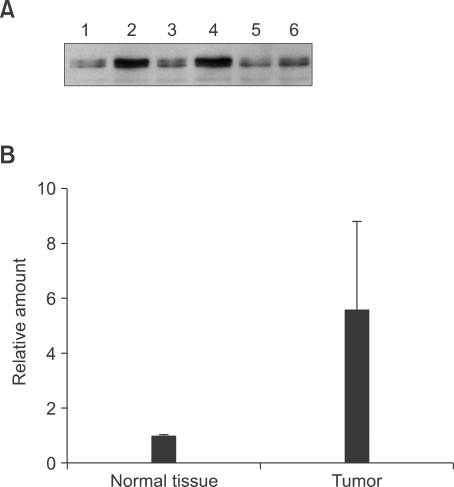
Figure 1
Figure 1
Expression of IQGAP1 in human hepatocellular carcinoma tissue. (A) Equal amounts of protein lysate from hepatocellular carcinoma tissue (lanes 2, 4 and 6) and paired normal liver (lanes 1, 3 and 5) from three different patients, were analyzed by Western blot using monoclonal anti-IQGAP1. (B) Quantification by TotalLab software showing the average of the three samples in A. Error bars show standard deviation.
Figure 2
Figure 2
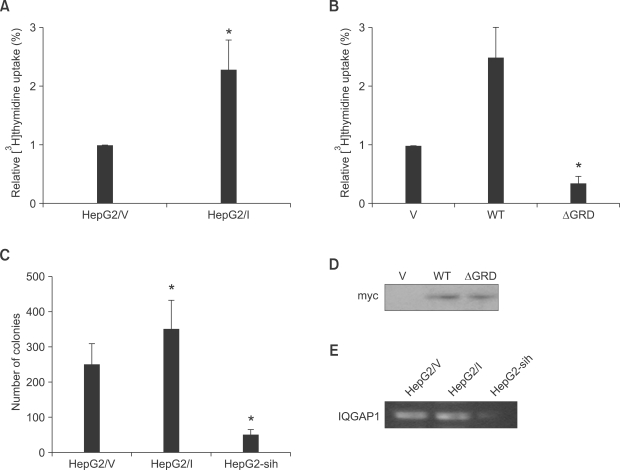
Effect of IQGAP1 on proliferation of HepG2 cells. (A) HepG2 cells (2 × 10⁵) stably expressing control vector pcDNA3 (HepG2/V) or Myc-tagged IQGAP1 (HepG2/I), were seeded into 24-well culture dishes. After 24 h, [3H]thymidine was added for 18 h, and incorporation measured. All assays were performed in triplicate. The means ± S.D. are shown (n = 12 replicates/group). *P < 0.01. (B) Equal numbers of HepG2 cells were transiently transfected with 10 µg of vector (V), wild type (WT) IQGAP1, or IQGAP1ΔGRD (ΔGRD). Cell proliferation was quantified as described for A. Data are expressed as means ± S.D. [3H]thymidine uptake relative to V cells, (n = 3, in quadruplicate). *P < 0.01; **P < 0.05. (C) HepG2/V, HepG2/I, and HepG2-sih (1 × 10⁴) cells were assessed by soft agar assay after 14 days at 37℃. Colonies > 0.2 mm were counted using a light microscope. The data are expressed as means ± S.D, n = 2, performed in triplicate. *P < 0.01 relative to HepG2/V-derived colonies. (D) Expression level of transfected IQGAP1 in HepG2 cells that transfected with 10 µg of vector (V), wild type (WT) IQGAP1, or IQGAP1ΔGRD (ΔGRD) was detected by Western blot using myc antibody. (E) The mRNA level of IQGAP1 in HepG2/V, HepG2/I, and HepG2-sih (1 × 10⁴) cells was accessed by RT-PCR.
Figure 3
Figure 3
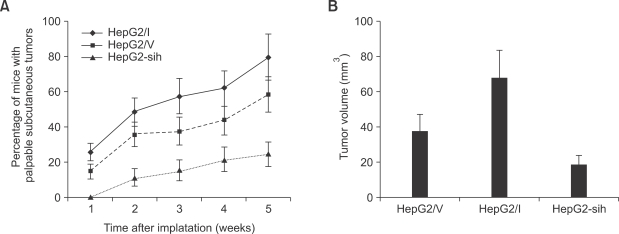
IQGAP1 promotes in vivo tumorigenic growth of HepG2 cells. (A) Immunocompromised nude mice received subcutaneous injections of equal numbers (1 × 10⁵) of HepG2/V, HepG2/I, and HepG2-sih cells and the rate of appearance of palpable primary tumors was examined. (B) Final volume of tumors derived from subcutaneous implants. Primary tumor volumes were measured 60 days after transplantation of HepG2/V, HepG2/I, and HepG2-sih cells. Data represent the mean ± S.D, n = 8 animals/group.
Figure 4
Figure 4
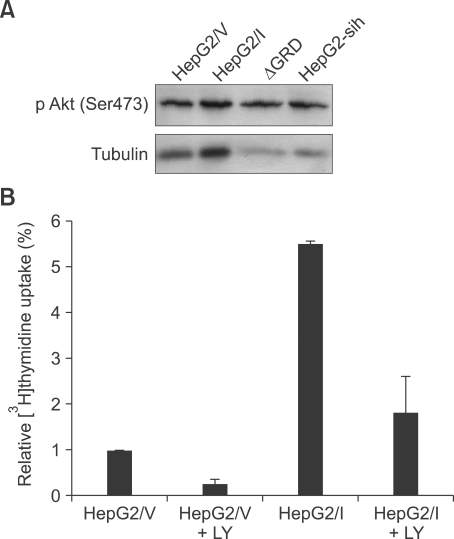
IQGAP1 regulates HepG2 cells proliferation through the PI3K/Akt pathway. (A) equal numbers of HepG2 cells were stably transfected with pcDNA3 vector (HepG2/V), Myc-tagged IQGAP1 (HepG2/I), IQGAP1ΔGRD (ΔGRD) or IQGAP1-sih (HepG2-sih) and analyzed by Western blot. (B) proliferation of HepG2/V cells, HepG2/I cells, or cells incubated with 50 µM PI3K inhibitor LY294002 (LY).
Figure 5
Figure 5
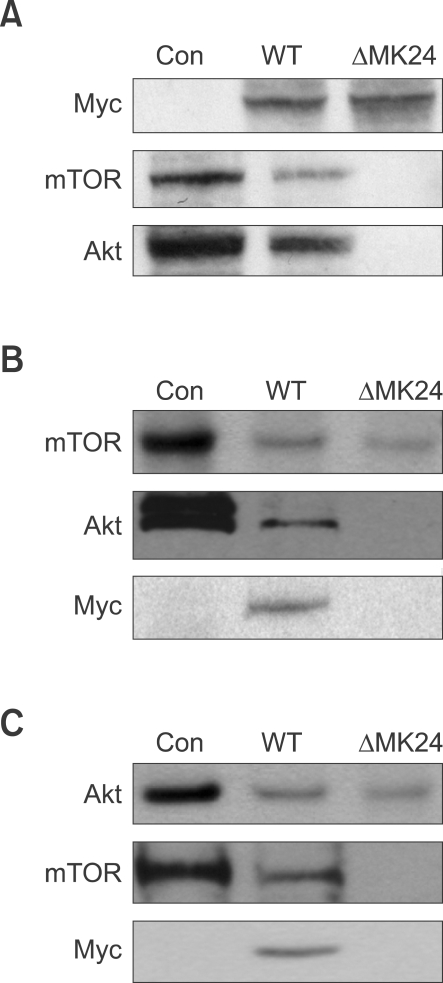
IQGAP1 is a scaffold protein that facilitates mTOR interaction with Akt. HEK-293 cells were transiently transfected with equal amounts of Myc-IQGAP1(WT), Myc-IQGAP1ΔMK24. After 36 h, cells were lysed. (A) Immunoprecipitated with anti-Myc antibody for IQGAP1, and subjected to Western blot with anti-Myc, anti-mTOR, or anti-Akt. Con indicates total lysates from non-transfected cells. (B) Immunoprecipitated with anti-mTOR antibody, and subjected to Western blot with anti-Myc, anti-mTOR, or anti-Akt. (C) Immunoprecipitated with anti-Akt antibody, and subjected to Western blot with anti-Myc, anti-mTOR, or anti-Akt.

References

    1. Briggs MW, Sacks DB. IQGAP proteins are integral components of cytoskeletal regulation. EMBO Rep. 2003;4:571–574. - PMC - PubMed
    1. Dong P, Nabeshima K, Nishimura N, Kawakami T, Hachisuga T, Kawarabayashi T, Iwasaki H. Overexpression and diffuse expression pattern of IQGAP1 at invasion fronts are independent prognostic parameters in ovarian carcinomas. Cancer Lett. 2006;243:120–127. - PubMed
    1. Dubrovska A, Kim S, Salamone RJ, Walker JR, Maria SM, García-Echeverría C, Schultz PG, Reddy VA. The role of PTEN/Akt/PI3K signaling in the maintenance and viability of prostate cancer stem-like cell populations. Proc Natl Acad Sci USA. 2009;106:268–273. - PMC - PubMed
    1. Franke TF. PI3K/Akt: getting it right matters Akt signaling in animal physiology and human disease. Oncogene. 2008;27:6473–6488. - PubMed
    1. Jadeski L, Mataraza JM, Jeong HW, Li Z, Sacks DB. IQGAP1 Stimulates Proliferation and Enhances Tumorigenesis of Human Breast Epithelial Cells. J Biol Chem. 2008;283:1008–1017. - PubMed

Publication types

MeSH terms

Substances

LinkOut - more resources