Optimality of mutation and selection in germinal centers
- PMID: 20532164
- PMCID: PMC2880589
- DOI: 10.1371/journal.pcbi.1000800
Optimality of mutation and selection in germinal centers
Abstract
The population dynamics theory of B cells in a typical germinal center could play an important role in revealing how affinity maturation is achieved. However, the existing models encountered some conflicts with experiments. To resolve these conflicts, we present a coarse-grained model to calculate the B cell population development in affinity maturation, which allows a comprehensive analysis of its parameter space to look for optimal values of mutation rate, selection strength, and initial antibody-antigen binding level that maximize the affinity improvement. With these optimized parameters, the model is compatible with the experimental observations such as the approximately 100-fold affinity improvements, the number of mutations, the hypermutation rate, and the "all or none" phenomenon. Moreover, we study the reasons behind the optimal parameters. The optimal mutation rate, in agreement with the hypermutation rate in vivo, results from a tradeoff between accumulating enough beneficial mutations and avoiding too many deleterious or lethal mutations. The optimal selection strength evolves as a balance between the need for affinity improvement and the requirement to pass the population bottleneck. These findings point to the conclusion that germinal centers have been optimized by evolution to generate strong affinity antibodies effectively and rapidly. In addition, we study the enhancement of affinity improvement due to B cell migration between germinal centers. These results could enhance our understanding of the functions of germinal centers.
Conflict of interest statement
The authors have declared that no competing interests exist.
Figures

 . Only 4.9% of the affinity affecting mutations could improve affinity.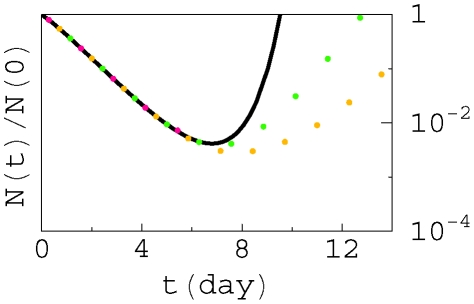
 (green),
  (yellow), and
  (red) respectively. The population in red goes extinct at the bottleneck.
 B cells) after going through the bottleneck, no matter how long it takes. (a): The optimal improvement of A occurs when about 50% daughter cells are mutated at divisions. (b): The grey scale shows the probability for the whole population to survive through the bottleneck. The black region at high mutation rate indicates lethal mutagenesis where there are too many lethal mutations for B cell population to increase.
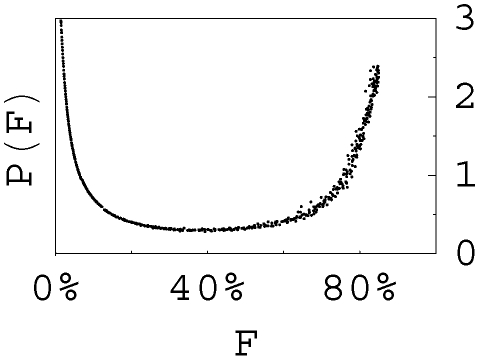
 , 50% mutated daughter cells, and selection strength
  . The calculation is terminated when the population in the GC recovers the initial size (3000 B cells), and F reaches 85% at the termination moment.
References
-
- MacLennan IC. Germinal centers. Annu Rev Immunol. 1994;12:117–139. - PubMed
-
- Rajewsky K. Clonal selection and learning in the antibody system. Nature. 1996;381:751–758. - PubMed
-
- Schwickert TA, Lindquist RL, Shakhar G, Livshits G, Skokos D, et al. In vivo imaging of germinal centres reveals a dynamic open structure. Nature. 2007;446:83–87. - PubMed
-
- Neuberger MS. Novartis Medal Lecture. Antibodies: a paradigm for the evolution of molecular recognition. Biochem Soc Trans. 2002;30:341–350. - PubMed
Publication types
MeSH terms
Grants and funding
LinkOut - more resources
Full Text Sources
Other Literature Sources