Review
. 2010 May-Jun;36(3):187-95.
doi: 10.1002/biof.96.

Emergence of protein kinase CK2 as a key target in cancer therapy

Affiliations
Review

Emergence of protein kinase CK2 as a key target in cancer therapy

Janeen H Trembley et al. Biofactors. 2010 May-Jun.

Abstract

Protein kinase CK2, a protein serine/threonine kinase, plays a global role in activities related to cell growth, cell death, and cell survival. CK2 has a large number of potential substrates localized in diverse locations in the cell including, for example, NF-kappaB as an important downstream target of the kinase. In addition to its involvement in cell growth and proliferation it is also a potent suppressor of apoptosis, raising its key importance in cancer cell phenotype. CK2 interacts with diverse pathways which illustrates the breadth of its impact on the cellular machinery of both cell growth and cell death giving it the status of a "master regulator" in the cell. With respect to cancer, CK2 has been found to be dysregulated in all cancers examined demonstrating increased protein expression levels and nuclear localization in cancer cells compared with their normal counterparts. We originally proposed CK2 as a potentially important target for cancer therapy. Given the ubiquitous and essential for cell survival nature of the kinase, an important consideration would be to target it specifically in cancer cells while sparing normal cells. Towards that end, our design of a tenascin based sub-50 nm (i.e., less than 50 nm size) nanocapsule in which an anti-CK2 therapeutic agent can be packaged is highly promising because this formulation can specifically deliver the cargo intracellularly to the cancer cells in vivo. Thus, appropriate strategies to target CK2 especially by molecular approaches may lead to a highly feasible and effective approach to eradication of a given cancer.


Figures
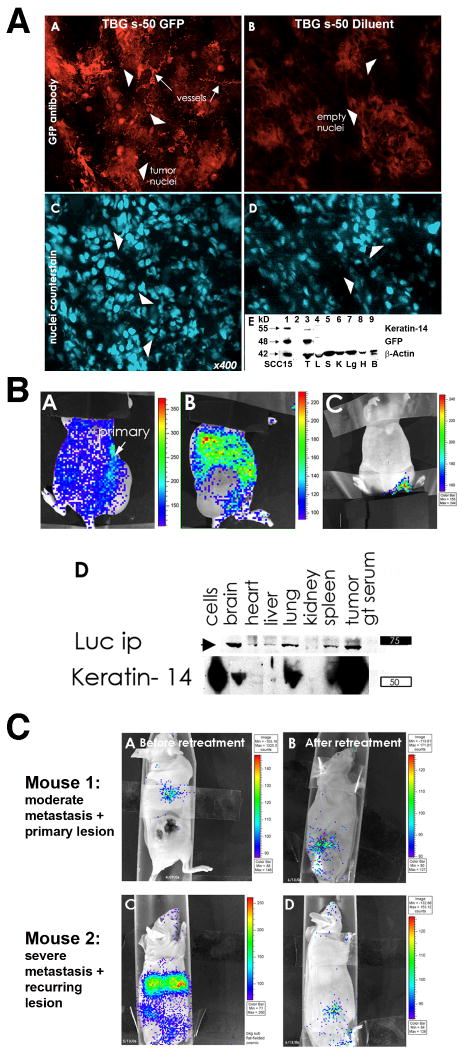
Fig. 1
Fig. 1. TBG s-50 nanocapsule tumor-homing and biodistribution in xenograft mice following systemic administration
A. TBG s-50 nanocapsules target tumor cells and tumor-derived microvessels following systemic distribution: Panels A-D - Tumor cryosections from mice bearing SCC-15 tongue carcinoma xenografts were immunodetected for nuclear GFP signal 3 weeks following i.p. administration at 0.2 mg/kg of TBG s-50 nanocapsules bearing nuclear-localized GFP plasmid (Panel A) or diluent (Panel B). Positioning of cell nuclei in tumors is depicted by bisbenzamide counterstain (Panels C,D). GFP immunosignal was located in the tumor-derived microvasculature (arrows, Panel A) and clusters of tumor cells (arrowheads, Panel A). Note the lack of nuclear GFP staining in the tumor sections from the TBG s-50 diluent injected mouse. Panel E - Immunoblot analysis of tumor and tissue lysates from mice treated with TBG s-50 nuclear GFP or diluent nanocapsules confirms microscopy by another method (only results for GFP treated mice shown). Lysates were subjected to electrophoresis on a 4-12% gradient gel and immunodetected for keratin-14 to identify tumor cells (Panel E-top line), GFP fusion protein (Panel E, middle line), and β-actin as a loading control (Panel E, lower line). The lanes contain the following samples: 1) GFP transfected SCC-15 cell line as positive control, 2) MW marker, 3) tumor, 4) liver, 5) spleen, 6) kidney, 7) lung, 8) heart and 9) brain. B. TBG s-50 nanocapsules deliver nucleic acid cargo specifically to tumor metastases. Panels A-D - A mouse with a large UM-11b laryngeal carcinoma xenograft flank tumor was injected i.p. with TBG s-50 nanocapsules containing 12.5 μg of luciferase plasmid and imaged using the Xenogen method 5 days later to allow for development of luciferase gene expression (Panels A,B). A control mouse, first injected with TBG s-50 nanocapsules bearing trehalose, was injected after 5 days with luciferin substrate and imaged together with the luciferase mouse for background control and comparison (Panel C). Luciferase signal was apparent in the viable rim of the cytolytic tumor mass (Panel A) and throughout the lung and abdominal region (Panel B). Large peritoneal metastases were encountered upon necropsy, but not assayed further. Panel D - Tissues from the metastases-burdened mouse were immunoprecipitated for luciferase, and the immunoprecipitates were analyzed by immunoblot along with lysate to correlate luciferase expression with the presence of keratin-14, a marker for head neck cancer. Substantial keratin-14 signal was co-present with luciferase protein signal in brain, lung, spleen and tumor. The lane labeled “cells” represents UM-11b cells used for xenograft injection. C. Existing metastases are cleared by TBG s-50 anti-CK2 nanocapsules in mice at ng/kg dosing. Panels A,C - Mice with SCC-15 tongue carcinoma xenografts were assayed for tumor burden 6 months following docetaxel/cisplatin treatment by the Xenogen method following i.p. administration of 12.5 μg of TBG s-50 luciferase plasmid. Panels B,D - Mice were administered additional tumor-targeted TBG s-50 luciferase plasmid nanocapsules and reimaged 4-6 weeks later following continual TBG s-50 anti-CK2 oligonucleotide nanocapsule treatment. The AB panel series was imaged after 6 weeks of 100 ng/kg q2d i.p. dosing together with topical 3 μg/ml TBG s-50 anti-CK2 oligonucleotide nanocapsule treatment for the last 2 weeks. The CD panel series was reimaged following 4 weeks of 100 ng/kg q2d i.p. treatment with TBG s-50 anti-CK2 oligonucleotide nanocapsules. Following reimaging, mice were treated with surgery (mouse in Panel B) or not (mouse in Panel D) and combination low-dose metronomic chemotherapy (20 μg/kg cisplatin, 1/1000 of murine MTD) with increasing doses of TBG s-50 anti-CK2 oligonucleotide nanocapsules before cessation of treatment. Mice were euthanized six months later at two years of age with no evidence of recurrence by imaging analysis.
Fig. 2
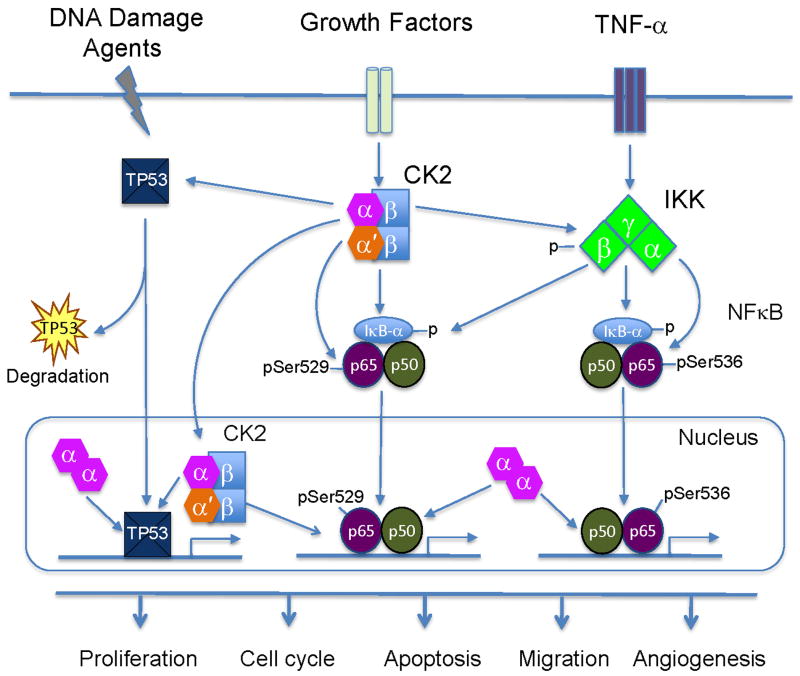
Fig. 2. Proposed model for CK2 modulation of NF-κB and TP53 pathways
Increased external signaling events, such as from TNF-α and other growth factors, bind and activate cell surface receptors, which induce aberrant CK2 and NF-κB activation. CK2 modulates IKKβ and IκBα phosphorylation and degradation, as well as promotes IKK mediated phosphorylation of NF-κB p65 at serine536. In addition, CK2 is able to directly phosphorylate p65 at serine529. At present, it is not clear if these phosphorylations occur on the same or different molecules. Activated NF-κB subunits translocate into the nucleus, bind to the NF-κB target gene promoters, and modulate transcriptional activity. In addition, CK2 is able to regulate TP53 and family members through protein phosphorylation, degradation, and modulation of expression. Abundant CK2α subunits are present in the nucleus of tumor cells and co-regulate NF-κB and TP53 family proteins and target gene expression. Thus, CK2 subunits regulate broad cellular functions affecting proliferation, cell cycle, apoptosis, migration and angiogenesis, which promote tumorigenesis of head and neck or other cancers. TNF-α: Tumor necrosis factor-α; NF-κB: nuclear factor κB; IKK: Inhibitor kappaB kinase; IκBα: Inhibitor κBα

References

    1. Allende JE, Allende CC. Protein kinase CK2 - an enzyme with multiple substrates and a puzzling regulation. FASEB J. 1995;9:313–323. - PubMed
    1. Ahmed K. Nuclear matrix and protein kinase CK2 signaling. Crit Rev Eukaryot Gene Expr. 1999;9:329–336. - PubMed
    1. Ahmed K, Gerber DA, Cochet C. Joining the cell survival squad: An emerging role for protein kinase CK2. Trends in Cell Biology. 2002;12:226–230. - PubMed
    1. Pinna LA. Protein kinase CK2: A challenge to canons. J Cell Sci. 2002;115:3873–3878. - PubMed
    1. Litchfield DW. Protein kinase CK2: Structure, regulation and role in cellular decisions of life and death. Biochem J. 2003;369:1–15. - PMC - PubMed

Publication types