. 2010 Jun 15;107(24):10967-71.
doi: 10.1073/pnas.1005256107. Epub 2010 Jun 1.

BH3 mimetics antagonizing restricted prosurvival Bcl-2 proteins represent another class of selective immune modulatory drugs

Affiliations

BH3 mimetics antagonizing restricted prosurvival Bcl-2 proteins represent another class of selective immune modulatory drugs

Emma M Carrington et al. Proc Natl Acad Sci U S A. .

Abstract

Death by apoptosis shapes tissue homeostasis. Apoptotic mechanisms are so universal that harnessing them for tailored immune intervention would seem challenging; however, the range and different expression levels of pro- and anti-apoptotic molecules among tissues offer hope that targeting only a subset of such molecules may be therapeutically useful. We examined the effects of the drug ABT-737, a mimetic of the killer BH3 domain of the Bcl-2 family of proteins that induces apoptosis by antagonizing Bcl-2, Bcl-X(L), and Bcl-W (but not Mcl-1 and A1), on the mouse immune system. Treatment with ABT-737 reduced the numbers of selected lymphocyte and dendritic cell subpopulations, most markedly in lymph nodes. It inhibited the persistence of memory B cells, the establishment of newly arising bone marrow plasma cells, and the induction of a cytotoxic T cell response. Preexisting plasma cells and germinal centers were unaffected. Notably, ABT-737 was sufficiently immunomodulatory to allow long-term survival of pancreatic allografts, reversing established diabetes in this model. These results provide an insight into the selective mechanisms of immune cell survival and how this selectivity avails a different strategy for immune modulation.


Conflict of interest statement

The authors declare no conflict of interest.

Figures
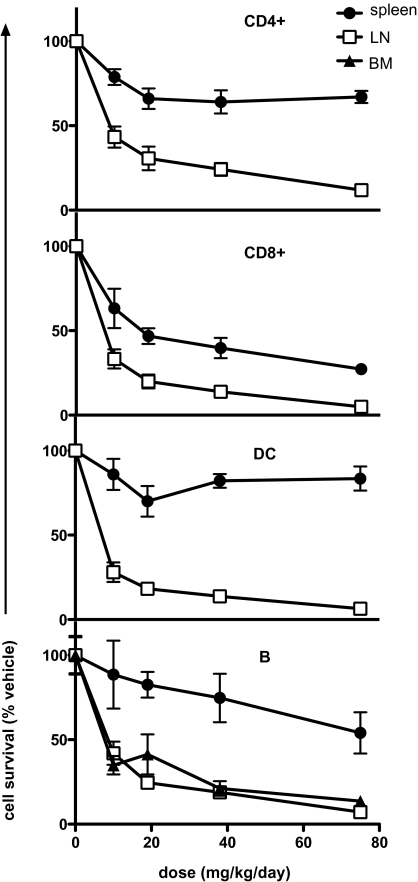
Fig. 1.
Fig. 1.
Selective reduction in immune cell subsets induced by in vivo ABT-737 treatment is proportional to drug dosage. B6 mice were treated daily with ABT-737 (10, 19, 38, or 75 mg/kg) or vehicle (0 mg/kg) for 14 consecutive d (n = 6). After treatment, LN, spleen, and BM were recovered and the proportion of T cells (CD4+,CD8+), B cells, and DC remaining in the organs was determined by flow cytometry. All data are shown as a proportion (%) of the average number of cell subsets isolated from vehicle-treated mice, with means ± SE from individual drug-treated mice.
Fig. 2.
Fig. 2.
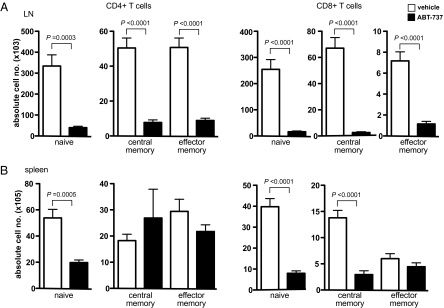
In vivo ABT-737 treatment affects all naïve and memory T cells in LN, while sparing central memory and effector memory CD4+, and effector memory CD8+ T cell subsets in spleen. B6 mice were treated daily for 14 consecutive d with either ABT-737 (75 mg/kg) or vehicle control (n = 5–6). After treatment, LN (A) and spleen (B) were recovered and the number of naïve (CD62Lhi CD44lo), central memory (CD62Lhi CD44hi), and effector memory (CD62Llo CD44hi) CD4+ and CD8+ T cell subsets determined by flow cytometry. All data are expressed as the means ± SE from individual mice.
Fig. 3.
Fig. 3.
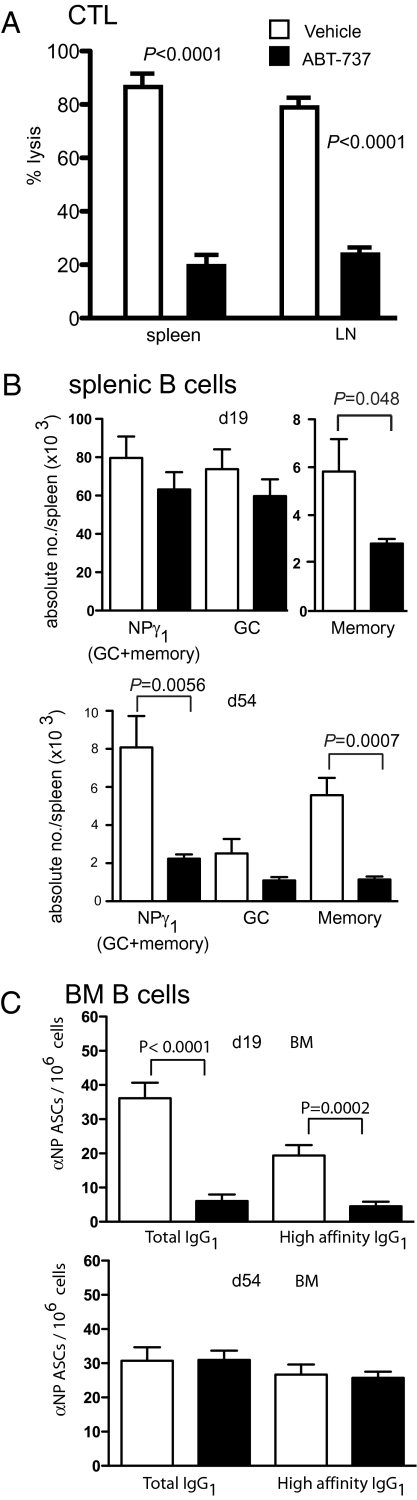
In vivo CTL and B cell responses against exogenous antigen are inhibited by ABT-737 treatment. (A) B6 mice were treated daily for 14 consecutive d with either ABT-737 (75 mg/kg) (n = 8) or vehicle control (n = 8). On treatment day 6, mice were primed in vivo with irradiated, ovalbumin-coated splenocytes (OCS) and endogenous in vivo CTL responses measured in spleen and lymph node after 7 d. Means ± SE are shown. (B) B6 mice were immunized with NP-KLH in alum and then treated with ABT-737 (75 mg/kg) or vehicle control for 14 consecutive d starting either day 5 or day 40 after immunization. Spleens were analyzed for NP-specific GC or memory B cells on day 19 (Upper) or 54 (Lower). (C) Frequencies of total (NP20) and high affinity (NP2) NP-specific IgG1 ASCs in BM on day 19 (Upper) or 54 (Lower) after immunization. Data are the average means ± SE of between six to eight mice for each group at each time point.
Fig. 4.
Fig. 4.
Allogenic islet graft rejection is ameliorated by in vivo ABT-737 treatment. 50-1/CBA nonautoimmune diabetic mice were treated daily for 14 consecutive d with either ABT-737 (50 mg/kg) or vehicle control. On treatment day 6, mice received an allogenic graft of F1 (B6 × SJL) islets transplanted under the kidney capsule. Blood glucose was measured at various times after transplantation. Grafts were deemed successful if normal blood glucose (<15 mmol/L) levels were achieved within 4 d after transplantation. Islets grafts transplanted into ABT-737–treated recipients functioned significantly longer than grafts transplanted into vehicle control-treated recipients (no icon) (P < 0.002 as determined by a log-rank test).

References

    1. Augustine JJ, Bodziak KA, Hricik DE. Use of sirolimus in solid organ transplantation. Drugs. 2007;67:369–391. - PubMed
    1. Knoll G. Trends in kidney transplantation over the past decade. Drugs. 2008;68(Suppl 1):3–10. - PubMed
    1. Strasser A. The role of BH3-only proteins in the immune system. Nat Rev Immunol. 2005;5:189–200. - PubMed
    1. Green DR. Apoptotic pathways: Ten minutes to dead. Cell. 2005;121:671–674. - PubMed
    1. Newmeyer DD, Ferguson-Miller S. Mitochondria: releasing power for life and unleashing the machineries of death. Cell. 2003;112:481–490. - PubMed

Publication types

MeSH terms

LinkOut - more resources