. 2010 Jun 15;107(24):11080-5.
doi: 10.1073/pnas.1006584107. Epub 2010 Jun 1.

Plasma membrane insertion of the AMPA receptor GluA2 subunit is regulated by NSF binding and Q/R editing of the ion pore

Affiliations

Plasma membrane insertion of the AMPA receptor GluA2 subunit is regulated by NSF binding and Q/R editing of the ion pore

Yoichi Araki et al. Proc Natl Acad Sci U S A. .

Abstract

The delivery of AMPA receptors to the plasma membrane is a critical step both for the synaptic delivery of these receptors and for the regulation of synaptic transmission. To directly visualize fusion events of transport vesicles containing the AMPA receptor GluA2 subunit with the plasma membrane we used pHluorin-tagged GluA2 subunits and total internal reflection fluorescence microscopy. We demonstrate that the plasma membrane insertion of GluA2 requires the NSF binding site within its intracellular cytoplasmic domain and that RNA editing of the Q/R site in the ion channel region plays a key role in GluA2 plasma membrane insertion. Finally, we show that plasma membrane insertion of heteromeric GluA2/3 receptors follows the same rules as homomeric GluA2 receptors. These results demonstrate that the plasma membrane delivery of GluA2 containing AMPA receptors is regulated by its unique structural elements.


Conflict of interest statement

The authors declare no conflict of interest.

Figures
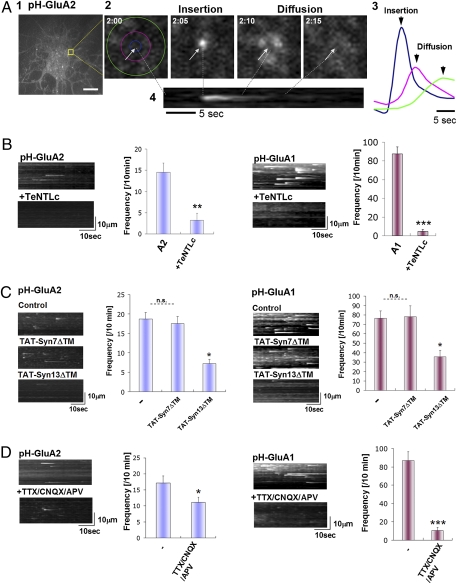
Fig. 1.
Fig. 1.
Direct imaging of GluA2 plasma membrane insertion events. (A) Representative images of GluA2 insertion events (1). Detection of pH-GluA2 insertion events over a 10-min time period in hippocampal neurons visualized using TIRF microscopy (Scale bar, 10 μm.) (2). Representative images of the time course of pH-GluA2 insertion and diffusion (3). Quantification of fluorescence change over time demonstrates lateral diffusion of pH-GluA2 following insertion (4). Y–t projection image shows MIP of the insertion event shown in (2) and (3). (B) Insertion of GluA1 and GluA2 is dependent of VAMP2. Cotransfection of TeNTLc abolished both GluA1 and GluA2 insertion events. Examples of the MIPs and quantitation of the insertion events are shown (means ± SEM, n = 12). (C) Effect of recycling inhibitor (TAT-Syn7/13ΔTM) on GluA1 and 2 insertion events frequency per 10 min. Only TAT-Syn13 ΔTM reduced both GluA1 and 2 insertion. Examples of the MIPs and quantitation of the insertion events are shown (means ± SEM, n = 10). (D) Acute activity block (TTX/CNQX/APV treatment) abolished most of GluA1 insertion, whereas this treatment had a smaller effect on GluA2 insertion. Examples of the MIPs and quantitation of the insertion events are shown (means ± SEM, n = 11).
Fig. 2.
Fig. 2.
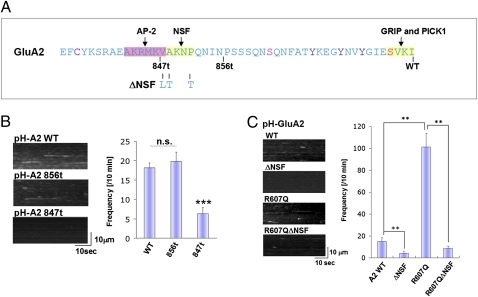
The NSF binding site is important for GluA2 insertion. (A) Mapping of GluA2 C-terminal region responsible for efficient insertion. GluA2 C-terminal sequence; the truncation and point mutants used in this study are indicated. (B) The GluA2 856t mutant has no effect on GluA2 insertion, whereas GluA2 847t mutant abolished its insertion. Examples of the MIPs and quantitation of the insertion events are shown (means ± SEM, n = 12). (C) Effect of GluA2 ΔNSF and R607Q to GluA2 insertion frequency. Mutation of the NSF site and the Q/R site significantly affect the insertion frequency. Examples of the MIPs and quantitation of the insertion events are shown (means ± SEM, n = 14).
Fig. 3.
Fig. 3.
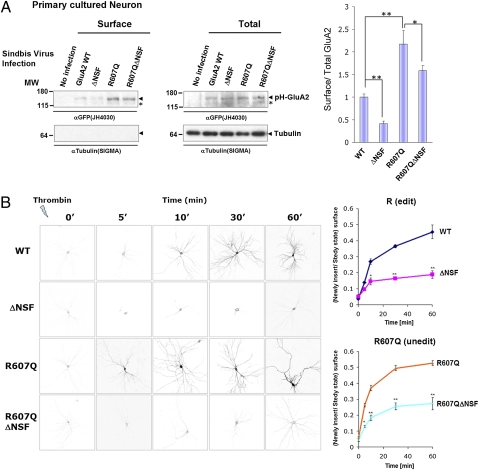
The NSF binding site is important for efficient delivery of GluA2 to plasma membrane. (A) Surface expression of GluA2 constructs in hippocampal neurons probed using a surface biotinylation assay. Hippocampal neurons were infected with Sindbis virus expressing the indicated GluA2 construct and the surface receptor analyzed using biotinylation techniques. The surface fraction precipitated by streptoavidin-beads (surface) and the total lysate (total) is shown. The graph shows the ratio of surface GluA2/total GluA2 (means ± SEM, n = 3). (B) Newly inserted GluA2 time course. Neurons expressing pH-GluA2 were treated by Thrombin for 5 min. After thoroughly washing the coverslip, the cells were incubated for the indicated times. The graph shows the recovery of surface receptors over time (means ± SEM, n = 3, each time point). We set steady state ratio of surface/total GluA2 is 1.
Fig. 4.
Fig. 4.
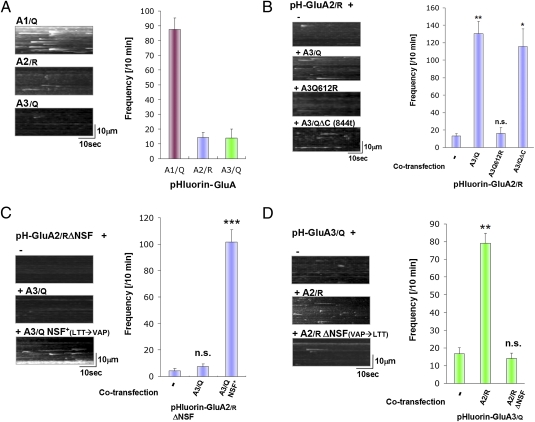
The NSF binding site and unedited residue (Q) is required for efficient insertion of GluA2/3 heteromers. (A) Insertion frequency for pH-GluA1/Q, GluA2/R, GluA3/Q when they were expressed alone in hippocampal neurons. R or Q indicates edited (R) or unedited (Q) amino acid in pore region of each AMPA receptor subunits. Examples of the MIPs and quantitation of the insertion events are shown (means ± SEM, n = 11). (B) Effect of GluA3 coexpression for GluA2/R insertion frequency. Examples of the MIPs and quantitation of the insertion events are shown (means ± SEM: n = 11). (C) Effect of coexpression of GluA3/Q containing an artificial NSF binding sequence on GluA2/R ΔNSF insertion frequency. Examples of the MIPs and quantitation of the insertion events are shown (means ± SEM, n = 12). (D) Effect of GluR2 coexpression for pH-GluA3/Q insertion events. GluA2 carrying the NSF binding sequence facilitates GluA3 insertion event frequency. Examples of the MIPs and quantitation of the insertion events are shown (means ± SEM, n = 12).

References

    1. Dingledine R, Borges K, Bowie D, Traynelis SF. The glutamate receptor ion channels. Pharmacol Rev. 1999;51:7–61. - PubMed
    1. Malenka RC, Bear MF. LTP and LTD: An embarrassment of riches. Neuron. 2004;44:5–21. - PubMed
    1. Collingridge GL, Isaac JT, Wang YT. Receptor trafficking and synaptic plasticity. Nat Rev Neurosci. 2004;5:952–962. - PubMed
    1. Bredt DS, Nicoll RA. AMPA receptor trafficking at excitatory synapses. Neuron. 2003;40:361–379. - PubMed
    1. Hollmann M, Heinemann S. Cloned glutamate receptors. Annu Rev Neurosci. 1994;17:31–108. - PubMed

Publication types

MeSH terms

LinkOut - more resources