


Exploiting mosquito sugar feeding to detect mosquito-borne pathogens
- PMID: 20534559
- PMCID: PMC2895145
- DOI: 10.1073/pnas.1002040107
Exploiting mosquito sugar feeding to detect mosquito-borne pathogens
Abstract
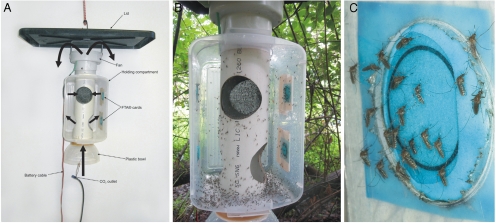
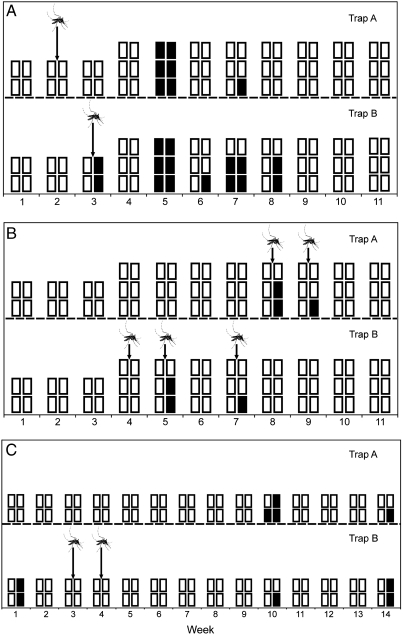
Arthropod-borne viruses (arboviruses) represent a global public health problem, with dengue viruses causing millions of infections annually, while emerging arboviruses, such as West Nile, Japanese encephalitis, and chikungunya viruses have dramatically expanded their geographical ranges. Surveillance of arboviruses provides vital data regarding their prevalence and distribution that may be utilized for biosecurity measures and the implementation of disease control strategies. However, current surveillance methods that involve detection of virus in mosquito populations or sero-conversion in vertebrate hosts are laborious, expensive, and logistically problematic. We report a unique arbovirus surveillance system to detect arboviruses that exploits the process whereby mosquitoes expectorate virus in their saliva during sugar feeding. In this system, infected mosquitoes captured by CO(2)-baited updraft box traps are allowed to feed on honey-soaked nucleic acid preservation cards within the trap. The cards are then analyzed for expectorated virus using real-time reverse transcription-PCR. In field trials, this system detected the presence of Ross River and Barmah Forest viruses in multiple traps deployed at two locations in Australia. Viral RNA was preserved for at least seven days on the cards, allowing for long-term placement of traps and continuous collection of data documenting virus presence in mosquito populations. Furthermore no mosquito handling or processing was required and cards were conveniently shipped to the laboratory overnight. The simplicity and efficacy of this approach has the potential to transform current approaches to vector-borne disease surveillance by streamlining the monitoring of pathogens in vector populations.
Conflict of interest statement
The authors declare no conflict of interest.
Figures
References
-
- Gould EA, Solomon T. Pathogenic flaviviruses. Lancet. 2008;371:500–509. - PubMed
-
- Staples JE, Breiman RF, Powers AM. Chikungunya fever: An epidemiological review of a re-emerging infectious disease. Clin Infect Dis. 2009;49:942–948. - PubMed
-
- Eisen L, Beaty BJ, Morrison AC, Scott TW. Proactive vector control strategies and improved monitoring and evaluation practices for dengue prevention. J Med Entomol. 2009;46:1245–1255. - PubMed
-
- Hanna JN, et al. Japanese encephalitis in north Queensland, Australia, 1998. Med J Aust. 1999;170:533–536. - PubMed
Publication types
MeSH terms
Substances
LinkOut - more resources
Full Text Sources
Other Literature Sources
