


Effect of anxiety on treatment presentation and outcome: results from the Marijuana Treatment Project
- PMID: 20537406
- PMCID: PMC2914117
- DOI: 10.1016/j.psychres.2009.10.010
Effect of anxiety on treatment presentation and outcome: results from the Marijuana Treatment Project
Abstract
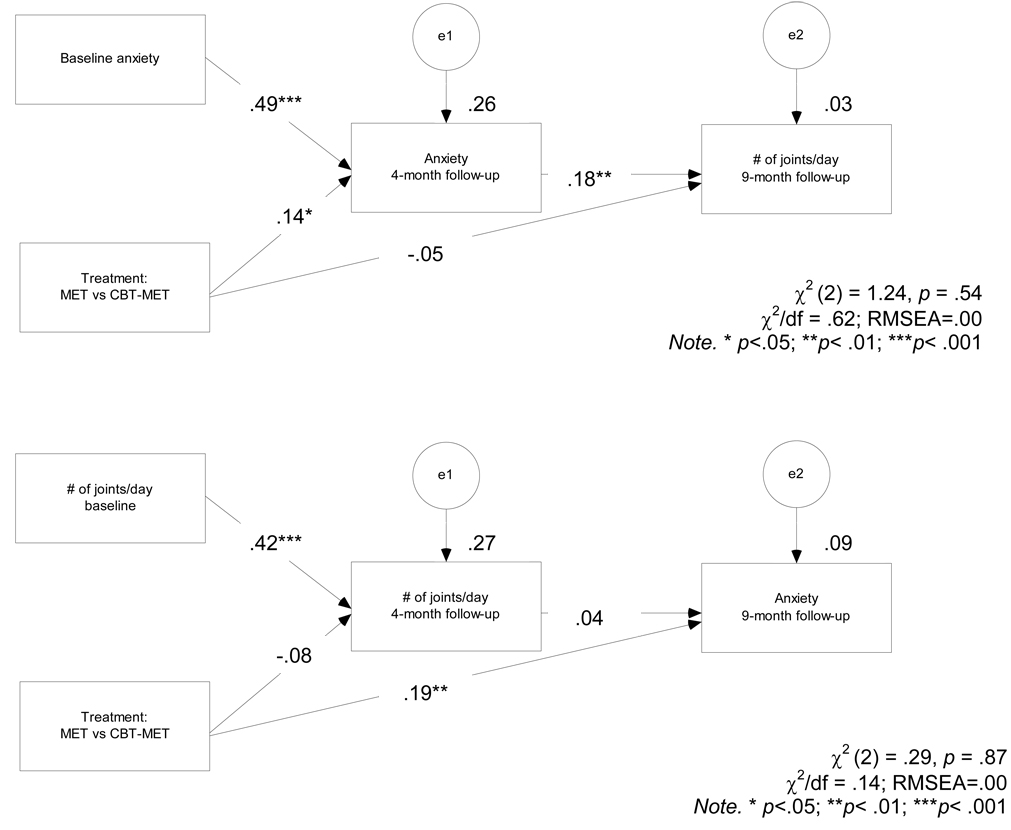
Despite emerging evidence of the efficacy of psychotherapies for marijuana dependence, variability in outcome exists. This study examined the role of anxiety on treatment involvement and outcome. Four questions were examined: (1) Is greater anxiety associated with greater impairment at baseline? (2) Is baseline anxiety related to greater marijuana use and problems following treatment? (3) Does adding cognitive-behavioral therapy (CBT) to motivation enhancement therapy (MET) reduce anxiety relative to MET alone; (4) Are reductions in anxiety associated with better outcomes? The sample comprised 450 marijuana-dependent patients in the Marijuana Treatment Project. Marijuana use and anxiety were measured at pretreatment and 4- and 9-month follow-ups. At baseline, anxiety was linked to more marijuana-related problems. CBT was associated with less anxiety at follow-up compared to MET alone. Reductions in anxiety were related to less marijuana use. In fact, reduction in anxiety from baseline to 4-month follow-up was associated with less marijuana use at 9 months, but reduction in marijuana use did not predict subsequent anxiety. Data suggest that anxiety is an important variable that deserves further attention in marijuana-dependence treatment.
Copyright (c) 2009 Elsevier Ltd. All rights reserved.
Figures
References
-
- Arendt M, Rosenberg R, Foldager L, Perto G, Munk-Jorgensen P. Psychopathology among cannabis-dependent treatment seekers and association with later substance abuse treatment. Journal of Substance Abuse Treatment. 2007;32:113–119. - PubMed
-
- Barnes LLB, Harp D, Jung WS. Reliability generalization of scores on the Spielberger State-Trait Anxiety Inventory. Educational and Psychological Measurement. 2002;62:603–618.
-
- Beck AT, Ward CH, Mendelson M. An inventory for measuring depression. Archives of General Psychiatry. 1961;4:461–471. - PubMed
-
- Buckner JD. Motivation enhancement therapy can increase utilization of cognitive-behavioral therapy: The case of social anxiety disorder. Journal of Clinical Psychology. in press. - PubMed
Publication types
MeSH terms
Grants and funding
- K05 DA00457/DA/NIDA NIH HHS/United States
- P50 DA009241/DA/NIDA NIH HHS/United States
- UR4 TI11274/TI/CSAT SAMHSA HHS/United States
- K05 DA000457/DA/NIDA NIH HHS/United States
- R01 DA015969/DA/NIDA NIH HHS/United States
- UR4 TI 11310/TI/CSAT SAMHSA HHS/United States
- F31 DA021457/DA/NIDA NIH HHS/United States
- P50 DA09241/DA/NIDA NIH HHS/United States
- R25 DA020515/DA/NIDA NIH HHS/United States
- UR4 TI11270/TI/CSAT SAMHSA HHS/United States
- R37 DA015969/DA/NIDA NIH HHS/United States
- UR4 TI11273/TI/CSAT SAMHSA HHS/United States
- R37 DA 015969/DA/NIDA NIH HHS/United States
LinkOut - more resources
Full Text Sources
Medical
Miscellaneous
