


Validation of the safety of MDCK cells as a substrate for the production of a cell-derived influenza vaccine
- PMID: 20537553
- PMCID: PMC7129197
- DOI: 10.1016/j.biologicals.2010.04.003
Validation of the safety of MDCK cells as a substrate for the production of a cell-derived influenza vaccine
Abstract
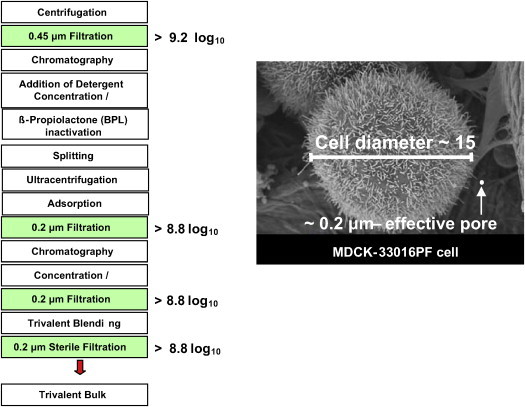
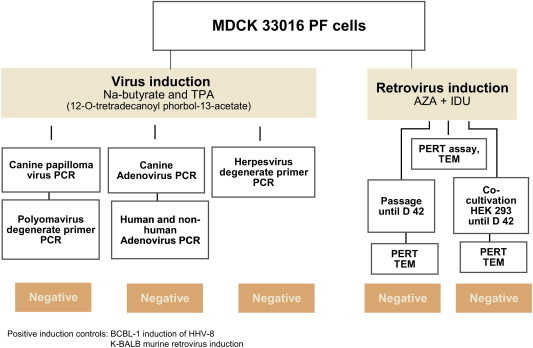
Cell culture-based production methods may assist in meeting increasing demand for seasonal influenza vaccines and developing production flexibility required for addressing influenza pandemics. MDCK-33016PF cells are used in propagation of a cell-based seasonal influenza vaccine (Optaflu); but, like most continuous cell lines, can grow in immunocompromised mice to produce tumors. It is, therefore, essential that no residual cells remain within the vaccine, that cell lysates or DNA are not oncogenic, and that the cell substrate does not contain oncogenic viruses or oncogenic DNA. Multiple, redundant processes ensure the safety of influenza vaccines produced in MDCK-33016PF cells. The probability of a residual cell being present in a dose of vaccine is approximately 1 in 10(34). Residual MDCK-DNA is < or =10 ng per dose and the ss-propiolactone used to inactivate influenza virus results in reduction of detectable DNA to less than 200 base pairs (bp). Degenerate PCR and specific PCR confirm exclusion of oncogenic viruses. The manufacturing process has been validated for its capacity to remove and inactivate viruses. We conclude that the theoretical risks arising from manufacturing seasonal influenza vaccine using MDCK-33016PF cells are reduced to levels that are effectively zero by the multiple, orthogonal processes used during production.
Copyright 2010 The International Association for Biologicals. Published by Elsevier Ltd. All rights reserved.
Figures

References
-
- World Health Organization (WHO) Influenza vaccines. Wkly Epidemiol Rec. 2005;80:277–288.
-
- Fiore A.E., Shay D.K., Broder K., Iskander J.K., Uyeki T.M., Mootrey G. Prevention and control of seasonal influenza with vaccines, recommendations of the advisory committee on immunization practices (ACIP) MMWR. 2009;58:1–52. - PubMed
-
- Coop C.A., Balanon S.K., White K.M., Whisman B.A., Rathkopf M.M. Anaphylaxis from the influenza virus vaccine. Int Arch Allergy Immunol. 2008;146(1):85–88. - PubMed
-
- Zeiger R.S. Current issues with influenza vaccination in egg allergy. J Allergy Clin Immunol. 2002;110:834–840. - PubMed
-
- Lu B., Zhou H., Chan W., Kemble G., Jin H. Single amino acid substitutions in the hemagglutinin of influenza A/Singapore/21/04 (H3N2) increase virus growth in embryonated chicken eggs. Vaccine. 2006;24:6691–6693. - PubMed
Publication types
MeSH terms
Substances
Grants and funding
LinkOut - more resources
Full Text Sources
Other Literature Sources
Medical
