


Impact of poverty on serum phosphate concentrations in the Third National Health and Nutrition Examination Survey
- PMID: 20537917
- PMCID: PMC2937203
- DOI: 10.1053/j.jrn.2010.03.001
Impact of poverty on serum phosphate concentrations in the Third National Health and Nutrition Examination Survey
Abstract
Objective: Increased serum phosphate is associated with adverse health outcomes. High intake of inexpensive processed and fast foods is common in impoverished communities, and is linked with excessive dietary phosphorus intake and elevated serum phosphate concentrations in chronic kidney disease patients. We examined the impact of socioeconomic status on dietary phosphorus intake and serum phosphate concentrations in the general population.
Design: Cross-sectional study.
Participants: A total of 14,261 adult participants in the Third National Health and Nutrition Examination Survey. PREDICTORS AND OUTCOMES: Poverty to income ratio (PIR; family income indexed to the federal poverty level) was the primary index of socioeconomic status. Serum phosphate was the primary outcome variable.
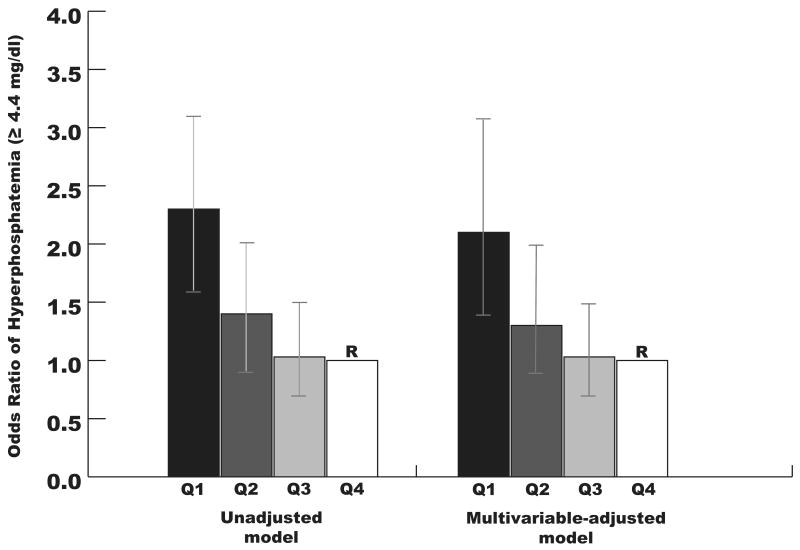
Results: Although estimated phosphorus intake decreased with decreasing quartiles of PIR (P < .001), serum phosphate was inversely associated with PIR (P = .003). The relationship between lower PIR and higher serum phosphate remained significant after adjustment for demographic, laboratory, and dietary intake characteristics (P = .02). Compared with participants in the highest PIR quartile (income >300% of the federal poverty level), participants in the lowest quartile (income < the federal poverty level) had more than twice the odds of hyperphosphatemia (≥ 4.4 mg/dL) in unadjusted and multivariable-adjusted logistic regression analyses (OR, 2.2; 95% CI, 1.5 to 3.2).
Conclusions: Although lower income was associated with decreased estimated phosphorus intake, increasing poverty was independently linked with increased serum phosphate and higher likelihood of hyperphosphatemia. These findings may indicate that conventional dietary instruments underestimate phosphorus intake, especially among impoverished individuals. Further studies are needed to explore these possibilities.
Copyright © 2011 National Kidney Foundation, Inc. Published by Elsevier Inc. All rights reserved.
Figures
References
-
- Dhingra R, Sullivan LM, Fox CS, et al. Relations of serum phosphorus and calcium levels to the incidence of cardiovascular disease in the community. Arch Intern Med. 2007;167:879–85. - PubMed
-
- Kestenbaum B, Sampson JN, Rudser KD, et al. Serum phosphate levels and mortality risk among people with chronic kidney disease. J Am Soc Nephrol. 2005;16:520–8. - PubMed
-
- Schwarz S, Trivedi B, Kalanter-Zadeh K, Kovesdy C. Association of Disorders of Mineral Metabolism with Progression of Chronic Kidney Disease. Clin J Am Soc Nephrol. 2006;1:825–831. - PubMed
-
- Tonelli M, Sacks F, Pfeffer M, Gao Z, Curhan G. Relation between serum phosphate level and cardiovascular event rate in people with coronary disease. Circulation. 2005;112:2627–33. - PubMed
Publication types
MeSH terms
Substances
Grants and funding
LinkOut - more resources
Full Text Sources
