


The pattern of expression of guanine nucleotide-binding protein beta3 in the retina is conserved across vertebrate species
- PMID: 20538044
- PMCID: PMC2914127
- DOI: 10.1016/j.neuroscience.2010.05.081
The pattern of expression of guanine nucleotide-binding protein beta3 in the retina is conserved across vertebrate species
Abstract
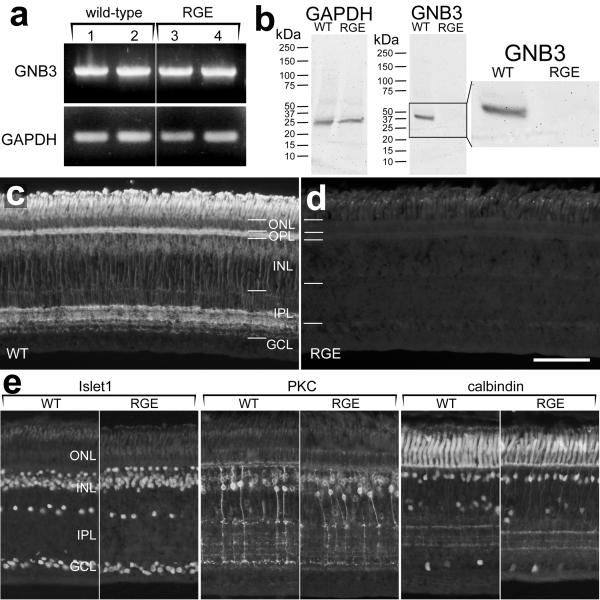
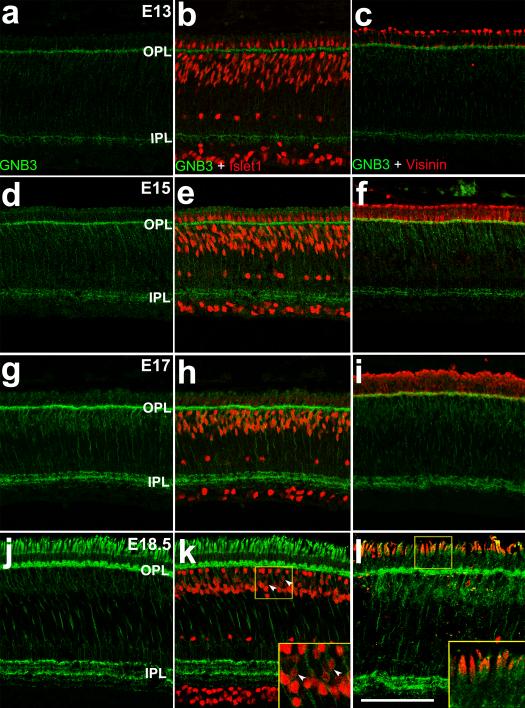
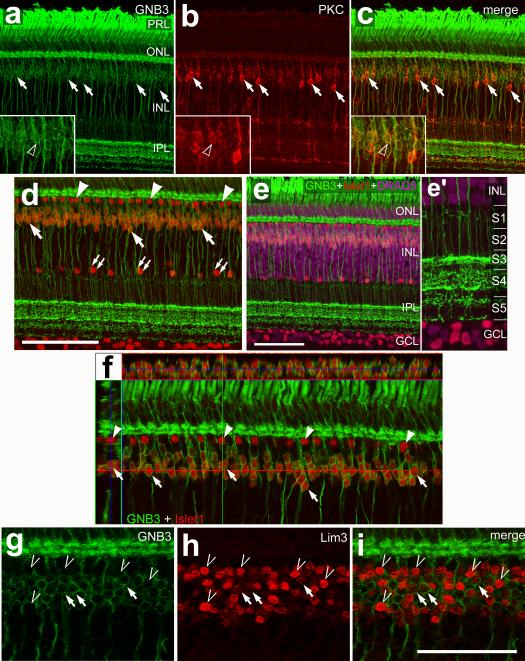
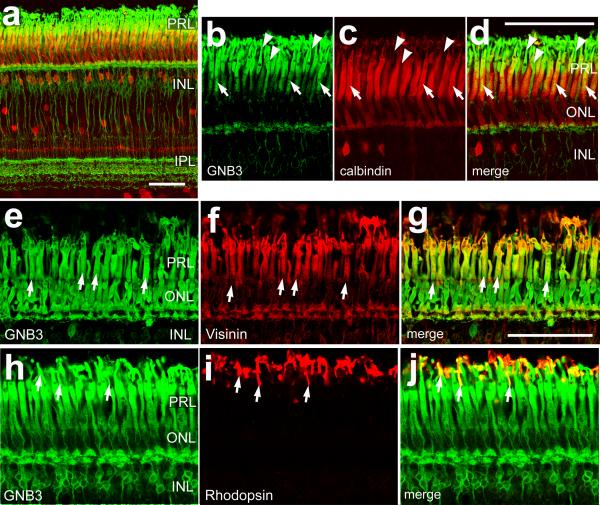
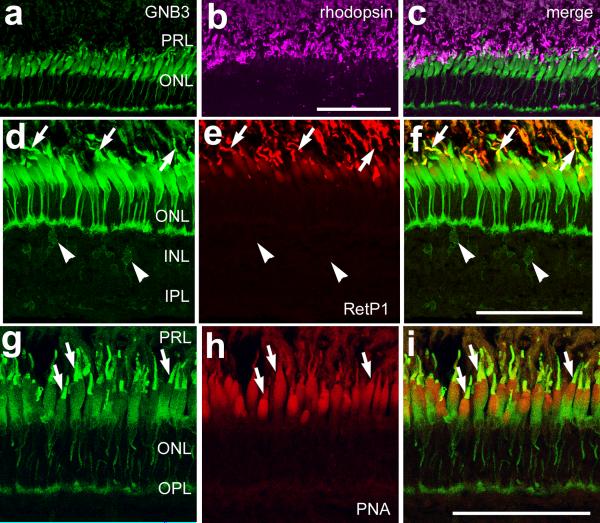
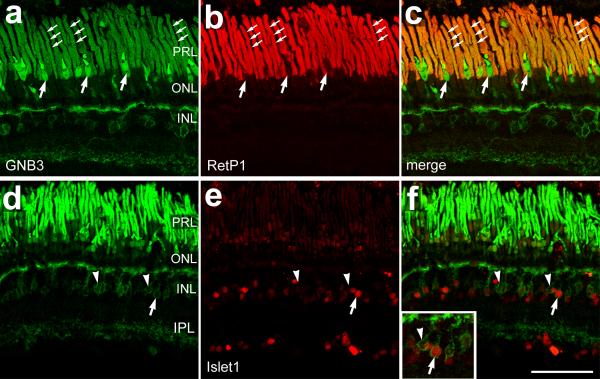
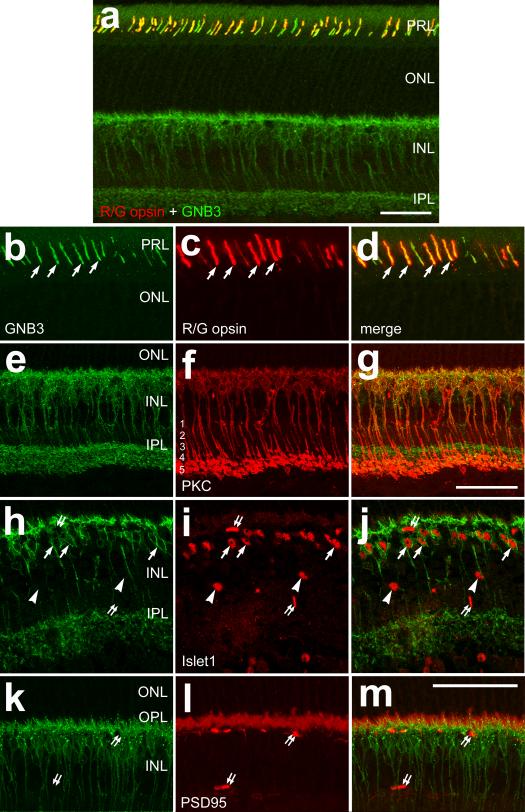
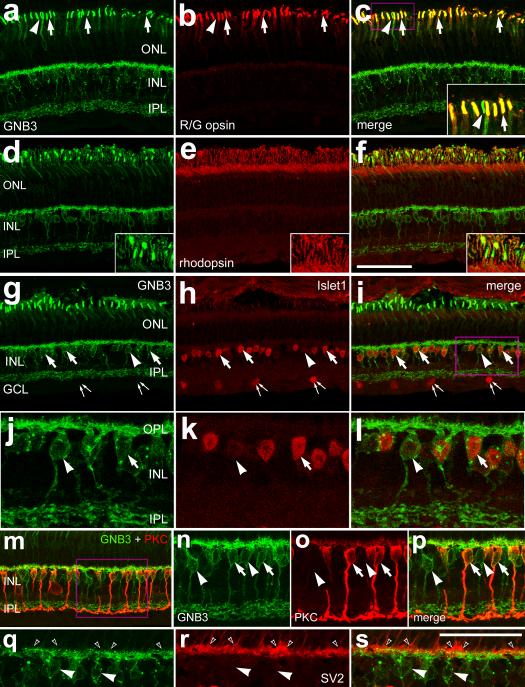
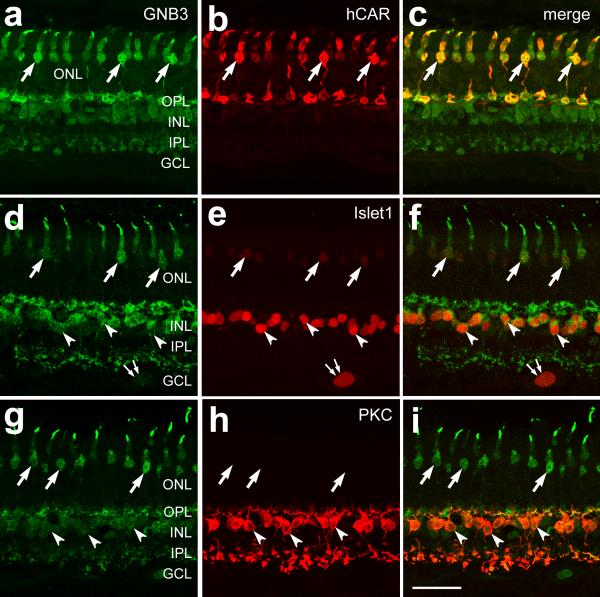
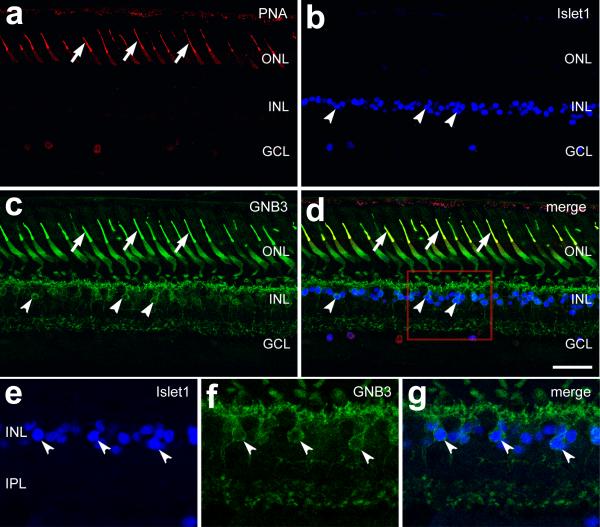
Guanine nucleotide-binding protein beta3 (GNB3) is an isoform of the beta subunit of the heterotrimeric G protein second messenger complex that is commonly associated with transmembrane receptors. The presence of GNB3 in photoreceptors, and possibly bipolar cells, has been confirmed in murine, bovine and primate retinas [Lee RH, Lieberman BS, Yamane HK, Bok D, Fung BK (1992) J Biol Chem 267:24776-24781; Peng YW, Robishaw JD, Levine MA, Yau KW (1992) Proc Natl Acad Sci U S A 89:10882-10886; Huang L, Max M, Margolskee RF, Su H, Masland RH, Euler T (2003) J Comp Neurol 455:1-10]. Studies have indicated that a mutation in the GNB3 gene causes progressive retinopathy and globe enlargement (RGE) in chickens. The goals of this study were to (1) examine the expression pattern of GNB3 in wild-type and RGE mutant chickens, (2) characterize the types of bipolar cells that express GNB3 and (3) examine whether the expression of GNB3 in the retina is conserved across vertebrate species. We find that chickens homozygous for the RGE allele completely lack GNB3 protein. We find that the pattern of expression of GNB3 in the retina is highly conserved across vertebrate species, including teleost fish (Carassius auratus), frogs (Xenopus laevis), chickens (Gallus domesticus), mice (Mus musculata), guinea-pigs (Cavia porcellus), dogs (Canis familiaris) and non-human primates (Macaca fasicularis). Regardless of the species, we find that GNB3 is expressed by Islet1-positive cone ON-bipolar cells and by cone photoreceptors. In some vertebrates, GNB3-immunoreactivity was observed in both rod and cone photoreceptors. A protein-protein alignment of GNB3 across different vertebrates, from fish to humans, indicates a high degree (>92%) of sequence conservation. Given that analogous types of retinal neurons express GNB3 in different species, we propose that the functions and the mechanisms that regulate the expression of GNB3 are highly conserved.
Copyright (c) 2010 IBRO. Published by Elsevier Ltd. All rights reserved.
Figures
References
-
- Aartsen WM, Kantardzhieva A, Klooster J, van Rossum AG, van de Pavert SA, Versteeg I, Cardozo BN, Tonagel F, Beck SC, Tanimoto N, Seeliger MW, Wijnholds J. Mpp4 recruits Psd95 and Veli3 towards the photoreceptor synapse. Hum Mol Genet. 2006;15:1291–1302. - PubMed
-
- Blanks JC, Johnson LV. Specific binding of peanut lectin to a class of retinal photoreceptor cells. A species comparison. Invest Ophthalmol Vis Sci. 1984;25:546–557. - PubMed
-
- Brann MR, Cohen LV. Diurnal expression of transducin mRNA and translocation of transducin in rods of rat retina. Science. 1987;235:585–587. - PubMed
-
- Cabrera-Vera TM, Vanhauwe J, Thomas TO, Medkova M, Preininger A, Mazzoni MR, Hamm HE. Insights into G protein structure, function, and regulation. Endocr Rev. 2003;24:765–781. - PubMed
Publication types
MeSH terms
Substances
Grants and funding
LinkOut - more resources
Full Text Sources
Miscellaneous
