


Dicarboxylate carrier-mediated glutathione transport is essential for reactive oxygen species homeostasis and normal respiration in rat brain mitochondria
- PMID: 20538765
- PMCID: PMC2928630
- DOI: 10.1152/ajpcell.00058.2010
Dicarboxylate carrier-mediated glutathione transport is essential for reactive oxygen species homeostasis and normal respiration in rat brain mitochondria
Abstract
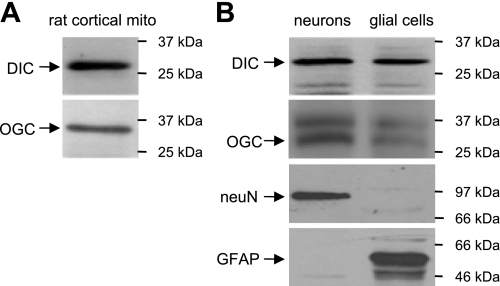
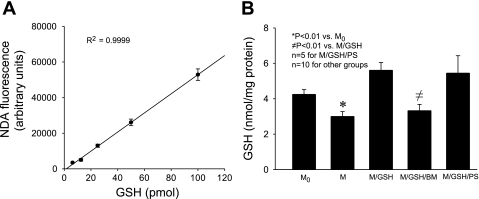
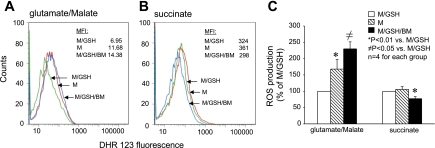
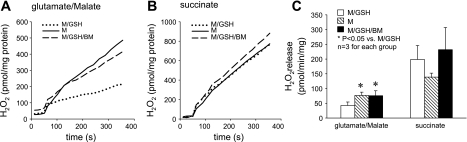
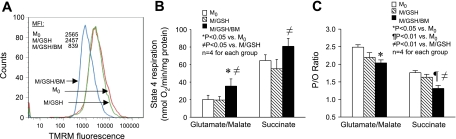
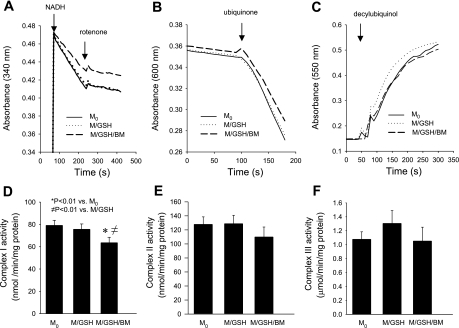
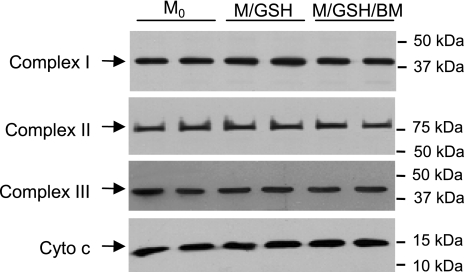
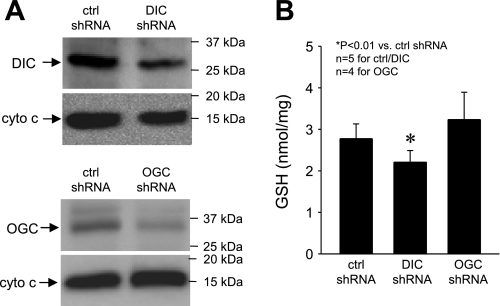
Glutathione transport into mitochondria is mediated by oxoglutarate (OGC) and dicarboxylate carrier (DIC) in the kidney and liver. However, transport mechanisms in brain mitochondria are unknown. We found that both carriers were expressed in the brain. Using cortical mitochondria incubated with physiological levels of glutathione, we found that butylmalonate, a DIC inhibitor, reduced mitochondrial glutathione to levels similar to those seen in mitochondria incubated without extramitochondrial glutathione (59% of control). In contrast, phenylsuccinate, an OGC inhibitor, had no effect (97% of control). Additional experiments with DIC and OGC short hairpin RNA in neuronal-like PC12 cells resulted in similar findings. Significantly, DIC inhibition resulted in increased reactive oxygen species (ROS) content in and H(2)O(2) release from mitochondria. It also led to decreased membrane potential, increased basal respiration rates, and decreased phosphorus-to-oxygen (P/O) ratios, especially when electron transport was initiated from complex I. Accordingly, we found that DIC inhibition impaired complex I activity, but not those for complexes II and III. This impairment was not associated with dislodgment of complex subunits. These results suggest that DIC is the main glutathione transporter in cortical mitochondria and that DIC-mediated glutathione transport is essential for these mitochondria to maintain ROS homeostasis and normal respiratory functions.
Figures
References
-
- Anderson MF, Sims NR. The effects of focal ischemia and reperfusion on the glutathione content of mitochondria from rat brain subregions. J Neurochem 81: 541–549, 2002 - PubMed
-
- Andreyev A, Kushnareva Y, Starkov A. Mitochondrial metabolism of reactive oxygen species. Biochemistry (Mosc) 70: 200–214, 2005 - PubMed
-
- Armstrong JS, Jones DP. Glutathione depletion enforces the mitochondrial permeability transition and causes cell death in Bcl-2 overexpressing HL60 cells. FASEB J 16: 1263–1265, 2002 - PubMed
Publication types
MeSH terms
Substances
Grants and funding
LinkOut - more resources
Full Text Sources
Molecular Biology Databases
