


The roles of somatostatin-expressing (GIN) and fast-spiking inhibitory interneurons in UP-DOWN states of mouse neocortex
- PMID: 20538767
- PMCID: PMC2934925
- DOI: 10.1152/jn.00206.2010
The roles of somatostatin-expressing (GIN) and fast-spiking inhibitory interneurons in UP-DOWN states of mouse neocortex
Abstract
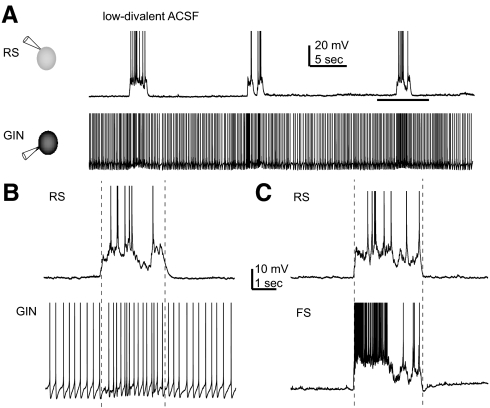
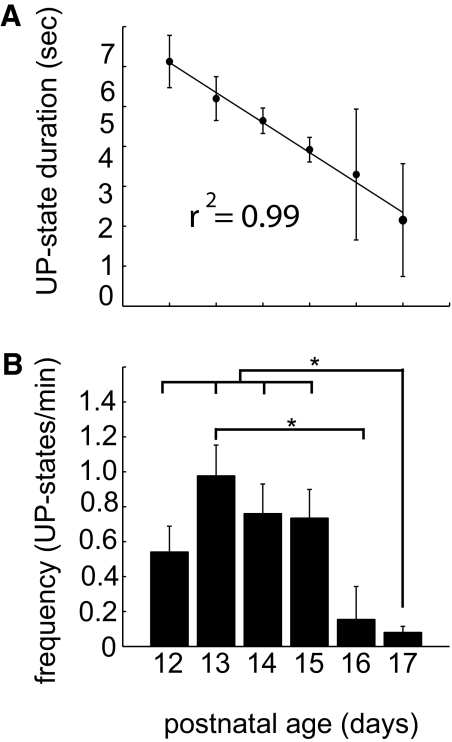
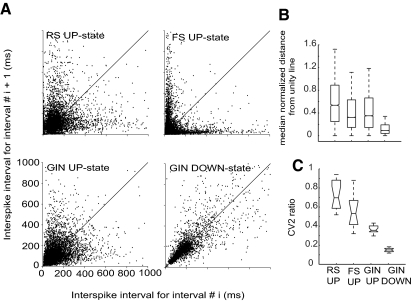
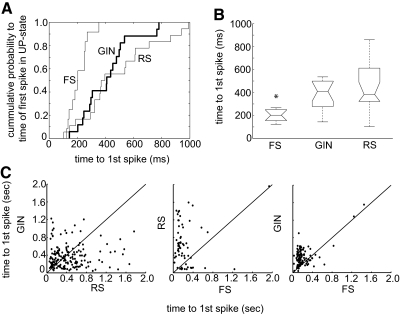
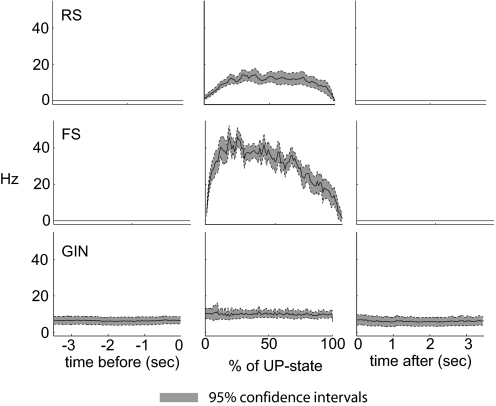
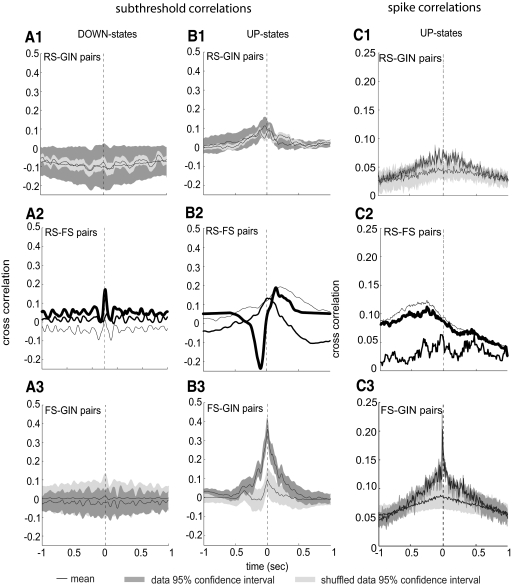
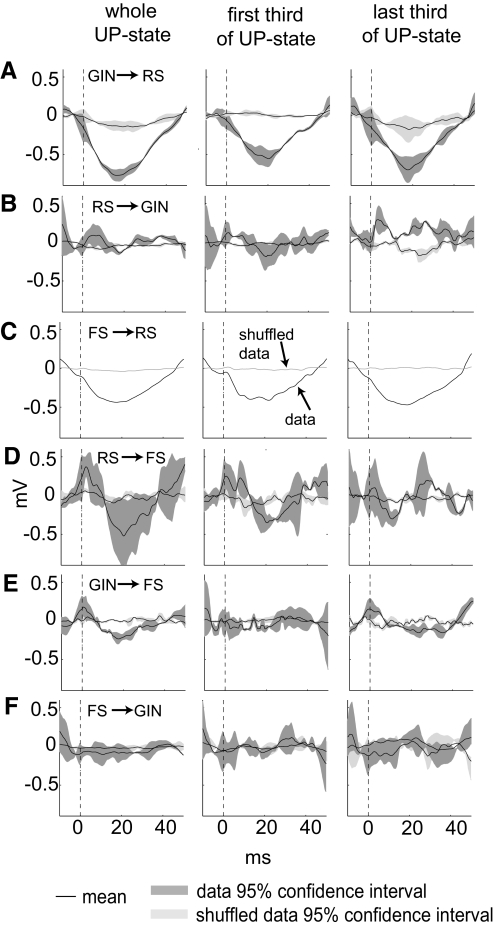
The neocortex contains multiple types of inhibitory neurons whose properties suggest they may play different roles within the cortical circuit. By recording from three cell types during two distinct network states (UP and DOWN states) in vitro, we were able to quantify differences in firing characteristics between these cells during different network regimes. We recorded from regular-spiking (RS) excitatory cells and two types of inhibitory neurons, the fast-spiking (FS) neurons and GFP- (and somatostatin-) expressing inhibitory neurons (GIN), in layer 2/3 of slices from mouse somatosensory neocortex. Comparisons of firing characteristics between these cells during UP- and DOWN-states showed several patterns. First, of these cell types, only GIN cells fired persistently during DOWN-states, whereas all three cell types fired readily during UP-states. Second, the onset of firing and distribution of action potentials throughout UP-states differed by cell type, showing that FS cell UP-state firing occurred preferentially near the beginning of the UP-state, whereas the firing of RS cells was slower to develop at the start of the UP-state, and GIN cell firing was sustained throughout the duration of the UP-state. Finally, membrane potential and spike correlations between heterogeneous cell types were more pronounced during UP-states and, in the case of RS synapses onto GIN cells, varied throughout the UP-state. These results suggest that there is a division of labor between FS and GIN cells as the UP-state progresses and suggest that GIN cells could be important in the termination of UP-states.
Figures
References
-
- Agmon A, Connors BW. Thalamocortical responses of mouse somatosensory (barrel) cortex in vitro. Neuroscience 41: 365–379, 1991 - PubMed
-
- Bacci A, Huguenard JR. Enhancement of spike-timing precision by autaptic transmission in neocortical inhibitory interneurons. Neuron 49: 119–130, 2006 - PubMed
-
- Bean BP. The action potential in mammalian central neurons. Nat Rev Neurosci 8: 451–465, 2007 - PubMed
-
- Beierlein M, Gibson JR, Connors BW. Two dynamically distinct inhibitory networks in layer 4 of the neocortex. J Neurophysiol 90: 2987–3000, 2003 - PubMed
-
- Compte A, Sanchez-Vives MV, McCormick DA, Wang XJ. Cellular and network mechanisms of slow oscillatory activity (<1 Hz) and wave propagations in a cortical network model. J Neurophysiol 89: 2707–2725, 2003 - PubMed
Publication types
MeSH terms
Substances
Grants and funding
LinkOut - more resources
Full Text Sources
