


The relationship between education level and mini-mental state examination domains among older Mexican Americans
- PMID: 20538969
- PMCID: PMC3040264
- DOI: 10.1177/0891988710373597
The relationship between education level and mini-mental state examination domains among older Mexican Americans
Abstract
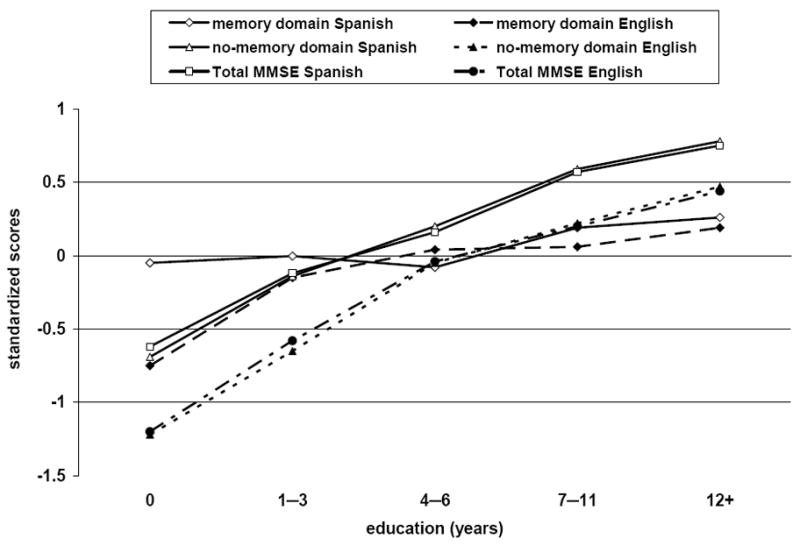
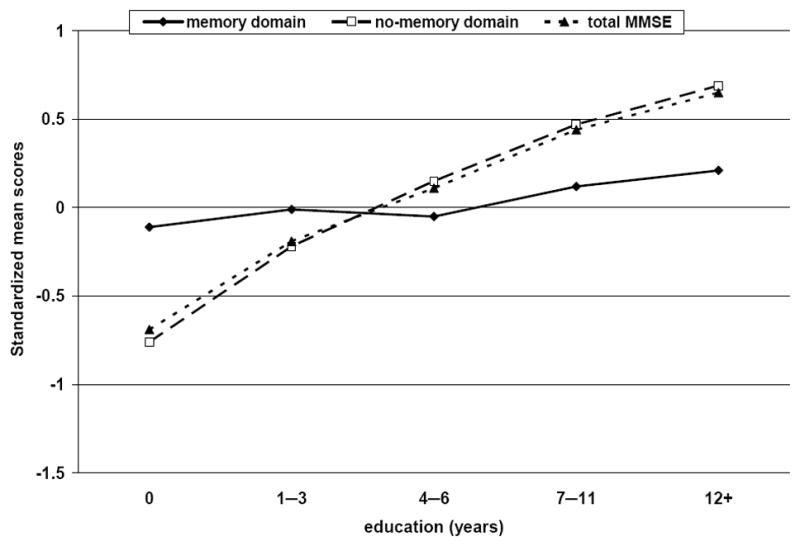
To study the effect of education and language of response at the interview on performance in the Mini-Mental State Examination (MMSE) domains, we studied 2861 Mexican Americans aged 65 and older from the Hispanic Established Populations for Epidemiologic Studies of the Elderly (EPESE) followed from 1993 to 1994 until 2004 to 2005. The MMSE was examined as total score (0-30) or divided into 2 global domains: (1) no-memory (score 0-24): Orientation, attention, and language; and (2) memory (score 0-6): working and delayed memory. Mean age and total MMSE were 72.7 years and 24.6 at baseline, and 81.7 years and 20.5 at 11 years of follow-up. Spanish-speaking participants had less education (4.1 vs 7.4 years, P < .0001), they had significantly higher adjusted mean scores for memory, no-memory, and total MMSE compared with English-speaking participants. In multivariate longitudinal analyses, participants with more years of education performed better than those with less education, especially in total MMSE and no-memory domain. Spanish-speaking participants with 4 to 6 years of education had higher memory scores than those speaking English (estimate 0.40, standard error [SE] = 0.14, P < .001), 7 to 11 (estimate 0.27, standard error = 0.13, P < .01) or 12+ (estimate 0.44, standard error = 0.13, P < .001). Results suggest that cultural factors and variables related to preferred language use determined variations in MMSE performance. Because the memory domain of the MMSE is less affected by education, it may be used along with other cognitive tests for early detection of cognitive decline in older populations with low education.
Figures
References
-
- Folstein MF, Folstein SE, McHugh PR. “Mini-mental state”. A practical method for grading the cognitive state of patients for the clinician. J Psychiatr Res. 1975;12:189–98. - PubMed
-
- Espino DV, Lichtenstein MJ, Palmer RF, Hazuda HP. Evaluation of the mini-mental state examination’s internal consistency in a community-based sample of Mexican-American and European-American elders: results from the San Antonio Longitudinal Study of Aging. J Am Geriatr Soc. 2004;52:822–7. - PubMed
-
- Simpao MP, Espino DV, Palmer RF, et al. Association between acculturation and structural assimilation and mini-mental state examination-assessed cognitive impairment in older Mexican Americans: findings from the San Antonio Longitudinal Study of Aging. J Am Geriatr Soc. 2005;53:1234–9. - PubMed
-
- Ardila A, Ostrosky-Solis F, Rosselli M, Gomez C. Age-related cognitive decline during normal aging: the complex effect of education. Arch Clin Neuropsychol. 2000;15:495–513. - PubMed
-
- Alvarado BE, Zunzunegui MV, Del Ser T, Beland F. Cognitive decline is related to education and occupation in a Spanish elderly cohort. Aging Clin Exp Res. 2002;14:132–42. - PubMed
Publication types
MeSH terms
Grants and funding
LinkOut - more resources
Full Text Sources
Medical
