


Personality and reproductive success in a high-fertility human population
- PMID: 20538974
- PMCID: PMC2900694
- DOI: 10.1073/pnas.1001752107
Personality and reproductive success in a high-fertility human population
Abstract
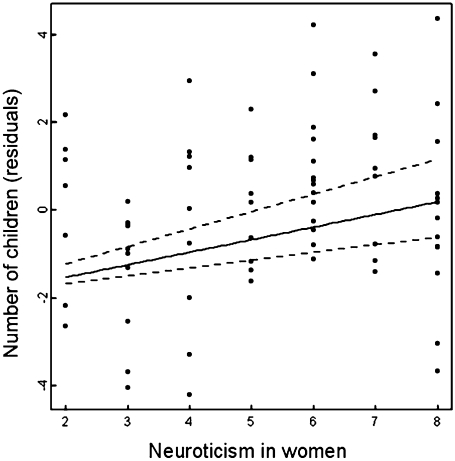
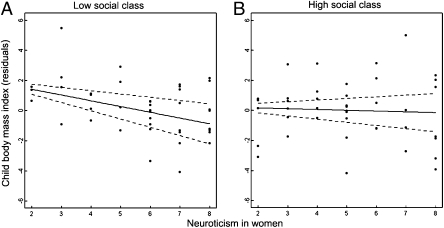
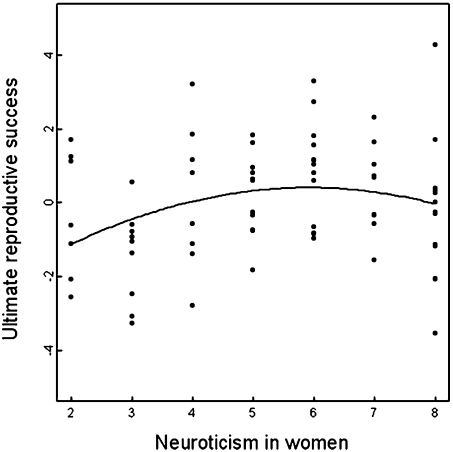
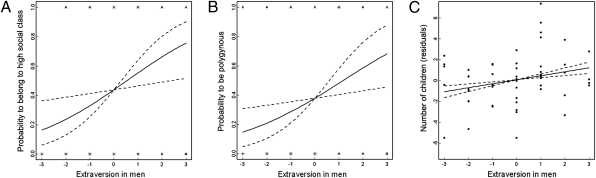
The existence of interindividual differences in personality traits poses a challenge to evolutionary thinking. Although research on the ultimate consequences of personality differences in nonhuman animals has recently undergone a surge of interest, our understanding of whether and how personality influences reproductive decisions in humans has remained limited and informed primarily by modern societies with low mortality-fertility schedules. Taking an evolutionary approach, we use data from a contemporary polygynous high-fertility human population living in rural Senegal to investigate whether personality dimensions are associated with key life-history traits in humans, i.e., quantity and quality of offspring. We show that personality dimensions predict reproductive success differently in men and women in such societies and, in women, are associated with a trade-off between offspring quantity and quality. In women, neuroticism positively predicts the number of children, both between and within polygynous families. Furthermore, within the low social class, offspring quality (i.e., child nutritional status) decreases with a woman's neuroticism, indicating a reproductive trade-off between offspring quantity and quality. Consistent with this, maximal fitness is achieved by women at an intermediate neuroticism level. In men, extraversion was found to be a strong predictor of high social class and polygyny, with extraverted men producing more offspring than their introverted counterparts. These results have implications for the consideration of alternative adaptive hypotheses in the current debate on the maintenance of personality differences and the role of individual factors in fertility patterns in contemporary humans.
Conflict of interest statement
The authors declare no conflict of interest.
Figures
References
-
- Réale D, Reader SM, Sol D, McDougall PT, Dingemanse NJ. Integrating animal temperament within ecology and evolution. Biol Rev Camb Philos Soc. 2007;82:291–318. - PubMed
-
- Dall SRX, Houston AI, McNamara JM. The behavioural ecology of personality: consistent individual differences from an adaptive perspective. Ecol Lett. 2004;7:734–739.
-
- Smith BR, Blumstein DT. Fitness consequences of personality: a meta-analysis. Behav Ecol. 2008;19:448–455.
Publication types
MeSH terms
LinkOut - more resources
Full Text Sources
